

Unicode to Bamini Converter
This free online tool instantly converts Tamil text between Unicode, Bamini, and over twenty other legacy encodings with no download required.
About Unicode to Bamini Converter
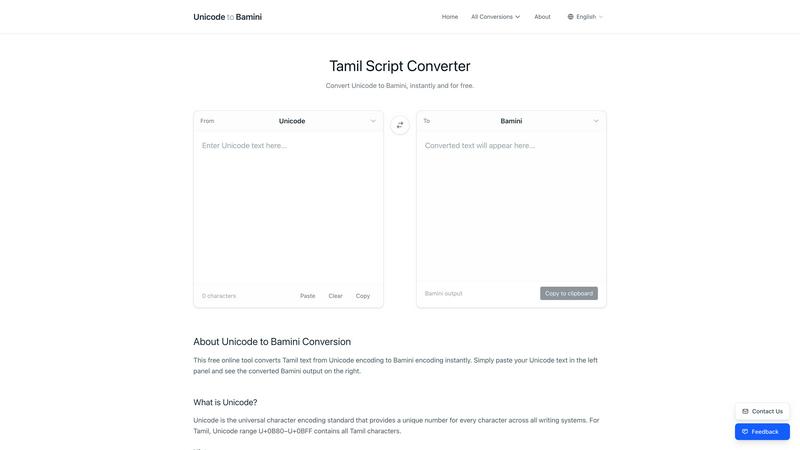
The Unicode to Bamini Converter is an essential, web-based digital tool designed to bridge the gap between historical and modern Tamil text encoding. It serves as a comprehensive solution for converting Tamil script seamlessly between the universal Unicode standard and over 25 legacy font encodings, with a primary focus on the widely used Bamini format. This tool addresses a critical challenge in the digital preservation and accessibility of Tamil literature, journalism, and archival documents. For decades, vast repositories of Tamil content—including newspapers, books, and government documents from Sri Lanka and the diaspora—were created using proprietary fonts like Bamini and TSCII. These documents become unreadable on contemporary devices without the specific, often obsolete, fonts installed. This converter effortlessly transforms such legacy text into future-proof Unicode, ensuring it displays correctly on any modern browser, operating system, or mobile device. Conversely, it also enables conversion back to Bamini for compatibility with older systems and workflows. Designed for publishers, journalists, researchers, developers, and content creators, this free tool eliminates technical barriers, fostering the preservation, sharing, and continued use of Tamil cultural and intellectual heritage in the digital age.
Features of Unicode to Bamini Converter
Extensive Encoding Support
This converter supports a vast library of over 25 Tamil font encodings, far beyond simple Unicode-to-Bamini conversion. Users can seamlessly translate text between Unicode and legacy formats like TSCII, Anjal, TAB, Dinamani, and Murasoli, as well as between any two legacy encodings. This comprehensive coverage makes it a one-stop solution for handling virtually any Tamil document from the pre-Unicode era, ensuring no piece of text is left inaccessible due to encoding obsolescence.
Real-Time, Instant Conversion
The tool operates with remarkable efficiency, providing instantaneous conversion without requiring page reloads or submissions. As users type or paste text into the source panel, the converted output appears immediately in the target panel. This real-time processing significantly streamlines workflows, allowing for quick edits, comparisons, and batch processing of text, thereby enhancing productivity for users dealing with large volumes of documents.
Complete Character Mapping Reference
Transparency and accuracy are paramount. The converter includes a detailed, interactive character map that displays the exact correspondence between characters in Unicode and Bamini (and other supported encodings). This reference table, showcasing all 289+ mappings, allows users to verify conversion accuracy, understand the encoding logic, and troubleshoot any discrepancies, ensuring fidelity in the conversion process for scholarly or archival work.
Cross-Platform and Multilingual Accessibility
Built as a responsive web application, the tool works flawlessly on desktop computers, tablets, and smartphones without any software installation. Furthermore, it is accessible to a global audience through its interface, available in five languages: English, Tamil, Sinhala, Hindi, and Chinese. This inclusive design ensures that users from different linguistic backgrounds can easily navigate and utilize the converter for their specific needs.
Use Cases of Unicode to Bamini Converter
Digital Archiving and Document Preservation
Libraries, universities, and historical societies can use this tool to digitize and preserve decades-old Tamil newspapers, manuscripts, and official records encoded in Bamini or TSCII. By converting these documents to Unicode, they become permanently accessible and searchable on modern digital platforms, safeguarding Tamil literary and journalistic history from technological obsolescence for future generations.
Modernizing Publishing and Journalism Workflows
Tamil newspapers and publishing houses with extensive archives in legacy formats can integrate this converter into their production process. It allows them to republish classic articles online, compile anthologies, or migrate entire back-catalogues to modern content management systems that require Unicode, thus expanding their reach to contemporary digital audiences.
Software Development and System Integration
Developers building applications for the Tamil-speaking community, such as content management systems, educational software, or government portals, can use this tool's underlying logic or the web interface itself to ensure backward compatibility. It allows new systems to accept and process data from older Bamini-based databases or user submissions, facilitating smoother digital transitions and data migration projects.
Academic Research and Linguistic Analysis
Researchers and linguists studying Tamil literature, historical texts, or font encoding evolution can utilize the converter to standardize text from various sources into a single encoding (Unicode) for analysis. The character map also serves as a valuable reference for understanding how different encoding schemes represent the same linguistic elements, aiding in comparative studies and computational linguistics.
Frequently Asked Questions
What is the difference between Unicode and Bamini encoding?
Unicode is an international standard that assigns a unique code point to every character in most of the world's writing systems, including Tamil. It ensures consistent display across all devices and platforms. Bamini, developed in the early 1990s, is a proprietary 8-bit font encoding that uses ASCII character positions to represent Tamil letters. It requires the specific Bamini font to be installed to display correctly, whereas Unicode text is universally readable.
Is my text data safe when using this online converter?
Yes. The Unicode to Bamini Converter operates entirely within your web browser using client-side JavaScript. This means the text you paste into the converter is never sent to or stored on any external server. All conversion happens locally on your device, ensuring complete privacy and security for your sensitive or copyrighted documents.
Can I convert files (like .doc or .pdf) directly with this tool?
No, this is a text-based converter. It works with plain text content. To convert text from within a file (like a Word document or PDF), you must first open that file in its respective application, copy the Tamil text, and then paste it into the converter. For bulk file conversion, you would need to extract the text from each file individually or use a specialized batch processing script.
Why would I need to convert from Unicode back to Bamini?
While converting to Unicode is the norm for modern use, there are legitimate reasons for reverse conversion. You may need to edit text in an older software application that only supports Bamini input, update a legacy website or system that hasn't been migrated, or maintain format consistency when adding to an existing archive of Bamini-encoded documents to ensure uniform display.
Explore more in this category:
Similar to Unicode to Bamini Converter

Wordy
Learn languages with real movie and TV show clips.

MeloLingua
MeloLingua teaches you new languages by creating and listening to personalized stories about your own life.

Glossa
Glossa provides real-time AI translation of sermons into 100+ languages, helping churches connect with diverse.


YouTube to Transcript
Effortlessly convert any YouTube video into an accurate transcript for free, with no signup or limits, in just seconds.

Pathoura
Pathoura delivers instant multilingual audio guides for museums, transforming visitor experiences with AI-powered.

Bargou One
Bargou One offers AI-driven chat, content creation, translation, and transcription tools in one powerful suite.