

Tuning Engines
Tuning Engines centralizes AI model access, governance, and optimization, empowering you to adapt and deploy intelligence seamlessly.
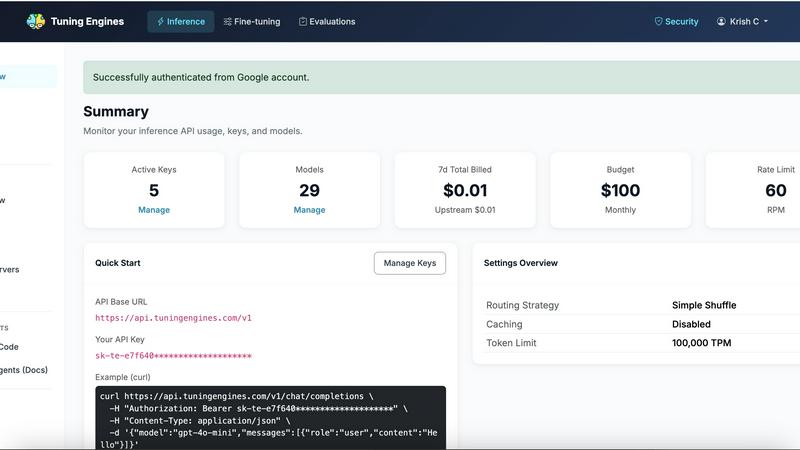
About Tuning Engines
Tuning Engines is an innovative AI control and governance layer designed to streamline the complexities of production intelligence across a variety of models, agents, and tools. It serves as a centralized platform that encompasses the entire AI lifecycle, allowing organizations to manage inference, model routing, fine-tuning jobs, datasets, evaluations, and more, all in one governed environment. This platform caters to developers and admins alike, offering OpenAI-compatible APIs, Anthropic-compatible routes, and various integrations with popular AI workflows. By providing a unified approach to AI governance, Tuning Engines enables teams to move beyond isolated experiments and build secure, observable, and extensible AI systems. Its robust features ensure that models can be trained, evaluated, governed, and deployed efficiently, making it an essential tool for organizations looking to optimize their AI operations at scale.
Features of Tuning Engines
Unified Inference
Tuning Engines provides a single OpenAI-compatible endpoint that allows users to access both commercial and custom-tuned models. This feature simplifies the AI development process by eliminating the need for multiple APIs and reducing the complexity of model management.
Model Tuning
Organizations can easily adapt open models to fit their specific data, workflows, and production goals. Tuning Engines facilitates supervised fine-tuning and other adaptation techniques, ensuring that models remain aligned with evolving business needs and deliver high-quality outputs.
Comprehensive Evaluations
This feature allows teams to measure the quality of their models, compare different variants, and make evidence-based decisions regarding model deployment. With robust evaluation tools, organizations can continuously improve their AI systems and ensure they meet performance expectations.
Centralized Governance
Tuning Engines includes essential controls for admins, such as role-based access, billing controls, and tenant isolation. This centralized governance ensures that organizations maintain compliance, manage costs, and enforce policies across their AI operations effectively.
Use Cases of Tuning Engines
Code Assistance
Developers can leverage Tuning Engines to create IDE copilots, automate code generation, perform refactoring, and facilitate debugging. This use case enhances productivity and streamlines the software development lifecycle.
Conversational AI
With Tuning Engines, teams can build sophisticated customer support bots, internal helpdesks, and multilingual chat systems. This capability allows organizations to improve customer interactions and operational efficiency through AI-driven communication.
Agentic Systems
Organizations can utilize Tuning Engines to develop multi-step reasoning and planning systems that execute complex tasks. This use case is particularly beneficial for automating workflows that involve tool-using execution pipelines, enhancing overall productivity.
Enterprise RAG
Tuning Engines enables secure and scalable retrieval over knowledge bases and private documents, making it ideal for organizations that need to manage sensitive data. This use case supports informed decision-making and improves access to information within enterprises.
Frequently Asked Questions
What types of models can be accessed through Tuning Engines?
Tuning Engines provides access to a wide array of models, including popular open models, frontier commercial models, and any custom-tuned variants. This flexibility allows organizations to meet diverse AI needs from a single platform.
How does Tuning Engines ensure security and governance?
The platform incorporates robust governance features, including role-based access controls, auditability, and centralized policy management. These elements work together to maintain secure AI interactions and ensure compliance with organizational policies.
Can Tuning Engines integrate with existing workflows?
Yes, Tuning Engines is designed to integrate seamlessly with popular AI workflows and development environments, including Claude Code, OpenCode, and VS Code. This compatibility allows teams to adopt Tuning Engines without significant disruptions to their existing processes.
What support does Tuning Engines offer for model fine-tuning?
Tuning Engines supports various fine-tuning methods, including supervised fine-tuning and LoRA adapters, allowing organizations to adapt models based on their unique datasets and requirements. This feature ensures that models remain relevant and effective over time.
Similar to Tuning Engines

AI Email Filter
AI Email Filter sorts incoming mail into folders using plain-language prompts you write. Works with any IMAP mailbox; bring your own LLM if you want.


amaze.directory
Find an AI tool by the job you need done, not the buzzword.

saasgrow.ai
No sponsored slots, no paid placement. Just SaaS growth tools that passed screening, sorted into categories you can browse.

Tools Network
Tools Network is a curated directory that brings the internet's best AI tools together in one organized, easy-to-navigate place.

UseWok
Done-for-You SaaS Visibility for Search & AI | UseWok

Postqued
Schedule and publish social content across 10 platforms with one dashboard, API, and MCP built for teams and AI agents.

EntreDash
Turn daily annoyances and raw ideas into inventions, products, and businesses. EntreDash provides a virual personal advisory board using AI automation