

Rock Smith
Rock Smith uses AI agents to visually test your app like a real user, eliminating flaky tests.
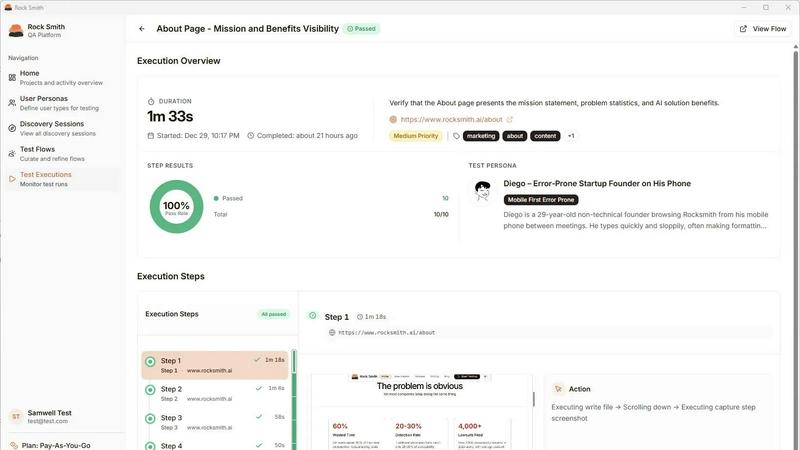
About Rock Smith
Rock Smith represents a fundamental evolution in the landscape of software quality assurance. It is an AI-powered, autonomous testing platform designed to liberate engineering teams from the constraints and maintenance overhead of traditional test automation. Unlike conventional frameworks that rely on brittle, code-based selectors which break with every UI tweak, Rock Smith employs advanced visual intelligence and semantic understanding. It interacts with web applications precisely as a human would, identifying elements by their appearance, text, and contextual role. This paradigm shift enables the creation of self-healing, resilient tests that adapt to changes in the user interface. The platform is built for a wide spectrum of users: QA engineers can automate complex, repetitive tasks and uncover elusive edge cases; developers can implement robust test coverage without needing deep automation expertise; and product leaders gain access to reliable, actionable quality metrics. Crucially, Rock Smith operates as a secure desktop application, executing tests directly in a local browser. This ensures that sensitive data from internal, staging, or localhost environments never leaves the user's machine, addressing critical security and privacy concerns. By automating the tedious and fragile aspects of QA, Rock Smith empowers organizations to accelerate their development cycles, enhance software reliability, and redirect valuable human creativity toward innovation and strategic quality initiatives.
Features of Rock Smith
AI-Powered Visual & Semantic Testing
Rock Smith's core intelligence lies in its ability to understand a web application visually and contextually, much like a human user. Instead of targeting fragile CSS selectors or XPaths, tests are written or generated using natural language descriptions of elements, such as "the login button" or "the checkout total field." This semantic approach allows the AI agents to locate components based on their rendered appearance and functional purpose, making the automation suite inherently more robust and adaptable to UI changes.
Autonomous Agent-Based Execution
The platform utilizes autonomous AI agents to perform testing workflows. These agents can navigate complex user journeys, input data, click elements, and validate outcomes without step-by-step scripting for every action. They operate within a real browser environment, enabling them to handle dynamic content, JavaScript-heavy applications, and stateful interactions that often challenge traditional automation tools, providing a truly black-box testing experience.
Self-Healing and Resilient Test Suites
One of the most significant value propositions of Rock Smith is its capacity for self-maintenance. When a button moves or a label changes, traditional tests fail and require manual debugging. Rock Smith's visual intelligence allows it to recognize the intended element despite minor alterations in the DOM structure. This self-healing capability dramatically reduces the maintenance burden, ensuring test suites remain reliable over time and across deployments.
Secure Local Execution for All Environments
Security and flexibility are paramount. Rock Smith runs as a desktop application that controls a browser on your local machine or CI server. This architecture means you can comprehensively test applications on localhost, private staging servers, or internal tools without ever exposing sensitive data or credentials to an external cloud service. It brings enterprise-grade testing capability to any environment, regardless of its connectivity.
Use Cases of Rock Smith
Accelerating Agile and CI/CD Pipelines
For fast-moving development teams practicing continuous integration and delivery, Rock Smith integrates seamlessly to provide rapid, reliable feedback. Its resilient tests can be executed on every pull request or build, catching regressions in the user interface and functionality without becoming a bottleneck. This ensures new features can be shipped with confidence at the pace of modern development.
Empowering Developers with Shift-Left Testing
Rock Smith lowers the barrier to entry for creating meaningful tests. Developers can quickly generate or describe test scenarios in plain language to validate their work before committing code. This shift-left approach embeds quality assurance into the earliest stages of development, preventing bugs from propagating downstream and reducing the cost of fixes.
Comprehensive QA for Complex User Journeys
QA engineers can leverage Rock Smith to automate intricate, multi-step workflows that are critical to business operations, such as user onboarding, e-commerce checkouts, or data dashboard interactions. The platform's ability to understand context and state allows it to reliably execute these lengthy journeys, freeing QA professionals to focus on exploratory testing and more strategic quality analysis.
Validating UI/UX Changes and Redesigns
During website redesigns or major UI refactors, test suites often break entirely. Rock Smith's visual testing approach is uniquely suited for these scenarios. Tests written around the semantic purpose of elements are more likely to survive a redesign, allowing teams to validate that core functionalities still work as intended even after significant visual overhauls.
Frequently Asked Questions
How is Rock Smith different from Selenium or Cypress?
Rock Smith operates on a fundamentally different principle. While Selenium and Cypress are powerful coding frameworks that rely on developers writing scripts tied to specific HTML elements (selectors), Rock Smith uses AI to understand the application visually and semantically. This makes Rock Smith tests far less brittle to UI changes, as they are based on what the user sees and interacts with, not the underlying code structure that frequently changes.
Does Rock Smith require coding skills to use?
No, one of Rock Smith's primary advantages is its accessibility to users without deep programming expertise. Tests can be created using natural language descriptions and through a record-and-generate functionality. While it offers advanced capabilities for technical users, its core value is enabling product managers, designers, and manual QA testers to contribute directly to the automation effort.
Can I test applications that are not publicly accessible?
Absolutely. This is a key strength of Rock Smith. Since it runs tests locally via its desktop application, it can test any application that is accessible from your local browser, including those on localhost (like http://localhost:3000), internal company networks, or secured staging environments. Your application data never needs to be sent to an external cloud.
How does the "self-healing" feature actually work?
The self-healing capability is powered by Rock Smith's visual and semantic AI. When a test step fails because an element cannot be found via its previous "understanding," the AI re-scans the page. It looks for elements that visually and contextually match the original intent (e.g., a blue "Submit" button near a form). If a suitable match is found with high confidence, the test automatically updates its internal model and proceeds, often without any human intervention required.