

RecordFlow
RecordFlow automatically backs up Zoom cloud recordings to Google Drive and can delete them from Zoom to free storage, with a simple setup that runs.
About RecordFlow
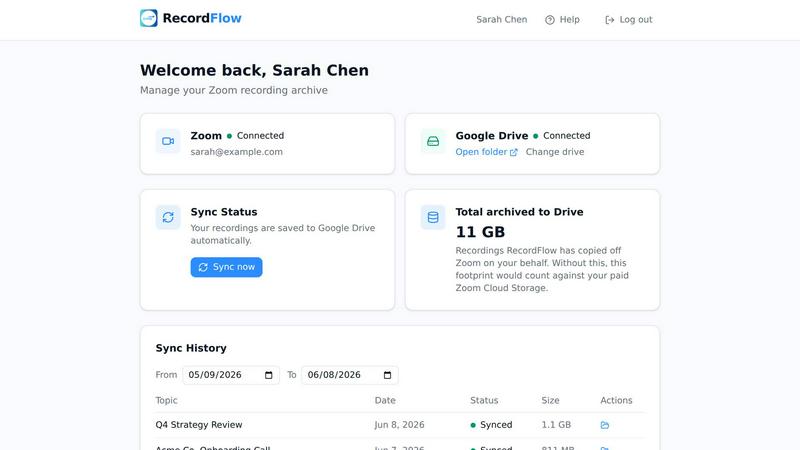
RecordFlow is a specialized automation tool designed to solve the persistent and often frustrating problem of managing Zoom cloud recordings. At its core, the product creates an automatic, secure, and reliable bridge between Zoom and Google Drive. When a Zoom meeting ends, RecordFlow instantly transfers every associated file from the Zoom cloud to a designated Google Drive folder, eliminating the need for manual downloads, uploads, and file organization. This process is not limited to new recordings; the tool also performs a comprehensive backfill, retrieving and archiving recordings from the past two years. The primary audience for RecordFlow includes coaches, consultants, therapists, professors, small business teams, and IT administrators who rely on Zoom for critical communications and cannot afford to lose a single recording. The main value proposition is threefold: it saves significant time by automating a tedious weekly task, it prevents data loss by creating a secure secondary copy in Google Drive, and it reduces costs by allowing users to automatically delete recordings from Zoom's limited and expensive storage once they are safely archived. The setup is remarkably simple, taking only about 60 seconds to connect Zoom and Google Drive accounts and select a destination folder. The entire process is designed for reliability, using chunked transfers for large files, smart deduplication, and automatic retries to ensure every recording is captured without fail, all while maintaining high security standards with OAuth 2.0 and AES-256 encryption.
Features of RecordFlow
Automatic and Instant Sync
This feature is the foundational pillar of RecordFlow. Once configured, the tool operates autonomously, monitoring your Zoom account for the completion of any new cloud recording. Within minutes of a meeting ending, the system initiates a transfer of all associated files directly to your specified Google Drive folder. This includes not just the primary video file (MP4) but also the audio-only file (M4A), the meeting transcript (VTT), and the chat log. For new users, the tool also performs a one-time backfill, scanning and transferring all existing cloud recordings from the past two years. This ensures that your entire recording history is consolidated in one place from the moment you start, creating a complete and organized archive without any initial manual effort.
Comprehensive File Transfer and Organization
RecordFlow goes beyond simply moving a video file. It captures every piece of data generated by a Zoom cloud recording. The tool transfers the video (MP4), audio (M4A), transcript (VTT), and chat logs. Furthermore, it intelligently formats the transcript into a Google Doc, making it searchable and editable directly within your Drive ecosystem. To maintain a clean and navigable archive, all files are automatically organized into a folder structure by year and date. This systematic approach eliminates the chaos of a flat, unorganized folder of recordings and makes it simple for users to locate a specific meeting from months or years ago, saving valuable time and reducing frustration.
Smart Auto-Delete from Zoom Storage
This feature directly addresses the problem of limited Zoom storage. RecordFlow offers an optional but powerful auto-delete function. When enabled, the tool does not immediately remove a recording from Zoom. Instead, it waits for a safe, pre-configured delay after the transfer to Google Drive is successfully verified. This ensures that a complete and uncorrupted copy exists in Drive before the Zoom cloud copy is removed. By automatically freeing up space in your Zoom account, this feature prevents the common problem of hitting storage limits, which can block new recordings. It effectively turns your Google Drive into an unlimited, cost-effective archive, allowing you to use Zoom's storage only for temporary, immediate access.
Reliable, Secure, and Scalable Architecture
RecordFlow is engineered for dependability, especially when handling large or critical files. It uses chunked file transfers, which means large, hour-long meeting recordings are broken into smaller pieces for upload, preventing timeouts and failed uploads that plague simpler tools. The system also features smart deduplication, making it safe to re-run the sync without creating duplicate files in your Drive. Automatic retries handle transient network errors, ensuring the process completes. From a security perspective, RecordFlow is designed with a zero-knowledge architecture; recordings stream directly from Zoom to your Google Drive and are never stored on RecordFlow's servers. It uses industry-standard OAuth 2.0 for authentication and AES-256 encryption for data in transit and at rest, ensuring your sensitive meeting content remains private.
Use Cases of RecordFlow
Coaches and Consultants Archiving Client Sessions
For coaches and consultants who record multiple client sessions each week, RecordFlow is an essential tool. Zoom's limited storage fills up in days, creating a constant cycle of manual downloads and uploads. RecordFlow automates this entire workflow. After each session, the recording, transcript, and any chat logs are instantly and securely moved to a Google Drive folder. This provides a permanent, organized archive for the professional, and it also makes it easy to share a direct link to the recording with a client as a deliverable. The automatic transcription into a Google Doc is particularly valuable for creating session notes and searchable records of client progress.
Education Teams and Professors Managing Lectures
Universities and educational institutions that rely on Zoom for lectures and seminars face a unique challenge: providing students with long-term, reliable access to course materials. Zoom's retention policies and storage limits are not designed for academic archiving. RecordFlow solves this by automatically transferring every lecture recording into a shared Google Drive folder for the entire department or course. Students can then access the video, audio, and a fully formatted transcript of the lecture at any time. This creates a permanent, accessible library of course content that is not dependent on a single admin's Zoom account or subject to automatic deletion policies.
Business Teams Maintaining a Centralized Knowledge Base
In a business environment, recorded meetings are a valuable asset for onboarding, training, and knowledge retention. RecordFlow allows an IT admin to install the tool once for the entire Zoom account. Every team member who is opted in will have their cloud recordings automatically transferred into a single, centrally managed Google Drive folder. Sub-folders for each member are created automatically, keeping the archive organized. This eliminates the risk of losing critical product demos, client presentations, or internal strategy sessions when an employee leaves the company. It transforms a collection of individual Zoom accounts into a cohesive, searchable, and permanent corporate knowledge base.
IT and Operations Admins Enforcing Data Governance
For IT and Ops admins, data security and compliance are paramount. RecordFlow provides a simple, secure, and auditable solution for managing Zoom recordings. An admin can install the app for the entire organization, point it at a single root folder in a shared Drive, and then select which members to include. This gives the admin full control over where corporate data resides. The automatic sync ensures that recordings are moved from Zoom's cloud to the company's Google Drive, which is often subject to stricter security and compliance policies. The optional auto-delete feature can be configured to free up Zoom storage, but only after a successful transfer is verified, providing a robust safety net for critical data.
Frequently Asked Questions
How long does the initial setup take and what do I need to get started?
The setup process is designed to be incredibly fast and simple, typically taking about 60 seconds. To get started, you need a Zoom account that is on a paid plan (Pro, Business, or Enterprise) as cloud recording is required. You also need a Google Drive account, which can be personal or through Google Workspace. The process involves three simple steps: signing in with your Zoom account, connecting your Google Drive and granting the necessary permissions, and then selecting a destination folder. Once this is done, RecordFlow will immediately begin its one-time backfill and then automatically sync all future recordings.
Does RecordFlow store my recordings on its own servers?
No, RecordFlow operates on a zero-knowledge, serverless architecture. The tool acts as a secure bridge that facilitates the direct transfer of your files from Zoom's cloud to your Google Drive. The recordings stream directly from one service to the other and are never stored or cached on RecordFlow's infrastructure. This design is a core part of its security model, ensuring that your sensitive meeting data remains within your control and is not exposed to an unnecessary third-party storage risk. All data is encrypted in transit using industry-standard protocols.
What happens if a recording is very large or the internet connection is unstable?
RecordFlow is built with reliability in mind, specifically to handle large files and network interruptions. It uses a technique called chunked transfer encoding, where large video files are broken into smaller pieces and uploaded in parallel. If a connection is lost during the transfer, the system has automatic retry logic. It will resume the upload from the point of failure rather than starting over from the beginning. This ensures that even hour-long meetings with multi-gigabyte files are transferred reliably and completely, without timeouts or corrupted files.
Can I use RecordFlow to manage recordings for my entire team or just myself?
RecordFlow is designed to work for both individual users and entire organizations. A single user can install it to archive their own personal recordings. For teams, an IT admin can install RecordFlow for the entire Zoom account. When installed for an account, the admin can choose which specific members to include in the sync. All recordings from those opted-in members will then be automatically transferred into a single, admin-controlled root folder in Google Drive, with automatic sub-folders created for each team member to keep everything organized.
Explore more in this category:
Similar to RecordFlow


PerPageFax
PerPageFax lets you send a fax online from any browser for a flat $0.50 per page — no account, no subscription, no fax machine.

OctoWatch DLP
Track staff & time. Free trial. Cloud/on-prem.

calculate.at
calculate.at is a free online calculator hub — 290+ tools for finance, health, math, and conversions, no signup needed.

Fill PDF from Sheet
Fill PDF from Sheet automates the process of populating PDF forms from data in Excel, CSV, or Google Sheets.

linkwise.link
AI finds your lost links. Summarizes & tags URLs.

Glanced
Follow news, blogs, newsletters, and podcasts in a free RSS reader, with AI summaries, top stories, full-text search, saved searches, and a catalog.