

HiAPI
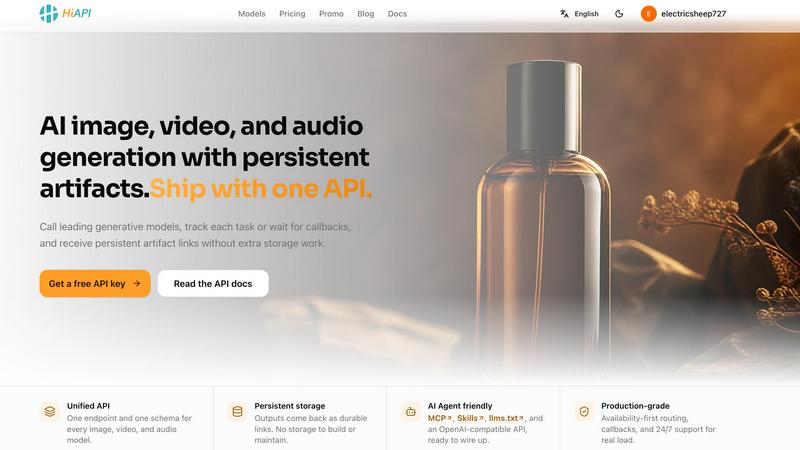
HiAPI unifies leading AI image, video, and text models under one simple API with persistent storage, callbacks, and production-grade reliability for.
About HiAPI
HiAPI is a developer-first AI API platform purpose-built to streamline and simplify the integration of generative AI into any application, workflow, or agent. It serves as a unified gateway for image, video, audio, and text generation, allowing developers to access a curated selection of leading models from top providers like OpenAI, ByteDance, Black Forest Labs, Google, and MiniMax through a single API key and a consistent, OpenAI-compatible interface. The core value proposition of HiAPI is eliminating the complexity traditionally associated with multi-model AI development. Instead of managing separate accounts, billing systems, authentication methods, and API schemas for each model provider, developers interact with one endpoint, one authentication mechanism, and one unified billing platform with transparent pay-as-you-go pricing. HiAPI is designed for a broad audience ranging from individual developers building side projects to engineering teams at scale, and especially for developers creating AI agents. The platform goes beyond simple API proxying by offering persistent artifact storage, meaning generated images, videos, and audio files are returned as durable links without requiring developers to build or maintain their own storage infrastructure. It also supports asynchronous workflows with task-based lifecycle management, callbacks, and idempotency keys for reliable production use. With built-in support for MCP (Model Context Protocol), Skills, and llms.txt, HiAPI is inherently agent-friendly, enabling autonomous AI systems to discover, call, and compose its capabilities with minimal human guidance. The platform also provides transparent per-model pricing so developers can accurately estimate costs before integrating. By combining unified access, persistent storage, production-grade reliability, and agent-ready tooling, HiAPI positions itself as the essential infrastructure layer for the next generation of AI-powered applications.
Features of HiAPI
Unified API with One Endpoint
HiAPI provides a single API endpoint for all supported generative models, radically simplifying the integration process. Developers pass the base model name as a parameter to route requests to the appropriate provider, meaning one codebase, one authentication header, and one request schema work for image generation, video creation, and audio production alike. This unified approach eliminates the need to learn multiple provider-specific APIs, reduces boilerplate code, and accelerates development cycles significantly. The endpoint also supports optional parameters for route selection, storage preferences, and callback configurations, all within the same consistent request structure, making it trivial to switch between models or providers without code changes.
Persistent Artifact Storage
Unlike many AI API platforms that require developers to handle file downloads and storage separately, HiAPI returns all generated outputs as persistent, durable artifact links. When the storage parameter is set to persistent, every image, video, or audio file is stored automatically and accessible via a stable URL that does not expire. This eliminates the need to build, maintain, or pay for separate cloud storage infrastructure, file management systems, or CDN configurations. Developers can simply use the returned link directly in their applications, share it with users, or reference it in downstream processes. This feature is particularly valuable for applications requiring long-term access to generated content, such as creative asset libraries, marketing platforms, and archival systems.
Asynchronous Task Lifecycle with Callbacks
HiAPI implements a robust task-based architecture for handling generative AI workflows asynchronously. When a request is submitted, the platform immediately returns a unique task ID, allowing developers to track the job through its lifecycle without blocking their application. For production-grade reliability, HiAPI supports optional callback URLs that are triggered upon task completion, eliminating the need for polling and reducing server load. The platform also supports idempotency keys, ensuring that retrying the same request does not create duplicate tasks or charges. This asynchronous design is essential for handling longer-running generation tasks like video creation or complex image editing, enabling applications to remain responsive and scalable under real-world production loads.
Agent-Ready Integration with MCP, Skills, and llms.txt
HiAPI is designed from the ground up to be compatible with modern AI agent ecosystems. It provides native support for the Model Context Protocol, enabling agents like Claude, Cursor, and Codex to discover and call HiAPI tools autonomously. Additionally, the platform offers reusable Skills, which are pre-built agent instructions for common workflows, allowing developers to quickly wire up image generation, video creation, or audio production capabilities into their agents. The llms.txt file provides a comprehensive documentation index that agents can read to understand HiAPI models and APIs, then autonomously decide whether to use Skills, Remote MCP, or direct API calls as the integration path. This multi-layered approach makes HiAPI uniquely accessible to both human developers and autonomous AI systems.
Use Cases of HiAPI
Building AI-Powered Creative Applications
Developers building applications for graphic design, content creation, or social media marketing can leverage HiAPI to integrate multiple generative models without managing separate provider accounts. For example, a design tool could use GPT Image 2 for text-rendering tasks, FLUX 1.1 Pro for high-fidelity image generation, and Seedream 5.0 Pro for editing, all through one API key and unified billing. The persistent artifact storage means generated assets are immediately available as shareable links, while the callback system enables real-time progress updates within the application interface. This unified approach dramatically reduces development time and operational complexity for creative software teams.
Enabling Autonomous AI Agents with Multi-Modal Capabilities
AI agents built on platforms like Claude, Cursor, or Codex can use HiAPI to gain multi-modal generation capabilities through MCP tools and Skills. An agent tasked with creating a marketing campaign could autonomously generate product images, compose background music, and produce promotional videos using different models accessed through the same HiAPI interface. The llms.txt documentation allows the agent to self-discover the available models and their parameters, then select the appropriate Skill or MCP tool for each task. This makes HiAPI an ideal backend for autonomous systems that need to generate, edit, and compose various media types without human intervention.
Production-Grade Content Pipelines for Enterprises
Enterprise teams building automated content pipelines for e-commerce, advertising, or publishing can rely on HiAPI's production-grade features for reliability at scale. The task-based lifecycle with idempotency keys ensures that retries do not cause duplicate charges or broken workflows, while callbacks enable seamless integration with existing job queues and notification systems. Transparent per-model pricing allows finance teams to accurately forecast costs before launch, and the availability-first routing ensures high uptime for critical generation tasks. This makes HiAPI suitable for mission-critical applications where consistency, cost predictability, and operational reliability are paramount.
Rapid Prototyping and Experimentation for AI Developers
Individual developers and small teams exploring generative AI can use HiAPI to rapidly prototype new ideas without committing to a single provider or managing complex infrastructure. The free credits upon signup allow experimentation with multiple models across image, video, and audio domains, while the unified API schema makes it easy to swap models and compare outputs. The persistent storage feature eliminates the need to set up separate file hosting for prototypes, and the transparent pricing helps developers understand costs from the start. This low-friction onboarding makes HiAPI an excellent platform for hackathons, personal projects, and early-stage product development.
Frequently Asked Questions
How does HiAPI handle billing and pricing across different models?
HiAPI uses a unified pay-as-you-go billing system where all charges are consolidated into a single invoice, regardless of which underlying model provider is used. Each model on the platform has its price listed transparently on the model details page, so developers can review costs before integration. There are no subscription fees or minimum commitments, and users only pay for the API calls they make. The free credits provided upon signup allow new users to test multiple models and evaluate the platform without upfront investment. All billing is managed through one account, eliminating the administrative overhead of dealing with multiple provider invoices.
What is the difference between using HiAPI's direct API versus MCP or Skills?
The direct API is the most flexible integration method, suitable for developers who want full control over request parameters, error handling, and application logic. MCP (Model Context Protocol) is designed for AI agents that need to discover and call HiAPI tools autonomously, providing a standardized interface for agent-to-API communication. Skills are pre-built agent instructions that bundle common workflows, making it even easier for agents to perform specific tasks like image generation or video creation without manual configuration. The llms.txt file helps agents decide which integration method is best for their specific use case, and developers can choose the approach that best fits their architecture.
Does HiAPI support synchronous requests or only asynchronous tasks?
HiAPI is primarily designed around asynchronous task-based workflows, which is essential for handling the variable processing times of generative AI models, especially for video and complex image generation. When a request is submitted, the platform returns a task ID immediately, and developers can either poll for status or provide a callback URL for notification upon completion. This asynchronous architecture ensures that applications remain responsive and scalable, even when processing long-running generation jobs. For most production use cases, the callback mechanism provides the most efficient and reliable approach to handling completed tasks.
How does the persistent artifact storage work and what are the costs?
When the storage parameter is set to persistent in a task request, HiAPI automatically stores the generated output file and returns a durable, stable URL that can be used indefinitely. Developers do not need to build or maintain any storage infrastructure, as the artifacts are hosted on HiAPI's infrastructure. The cost for persistent storage is included in the per-task pricing for each model, with no additional storage fees. This means developers can share artifact links directly with end users, embed them in applications, or reference them in downstream processes without worrying about file expiration or storage management.
Pricing of HiAPI
HiAPI operates on a transparent pay-as-you-go pricing model with no subscription fees or minimum commitments. Each model on the platform has its per-task price listed on its dedicated model details page, allowing developers to review and estimate costs before integration. New users receive up to $1 in free credits upon signing up, providing an opportunity to test the platform and evaluate different models without financial risk. All billing is consolidated into a single invoice per account, regardless of how many different underlying models are used. The persistent artifact storage is included in the per-task pricing with no additional storage charges. This straightforward pricing structure eliminates surprises and makes it easy for both individual developers and enterprise teams to budget for their AI generation needs.
Similar to HiAPI

AI Album Cover Maker
Create release-ready album covers from a prompt or photo. Generate, refine, and export art for singles, EPs, mixtapes, and playlists.


Lockimate - AI Live Wallpapers
Turn any photo into a real Apple Live Photo that animates when you wake your iPhone. Restyle it and choose the motion — customizable.

Vismuse
Create polished AI images and videos from prompts or references for social posts, ads, flyers, album covers, and campaigns.

StopScroll
AI YouTube thumbnail maker that generates multiple thumbnail concepts from a URL, title, or prompt.

NodeStory
One-click UGC videos, product photo sets, and reusable AI workflows, with 30+ image and video models in one studio.

IsThisAIImage
Free AI image checker: upload a photo for AI-generated and deepfake scores, a clear verdict, and optional generator hints.

HubVanta AI
HubVanta AI helps creators generate images and videos with advanced AI tools for visual content workflows.