
Deeploy vs iGPT
Side-by-side comparison to help you choose the right tool.

Deeploy
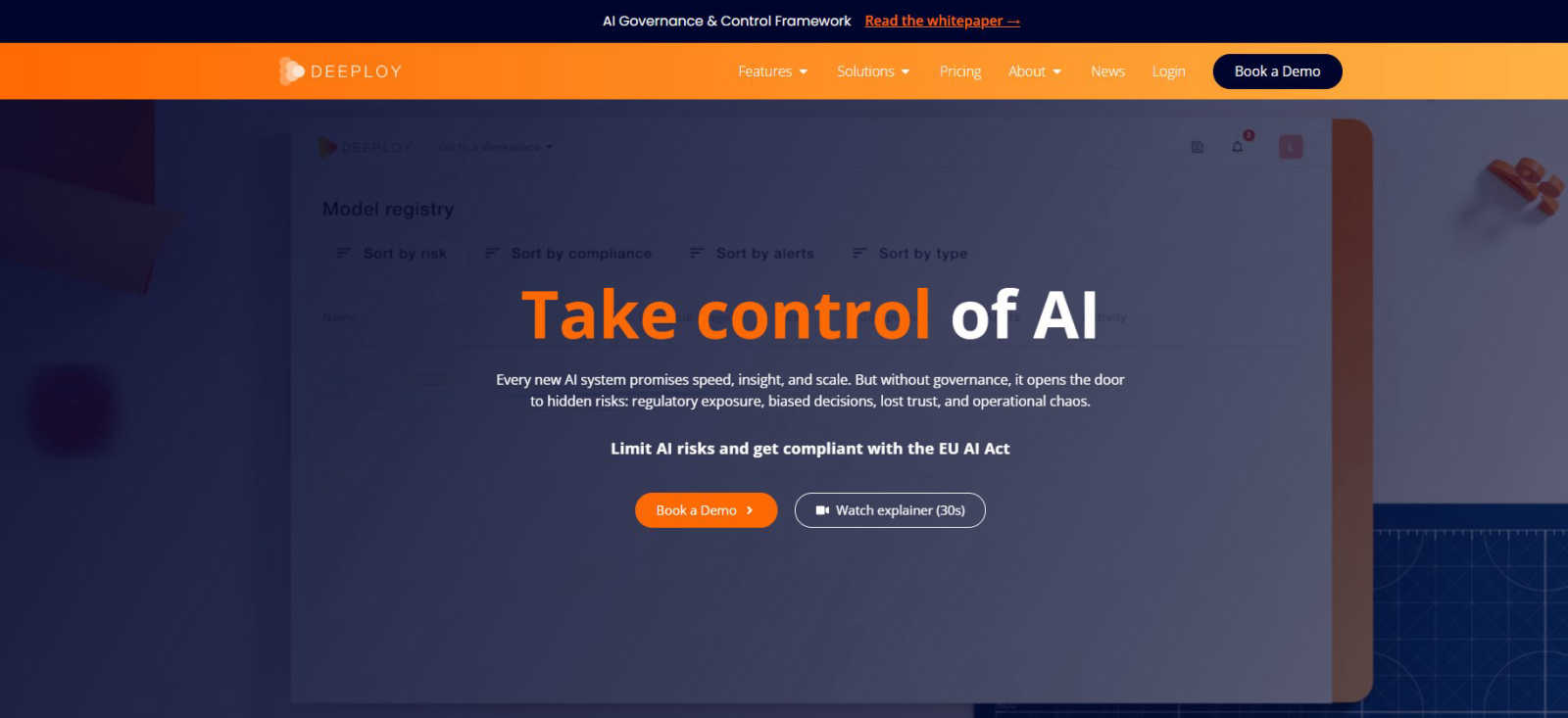
Deeploy provides organizations with robust AI governance for risk management, compliance, and scalable oversight of AI.
Last updated: March 1, 2026

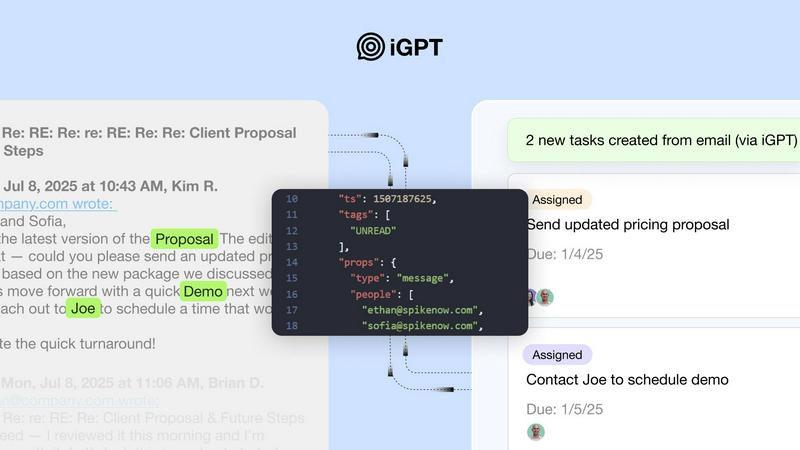
iGPT transforms messy email data into trusted, context-aware answers for enterprise workflows and AI agents.
Last updated: March 1, 2026
Visual Comparison
Deeploy
iGPT
Feature Comparison
Deeploy
AI Discovery and Onboarding
Deeploy provides complete visibility across the AI landscape within an organization, allowing users to discover, onboard, and manage every AI system from a single, user-friendly interface. This eliminates blind spots and simplifies the integration process, enabling organizations to centralize their AI inventory effortlessly.
Control Frameworks
The software offers guided workflows to navigate complex AI regulations, making compliance straightforward. Users can select from default control frameworks, like ISO 42001 and NIST AI RMF, or create custom frameworks, allowing them to classify AI system risks in mere minutes while establishing clear accountability.
Control Implementation
Deeploy facilitates the transition from governance frameworks to enforceable controls, ensuring that every AI system meets specific requirements without manual intervention. This streamlining empowers engineers with actionable requirements and accelerates compliance efforts through automated evidence collection.
Real-Time Monitoring
With real-time monitoring capabilities, Deeploy allows organizations to prevent AI incidents before they arise. Users can receive instant alerts regarding model drift or performance drops, ensuring that they can identify and rectify errors and anomalies before they impact end-users or lead to compliance issues.
iGPT
Unified Intelligence Endpoint
iGPT consolidates the entire complexity of email intelligence into one simple API call. Instead of managing separate systems for retrieval, context building, and reasoning, developers send a single natural language request. This unified endpoint handles semantic and keyword search, thread reconstruction, attachment processing, and optimal context shaping automatically, delivering a ready-to-use, structured response in seconds. This dramatically reduces development time and maintenance overhead.
Advanced Context Engineering Framework (CEF)
At the heart of iGPT is a sophisticated framework that automatically engineers the perfect context from chaotic email data. It intelligently processes and indexes messages and attachments in real-time, reconstructs full conversation threads across participants and time, and extracts text and data from documents like PDFs and spreadsheets. The system then optimizes this information for your LLM, eliminating the need for manual prompt tuning and ensuring responses are deeply contextual and accurate.
Enterprise-Grade Security & Auditability
iGPT is built with a zero-trust security model from the ground up. It guarantees zero data training, meaning your information is never used to improve models. It employs strict OAuth-based Role-Based Access Control (RBAC) for every request and operates on a zero data retention policy, processing inferences solely in memory. Furthermore, it provides a comprehensive audit trail, ensuring every answer is fully traceable back to its source messages and attachments for complete compliance.
Real-Time Ingestion & Hybrid Retrieval
The platform ensures your AI agents operate on the most current information by indexing new emails and attachments instantly as they arrive. Its retrieval system employs a powerful hybrid approach, combining semantic understanding, keyword matching, and configurable filters. These results are then intelligently scored and reranked within a single pipeline, ensuring the most relevant snippets from vast mailboxes are surfaced with high precision and speed.
Use Cases
Deeploy
Compliance Management
Organizations can utilize Deeploy to ensure compliance with various AI regulations and standards. By employing guided workflows and predefined control frameworks, teams can navigate complex legal landscapes with confidence and reduce the risk of non-compliance.
AI Performance Optimization
Deeploy's real-time monitoring feature allows businesses to continuously track the performance of their AI systems. This proactive approach helps identify issues early, enabling organizations to optimize their models and maintain high-quality outcomes for users.
Risk Assessment and Mitigation
By leveraging Deeploy's control frameworks, organizations can classify and assess the risks associated with their AI systems in a timely manner. This enables them to implement appropriate oversight mechanisms and mitigate potential risks before they escalate.
Enhanced Transparency for Stakeholders
Deeploy fosters transparency by providing built-in monitoring and explainability features. This is particularly beneficial for organizations that need to demonstrate the reliability and accountability of their AI systems to stakeholders, including clients and regulatory bodies.
iGPT
AI-Powered Email Assistants
Organizations can build intelligent agents that draft, prioritize, summarize, and act on email with full historical and attachment context. These assistants can manage inboxes, highlight urgent threads, and generate draft replies based on the complete conversation history and related files, turning individual productivity tools into powerful, context-aware copilots for entire teams.
Automated Workflow & Task Management
iGPT enables the automation of routine workflow processes directly from email threads. It can automatically parse conversations to identify decisions, extract action items, assign owners, and set deadlines. It can also flag stalled discussions or pending approvals, seamlessly turning email dialogues into structured tasks in project management or CRM systems without manual intervention.
Customer Support & Success Copilots
Support and customer success teams can leverage iGPT to instantly rebuild a customer's entire story. The API can analyze long, complex email chains with multiple participants and shifting tones, alongside all attached tickets and documents, to provide support agents with a immediate, comprehensive summary of the issue, past interactions, and agreed-upon solutions, drastically reducing resolution time.
Compliance, Auditing, & CRM Intelligence
For compliance-sensitive industries, iGPT creates an immutable link between AI-generated insights and their source material. It can trace feedback, approvals, and rationale directly back to the original email and attachment, providing a clear audit trail. Similarly, sales teams can use it to extract deal momentum, key decisions, and stakeholder sentiment directly from email threads to enrich CRM records.
Overview
About Deeploy
Deeploy is an advanced AI governance software that provides organizations with a comprehensive solution for centralizing oversight, compliance, and monitoring across their diverse AI systems. Designed for businesses grappling with the complexities of managing AI technologies that are often dispersed across multiple models, vendors, and embedded systems, Deeploy offers an innovative and unified interface for AI discovery and onboarding. This tool is essential for organizations aiming to adhere to stringent compliance standards, such as the EU AI Act, while also mitigating risks associated with AI deployment. By enhancing transparency, accountability, and responsible use of AI, Deeploy empowers businesses to unlock the transformative potential of artificial intelligence while maintaining regulatory compliance. Key features such as real-time monitoring, audit trails, and human feedback mechanisms ensure that organizations can optimize their AI systems' performance while adhering strictly to necessary frameworks.
About iGPT
iGPT is a pioneering email intelligence API engineered to bridge the critical gap between enterprise email data and modern AI-driven workflows. In a business landscape where email remains the central nervous system for communication, collaboration, and decision-making, traditional AI systems often fail to navigate its inherent complexity—long threads, nested attachments, and fragmented conversations. iGPT solves this by providing a secure, auditable, and unified gateway that transforms raw, messy email data into trusted, context-aware intelligence. Designed for forward-thinking enterprises, it serves as the foundational layer for agentic systems, enabling them to access, comprehend, and act upon information locked within email exchanges and their associated documents. Its core value proposition lies in simplifying the immense technical challenge of email context engineering, offering a single API call that replaces the need for manual parsing, chunking, indexing, and complex prompt tuning. This empowers organizations across sales, customer success, recruiting, and compliance to deploy sophisticated AI assistants and automation with confidence, enhancing productivity, streamlining operations, and maintaining stringent standards of privacy and data governance.
Frequently Asked Questions
Deeploy FAQ
What types of organizations can benefit from using Deeploy?
Deeploy is designed for organizations across various industries that leverage AI technologies. This includes businesses in sectors such as finance, healthcare, manufacturing, and technology, especially those aiming to comply with regulatory standards.
How does Deeploy help with compliance?
Deeploy simplifies compliance through its guided workflows and customizable control frameworks. Organizations can easily classify risks and establish accountability, ensuring that they meet regulatory requirements without added complexity.
What makes Deeploy different from other AI governance tools?
Deeploy stands out due to its unified interface for AI discovery and onboarding, its real-time monitoring capabilities, and its focus on transforming governance frameworks into actionable controls that engineers can readily implement.
Can Deeploy integrate with existing AI systems?
Yes, Deeploy is designed to connect with various MLOps and GenAI platforms, allowing organizations to integrate their existing AI systems seamlessly without the need for extensive migrations or overhauls of current setups.
iGPT FAQ
How does iGPT ensure the security and privacy of our email data?
iGPT is architected with enterprise-grade security as a core principle. It adheres to a strict zero data training policy, so your data is never used to train or improve any AI models. All processing is done with OAuth-enforced Role-Based Access Control, and the system operates on a zero data retention model—inputs, prompts, and outputs are processed in memory and never stored. Full audit trails ensure all activity is traceable and compliant.
What makes iGPT different from building our own email parsing and retrieval system?
Building a robust, in-house email intelligence system requires significant investment in parsing complex MIME structures, chunking text, managing vector databases, continuously tuning retrieval algorithms, and engineering prompts for context. iGPT abstracts all this complexity away. It provides a single, unified API that handles real-time ingestion, hybrid retrieval, thread reconstruction, and automatic context shaping, allowing your team to focus on building agent logic rather than maintaining fragile data pipelines.
Can iGPT process attachments, and what file types are supported?
Yes, deep attachment processing is a fundamental capability. iGPT automatically extracts text, data, and structural information from a wide variety of documents attached to emails. This includes common formats such as PDFs, Word documents, Excel spreadsheets, PowerPoint presentations, and plain text files, integrating their content seamlessly into the contextual understanding of the email thread.
How quickly can we integrate iGPT and start getting results?
Integration is designed to be immediate and straightforward. iGPT provides a comprehensive SDK, a live playground for testing API requests and responses in real-time, and support for popular frameworks like LangChain. You can connect your email data sources, and with a single API call, begin receiving contextual answers, often seeing first results in a matter of minutes, not weeks.
Alternatives
Deeploy Alternatives
Deeploy is an advanced AI governance software that specializes in centralizing oversight, compliance, and monitoring across various AI systems within an organization. It plays a crucial role in managing the complexities that arise from disparate AI technologies, ensuring that organizations can operate efficiently and transparently while adhering to applicable regulations. With its comprehensive suite of features, Deeploy is designed to empower businesses to harness the full potential of AI while maintaining accountability and trust. Users often seek alternatives to Deeploy for a variety of reasons, including pricing considerations, specific feature requirements, or the need for integration with existing platforms. As organizations continue to evolve, their needs may change, prompting them to explore different solutions that better align with their operational goals. When selecting an alternative, it is important to evaluate the software's capabilities, scalability, user interface, and how well it integrates into the existing technological ecosystem, ensuring that it meets both current and future demands.
iGPT Alternatives
iGPT is a specialized business intelligence platform that transforms enterprise email data into actionable, context-aware insights. It serves as a secure API for integrating AI-driven analysis directly into sales, customer success, and compliance workflows, enabling smarter agentic systems and more efficient operations. Users often explore alternatives for a variety of strategic reasons. These can include specific budget constraints, the need for different feature sets beyond email intelligence, or requirements for integration with a broader or different set of existing platforms and data sources within their tech stack. The search for a different solution is a natural part of finding the optimal fit for an organization's unique operational landscape. When evaluating potential solutions, key considerations should include the depth and security of data handling, the flexibility and power of the API for custom integrations, and the system's ability to provide transparent, auditable insights. The ideal platform will not only offer robust intelligence but will also align with stringent compliance standards and adapt seamlessly to evolving business processes.