
Interactive Circle of Fifths vs Polym
Side-by-side comparison to help you choose the right tool.

Interactive Circle of Fifths
Unlock the universal language of music by mastering scales, chords, and harmonic relationships interactively.
Last updated: March 1, 2026

Polym is an audio learning app that uses proven cognitive science to help you permanently remember essential knowledge.
Last updated: March 1, 2026
Visual Comparison
Interactive Circle of Fifths
Polym
Feature Comparison
Interactive Circle of Fifths
Dynamic Circle Visualization
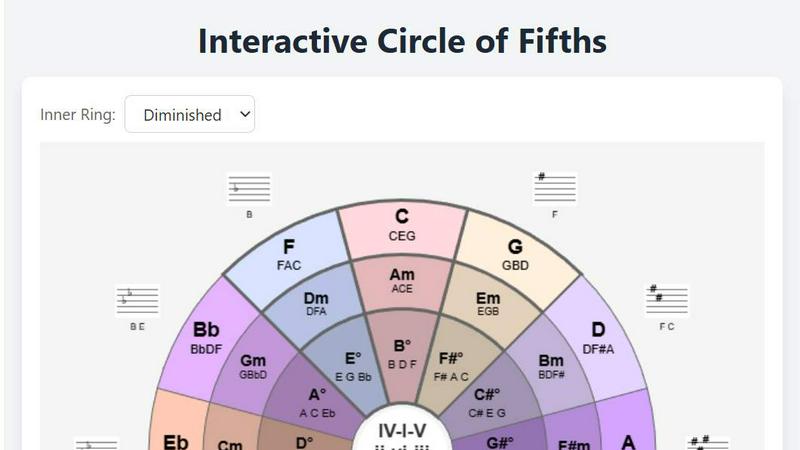
The central feature is an interactive, multi-layered Circle of Fifths. Users can click on any key to instantly reconfigure the entire display, revealing the corresponding major and relative minor scales, chords, and their harmonic functions. This dynamic visualization allows for immediate exploration of key relationships, modulations, and the intrinsic order of musical keys, transforming an abstract concept into a tangible, navigable map.
Comprehensive Scale & Chord Library
Beyond the standard major and minor scales, the tool includes an extensive library of essential scales for composition and improvisation. This includes the Pentatonic, Blues, Diatonic, and Diminished scales. Each scale is presented with its unique pattern and can be heard audibly, enabling users to study their distinct tonal colors and understand their practical application across different musical genres directly from the circle's interface.
Instrument-Specific Fingering Guides
To directly connect theory with practice, the platform features intuitive visualizers for both piano and guitar. When a chord or scale is selected, clear, interactive diagrams display the optimal fingerings on each instrument's fretboard or keyboard. This feature is invaluable for students and performers, allowing them to translate theoretical knowledge into physical muscle memory and playable patterns instantly.
Harmonized Scale & Chord Sequencer Panel
A dedicated panel displays the complete harmonized scale (e.g., C, Dm, Em, F, G, Am, B°) for the selected key, complete with Roman numeral analysis (I, ii, iii, IV, V, vi, vii°). The integrated chord sequencer lets users audition these chords in sequence, hear how they resolve (e.g., V to I), and experiment with building custom progressions. This turns the tool into an active composition and analysis lab.
Polym
Medium-Form Audio Courses
Polym offers in-depth, medium-form audio courses that delve into the foundational concepts of essential academic and professional disciplines. These courses are carefully crafted to translate traditionally text-heavy or visually-dependent subjects like logic, algorithms, and statistics into clear, narrative-driven audio formats. The content focuses on abstract principles and real-world applications, ensuring learners grasp the 'why' behind the 'what,' which strengthens conceptual understanding and practical application across various contexts in daily life and work.
Evidence-Based Active Learning (Retrieval Practice)
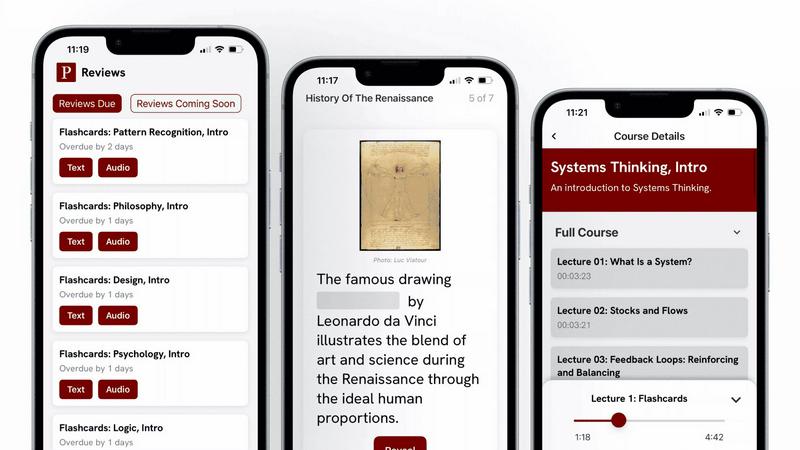
Central to Polym's methodology is the implementation of retrieval practice, a powerful active learning technique. Instead of passive review, the app prompts users to actively recall information through formats akin to audio flashcards. This process of actively retrieving knowledge from memory has been consistently shown in cognitive science research to create stronger, more durable neural pathways, significantly boosting long-term retention and making recall faster and more reliable when the knowledge is needed.
Spaced Repetition System
Polym incorporates a sophisticated spaced repetition algorithm to schedule review sessions at optimal intervals. This system intelligently determines when a learner is about to forget a piece of information and prompts a review just beforehand. By spacing out study sessions over increasing intervals of time, this method counteracts the natural curve of forgetting, transforming fragile short-term memories into solidified long-term knowledge with maximum efficiency and minimal time investment.
Interleaved Practice Sessions
Going beyond studying one topic in isolation, Polym utilizes interleaving—a strategy that mixes related concepts from different courses during a single study session. For example, a session might weave together concepts from statistics, logical fallacies, and cognitive biases. This approach challenges the brain to discern between subtly different ideas and apply the correct concept in varied contexts, leading to deeper learning, stronger associative connections, and improved problem-solving flexibility.
Use Cases
Interactive Circle of Fifths
Music Theory Education
Educators and students can use the tool as a central interactive textbook. It visually demonstrates complex concepts like relative minors, key signatures, chord functions, and scale construction in real-time, making lessons more engaging and comprehensible. It serves as an endless source of examples and exercises for classroom or self-directed study.
Songwriting and Composition
Songwriters can break through creative blocks by using the circle to discover related keys for modulations or to find chords that naturally fit together. The chord sequencer allows for rapid prototyping of chord progressions, while the scale library provides melodic inspiration, helping composers quickly develop coherent harmonic frameworks for new pieces.
Instrument Practice and Learning
Guitarists and pianists can utilize the fingering guides to learn new scales and chord voicings in any key. A student can select a scale like the Blues scale, see it on the circle, hear its sound, and immediately view the correct finger positions on their instrument, creating a seamless loop between aural, visual, and kinesthetic learning.
Music Analysis and Improvisation
Performers and analysts can deconstruct songs by inputting the key to see its harmonized scale and typical chord functions. Improvisers can visually identify which scales (e.g., pentatonic, diatonic) align with a song's chord progression, using the tool as a quick-reference guide to choose appropriate notes for solos that are theoretically sound.
Polym
The Career Advancing Professional
A marketing analyst can use Polym to solidify their understanding of statistical reasoning and probability, enabling them to interpret data with greater confidence. A project manager can brush up on logical frameworks and cognitive biases to improve decision-making and team communication. By integrating bite-sized learning into their daily routine, professionals across fields can efficiently build and retain the cross-disciplinary knowledge that fuels innovation and career growth.
The Committed Lifelong Learner & Aspiring Polymath
For individuals driven by intellectual curiosity, Polym provides a structured yet flexible pathway to explore diverse fields of knowledge. A history enthusiast can delve into economic principles, while a philosophy buff can explore the fundamentals of computer science. The app’s audio format and scientific learning techniques make the daunting goal of becoming a modern-day polymath—someone with wide-ranging knowledge—an achievable and enjoyable daily practice.
The Student Supplementing Formal Education
University students can use Polym as a powerful supplementary tool to reinforce core concepts from their coursework in subjects like economics, logic, or scientific research methods. The active recall and spaced repetition features function as a perfect companion for exam preparation, moving key terms and abstract theories from lecture notes into long-term memory, leading to better performance and a more integrated understanding of their field of study.
The Busy Individual Seeking Efficient Self-Improvement
For anyone with a packed schedule seeking personal development, Polym turns otherwise lost time—such as during a commute, household chores, or a walk—into productive learning sessions. The audio-first design allows for hands-free, eyes-free education, making it possible to build foundational knowledge in critical thinking, philosophy, or history without needing to carve out dedicated reading time, thus democratizing access to self-directed education.
Overview
About Interactive Circle of Fifths
The Interactive Circle of Fifths is a groundbreaking digital platform that redefines the study and application of music theory. It transcends the static, printed diagram by offering a dynamic, multi-sensory learning environment where users can visually explore and audibly experience the foundational relationships within music. This tool is meticulously designed for a universal audience, from the absolute beginner taking their first steps in understanding keys and chords, to the seasoned composer seeking fresh inspiration and theoretical verification. Its core value proposition lies in demystifying complex harmonic concepts, making them accessible, engaging, and immediately applicable. By integrating a visual Circle of Fifths with real-time auditory feedback and instrument-specific guidance, it bridges the gap between abstract theory and practical musicianship. Users can seamlessly navigate through keys, examine harmonized scales, and experiment with chord progressions, all while seeing the corresponding fingerings for piano and guitar. This holistic approach not only accelerates comprehension but also fosters a deeper, more intuitive connection with the language of music, empowering users to compose, improvise, and analyze with newfound confidence and creativity.
About Polym
Polym represents a paradigm shift in personal and professional development, transforming the timeless pursuit of knowledge into a seamlessly integrated, scientifically optimized audio experience. At its core, Polym is an innovative audio application meticulously engineered to facilitate active learning and dramatically enhance the retention and recall of foundational knowledge across a vast spectrum of essential subjects. It is designed for the modern lifelong learner, the curious professional, and the aspiring polymath who seeks to build a robust, interconnected understanding of the world. The app breaks down complex fields such as Statistics, Probability, Logic, Economics, Computer Science, AI, Philosophy, and History into digestible, audio-friendly formats, including medium-form courses, abbreviated summaries, and interactive audio flashcards. Its primary value proposition lies not just in content delivery, but in its foundational integration of evidence-based cognitive science strategies—specifically retrieval practice, spaced repetition, and interleaving. By leveraging these proven methods, Polym moves beyond passive listening to create an engaging learning environment that strengthens long-term memory formation. This approach makes mastering intricate and abstract concepts accessible to anyone, anywhere, turning commutes, workouts, or downtime into productive sessions of intellectual growth. Polym empowers users to efficiently learn and, more importantly, remember critical knowledge that is applicable both in advancing one's career and in enriching one's personal understanding of complex systems and ideas.
Frequently Asked Questions
Interactive Circle of Fifths FAQ
Is the Interactive Circle of Fifths suitable for complete beginners?
Absolutely. The tool is designed with an intuitive interface that visually guides users through fundamental concepts. Beginners can start by simply clicking on keys to hear scales and see basic chords, using the visualizers to connect sounds with shapes on their instrument. It progressively reveals more complex information as the user's understanding deepens.
Can I use this tool to help me learn guitar or piano?
Yes, it is an excellent supplemental resource for instrumental learning. The dedicated piano and guitar visualizers show precise fingerings for every chord and scale generated by the circle. This allows you to practice the practical application of music theory directly on your instrument, reinforcing both theoretical knowledge and technical skill simultaneously.
What is the "Harmonized Scale" panel used for?
The Harmonized Scale panel displays all seven chords that are naturally built from each note of a major scale. It shows their letter names, chord types (major, minor, diminished), and their Roman numeral function (I, IV, V, etc.). This is crucial for understanding chord progressions, songwriting, and analyzing why certain chords sound good together in a given key.
How does the "Function: Resolves To" feature work?
This feature highlights the inherent tension and resolution in harmony. For any chord within a key (particularly the dominant V chord), it indicates which chord it naturally "wants" to resolve to (typically the tonic I chord). Understanding these relationships is key to creating satisfying musical phrases, effective cadences, and compelling chord movements in composition and improvisation.
Polym FAQ
What research supports the learning strategies Polym uses?
The learning strategies at Polym's core—retrieval practice, spaced repetition, and interleaving—are extensively validated by decades of cognitive science research. These techniques are proven to enhance long-term memory retention and recall far more effectively than passive study methods like re-reading or highlighting. For a comprehensive overview of the science behind effective learning, you can explore resources such as the article "Improving Student Learning from Lectures" available through the National Institutes of Health.
What subjects does Polym cover?
Polym offers courses on a wide range of foundational subjects selected for their broad relevance and intellectual utility. The curriculum includes, but is not limited to, Logic and Logical Fallacies, Cognitive Biases, Statistics, Probability, Scientific Research Principles, Algorithms, Economics, Philosophy, and History. The focus is on the essential, abstract concepts within these fields that are most applicable across professional and personal contexts.
Who is the ideal user for Polym?
Polym is designed for anyone with a desire to learn and retain foundational knowledge more effectively. This includes professionals aiming to cross-skill, students supplementing their studies, lifelong learners exploring new disciplines, and curious minds seeking to understand the fundamental principles that shape our world. Essentially, it is for individuals who believe in the power of continuous learning and want a science-backed tool to make that process more efficient and durable.
Is technical and mathematical content suitable for audio?
Polym directly addresses this common challenge by meticulously curating and adapting technical content specifically for the audio medium. The courses focus on the conceptual and abstract layers of technical fields—the underlying principles, logic, and applications—rather than on dense equations or complex notation that require visual aid. This approach not only makes the content accessible via audio but often strengthens the learner's conceptual grasp by focusing on the 'why' behind the math or code.
Alternatives
Interactive Circle of Fifths Alternatives
The Interactive Circle of Fifths is a premier digital tool in the music education and learning category, designed to demystify music theory through interactive visual and auditory exploration. It serves as a comprehensive guide for understanding scales, chords, and their intricate relationships, making complex concepts accessible to musicians at all levels. Users may seek alternatives for a variety of practical reasons. These can include budget constraints, a need for different feature sets such as specific instrument focus or composition tools, or compatibility requirements with particular devices and operating systems. The desire for a different learning methodology or integration with other software platforms also commonly drives the search for other solutions. When evaluating other options, it is crucial to consider the depth of theoretical content, the quality of interactive visualization, and the range of supported instruments and scales. The ideal alternative should align with your primary learning goals, whether that is songwriting, improvisation, or foundational theory, while offering an intuitive and engaging user experience that makes the journey into music theory both effective and inspiring.
Polym Alternatives
Polym is an innovative audio learning application designed to enhance knowledge retention. It operates within the education and learning technology category, specifically focusing on evidence-based techniques like retrieval practice and spaced repetition to help users master foundational subjects. Its unique value lies in transforming complex topics into accessible audio formats for efficient, on-the-go study. Users may explore alternatives to Polym for various reasons. These can include budget considerations, a desire for different content formats like video or text, specific platform availability needs, or a preference for a different subject matter focus. The search for the right tool is highly personal, driven by individual learning styles, goals, and logistical requirements. When evaluating alternatives, key factors to consider are the core learning methodology, the depth and breadth of the subject library, and the flexibility of the platform. It is crucial to assess whether an app employs active, research-backed strategies for long-term retention, offers content relevant to your intellectual or professional pursuits, and fits seamlessly into your daily routine for consistent engagement.