
OpenMark AI vs Quickfix AI
Side-by-side comparison to help you choose the right tool.

OpenMark AI instantly benchmarks over 100 AI models on your specific task to find the optimal balance of cost, speed, and quality.
Last updated: March 26, 2026

Quickfix AI
Quickfix AI provides instant, clear diagnostics of your computer's performance and health for easy troubleshooting.
Last updated: February 28, 2026
Visual Comparison
OpenMark AI
Quickfix AI
Feature Comparison
OpenMark AI
Plain Language Task Benchmarking
OpenMark AI removes the barrier of technical complexity by allowing users to define their test scenarios using simple, descriptive language. You don't need to write complex scripts or structured prompts; you just describe what you want the AI to do, such as "extract dates and product names from customer service emails" or "generate three taglines for a new productivity app." The platform intelligently configures the benchmark, enabling rapid, iterative testing of your actual workflow without any coding required.
Multi-Model Comparison in One Session
The platform's core strength is its ability to run your described task against a massive selection of LLMs simultaneously. Instead of manually testing models one by one across different interfaces and dashboards, you launch a single benchmark job. OpenMark AI coordinates real API calls to all selected models, presenting the results in a unified dashboard for immediate, apples-to-apples comparison across quality scores, cost, and speed.
Variance and Stability Analysis
OpenMark AI provides deep insight into model reliability by running your task multiple times per model. This feature measures output consistency, showing you the variance in responses. It answers the critical question: "Will this model perform consistently when deployed at scale?" This focus on stability, beyond a single output, helps identify models that are robust and dependable versus those that are unpredictable.
Integrated Cost-Per-Request Calculation
Every benchmark includes precise, real-time calculation of the cost incurred for each API call to each model. This goes beyond listed token prices, showing you the actual expense of achieving a certain quality level for your specific task. This allows for true cost-efficiency analysis, helping you select a model that delivers the required performance at a sustainable operational cost, optimizing your AI budget effectively.
Quickfix AI
Intelligent Reply Generation
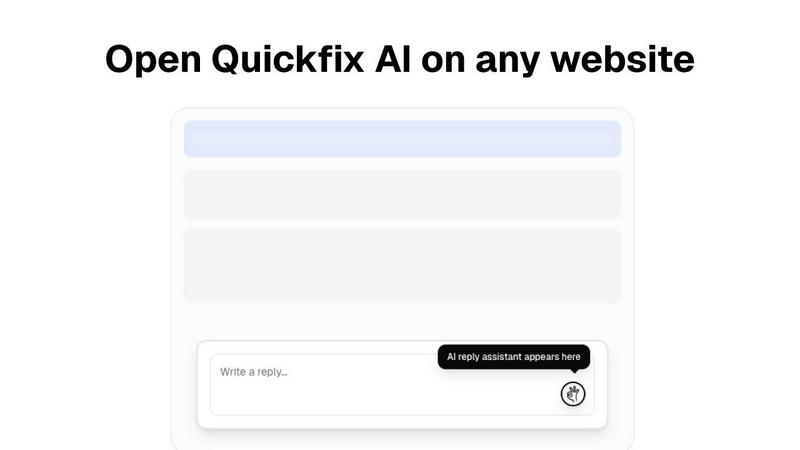
Quickfix AI's browser extension automatically crafts context-aware replies, enabling users to respond to communications without the hassle of manual typing. This feature is invaluable for busy professionals needing to manage multiple conversations efficiently.
Comprehensive System Diagnostics
The standalone diagnostics tool provides a complete analysis of system performance, covering aspects such as CPU usage, memory pressure, and disk health. Users can quickly assess their computer's status, making it easier to identify and address potential issues.
AI-Powered Insights
Quickfix AI's AI component breaks down complex technical data into plain English, making it accessible to users of all skill levels. This feature allows individuals to understand their system diagnostics without needing any prior technical knowledge.
Performance Monitoring and Reporting
The platform offers real-time monitoring of various system parameters, including security status and network connections. Users receive detailed reports that highlight critical areas, empowering them to take informed actions to optimize their system's performance.
Use Cases
OpenMark AI
Pre-Deployment Model Selection for New Features
Development teams building a new AI-powered feature, such as a content summarizer or a customer support chatbot, can use OpenMark to empirically determine the best foundational model. By benchmarking prototypes of their exact task, they can select the optimal model based on a combination of accuracy, response time, and cost before committing to an integration, reducing risk and technical debt.
Validating Model Performance for Critical Workflows
For companies with existing AI integrations in sensitive areas like data extraction, legal document review, or medical research assistance, OpenMark serves as a validation suite. Teams can regularly benchmark their current model against new alternatives to ensure they are still using the most effective and cost-efficient option, or to test the impact of model updates on their specific outputs.
Optimizing Agentic or Multi-Step AI Systems
When designing complex AI agents that involve routing, classification, or chaining multiple LLM calls, choosing the right model for each step is vital. Engineers can use OpenMark to benchmark subtasks—like intent classification or query reformulation—to find specialized models that improve overall system performance and reliability while controlling cascading costs.
Academic and Industrial AI Research
Researchers and analysts focused on LLM capabilities can utilize OpenMark's structured testing environment to conduct comparative studies. The platform's ability to run consistent prompts across many models and measure variance provides robust, reproducible data for analyzing model strengths, weaknesses, and evolution across different task types and difficulty levels.
Quickfix AI
Troubleshooting Computer Issues
When users encounter system slowdowns or crashes, Quickfix AI can diagnose the problem and provide clear explanations. Its user-friendly interface demystifies technical jargon, helping users understand what's wrong and how to fix it.
Enhancing Productivity for Professionals
Busy professionals can leverage Quickfix AI's intelligent reply feature to manage their communication more effectively. By generating quick responses, they can maintain productivity without getting bogged down in repetitive typing tasks.
Supporting IT Teams
IT support teams can use Quickfix AI to diagnose issues remotely. By sharing a link and obtaining a sharing code, technicians can instantly access system diagnostics, streamlining the troubleshooting process and improving response times.
Empowering Everyday Users
Whether a user is trying to understand why their laptop is running slowly or they want to check their system's health, Quickfix AI provides straightforward answers and actionable recommendations, empowering them to manage their technology confidently.
Overview
About OpenMark AI
OpenMark AI is a sophisticated, web-based platform designed to revolutionize how developers and product teams select and validate large language models (LLMs) for their specific applications. It moves beyond theoretical benchmarks and marketing claims by enabling task-level, real-world performance testing. The core premise is simple yet powerful: users describe their exact task in plain language, and OpenMark AI executes that prompt against a vast catalog of over 100 models in a single, unified session. This process generates comprehensive, side-by-side comparisons based on actual API calls, measuring critical metrics like scored output quality, cost per request, latency, and—crucially—output stability across multiple runs. By revealing variance and consistency, not just a single "lucky" output, OpenMark provides the empirical data needed to make informed, cost-efficient decisions before shipping an AI feature. It eliminates the logistical headache of managing multiple API keys and configurations, offering a hosted, credit-based system that grants immediate access to models from leading providers like OpenAI, Anthropic, and Google. Ultimately, OpenMark AI is built for professionals who prioritize finding the optimal balance between performance, reliability, and operational cost for their unique use case.
About Quickfix AI
Quickfix AI is an innovative, dual-purpose platform designed to streamline digital interactions and enhance system management for users across various backgrounds. At its core, it offers an intelligent browser extension that generates context-aware replies on any website, significantly reducing the time spent on manual typing and copy-pasting. This feature is particularly beneficial for professionals grappling with overflowing emails, support tickets, and social media messages, allowing them to respond swiftly and effectively. Additionally, Quickfix AI includes a powerful standalone system diagnostics tool that provides instant, understandable insights into computer performance and health. This combination of features caters to a wide audience, from everyday users seeking clarity in technical troubleshooting to experienced IT professionals needing detailed system analytics. The overarching value proposition of Quickfix AI is its ability to simplify complex tasks, save users precious hours weekly, and transform technical confusion into actionable insights, all facilitated through an intuitive, AI-driven interface.
Frequently Asked Questions
OpenMark AI FAQ
How does OpenMark AI calculate the quality score for model outputs?
OpenMark AI employs a sophisticated, automated evaluation system that scores model outputs based on their adherence to your task's instructions and desired outcome. While the exact methodology is proprietary, it typically involves a combination of metrics that may include semantic similarity, keyword presence, factual accuracy checks (where applicable), and structured format compliance. This provides a quantitative measure of how "correct" or suitable each model's response is for your specific benchmark.
Do I need API keys for OpenAI, Anthropic, or other model providers?
No, you do not need to provide or configure any external API keys. OpenMark AI operates on a credit-based system. You purchase credits through the platform, and these credits are used to pay for the underlying API calls when you run benchmarks. This hosted approach simplifies access, manages rate limits, and provides a single, unified cost structure for testing across the entire model catalog.
What is the difference between a "task" and a "benchmark" in OpenMark?
A "Task" is your defined objective—the instructions and any example inputs you create in plain language. A "Benchmark" is the execution of that task. When you run a benchmark, you select which models to test against your task, configure the number of repeat runs for stability analysis, and launch the job. The benchmark results then show how each model performed on that specific task.
Can I use OpenMark to test private or fine-tuned models?
Currently, OpenMark AI focuses on providing access to its extensive catalog of publicly available, state-of-the-art models from major providers. The platform is designed for comparative benchmarking of these off-the-shelf models. Support for testing privately hosted or custom fine-tuned models is not a standard feature, as the platform's value lies in its managed, unified access to a wide array of pre-existing models for direct comparison.
Quickfix AI FAQ
Is Quickfix AI free?
Quickfix AI offers a free version that allows users to access essential features. For advanced functionality, users can explore premium options that provide additional benefits.
Is my data secure?
Yes, Quickfix AI prioritizes user privacy and data protection. The platform employs robust security measures to ensure that user data remains confidential and secure at all times.
Do I need technical knowledge to use Quickfix AI?
No, Quickfix AI is designed for users of all technical backgrounds. Its AI-driven explanations and user-friendly interface make it accessible for everyone, regardless of their tech expertise.
What information does Quickfix AI collect?
Quickfix AI collects necessary diagnostic data to provide insights into system performance and health. This information is used solely for enhancing user experience and is not shared with third parties without consent.
Alternatives
OpenMark AI Alternatives
OpenMark AI is a specialized developer tool designed for task-level benchmarking of large language models. It allows teams to run real prompts against a wide catalog of LLMs in a single session, comparing critical metrics like cost, latency, quality, and output stability to inform pre-deployment decisions. Users may explore alternatives for various reasons, such as differing budget constraints, the need for on-premise deployment, or a requirement for more granular technical controls beyond hosted benchmarking. Some may seek tools integrated directly into their CI/CD pipeline or those offering different model access or pricing structures. When evaluating other solutions, key considerations include the scope of supported models, the authenticity of performance data, the depth of analysis on cost versus quality, and the overall workflow efficiency. The ideal tool should provide transparent, actionable insights that align with your specific development stage and operational requirements.
Quickfix AI Alternatives
Quickfix AI is an innovative dual-purpose platform designed to enhance both digital communication and system management. As a comprehensive solution, it features an intelligent browser extension that generates context-aware replies and a standalone system diagnostics tool that simplifies computer performance analysis. Users often seek alternatives to Quickfix AI due to various reasons such as pricing concerns, specific feature requirements, or compatibility with different platforms. When exploring alternatives, it is essential to consider factors like the range of features offered, ease of integration into existing workflows, pricing models, and the level of customer support available. Understanding your unique needs, whether for streamlined communication or effective system diagnostics, will help you choose the most suitable option.