
MonsterOps vs ScopeSnap
Side-by-side comparison to help you choose the right tool.

MonsterOps
Money Visualiser transforms any amount into interactive 3D bill stacks for instant, realistic currency comparison.
Last updated: March 1, 2026

ScopeSnap
ScopeSnap uses AI to transform your project discovery notes into structured scopes and client-ready proposals in minutes.
Last updated: March 18, 2026
Visual Comparison
MonsterOps
ScopeSnap
Feature Comparison
MonsterOps
Unified Business Workspace
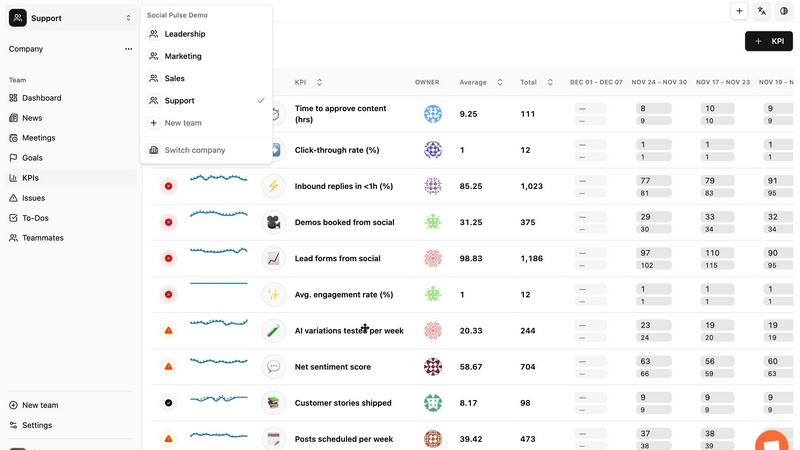
MonsterOps consolidates all critical business functions—including goal tracking, task management, document storage, and communication—into a single, intuitive digital environment. This eliminates the inefficiency and errors associated with toggling between multiple disconnected applications, ensuring that data, decisions, and directives reside in one source of truth. The workspace is designed for clarity, reducing cognitive load and allowing teams to focus purely on execution and results.
Real-Time KPI & Metric Dashboards
Gain immediate, visual insight into your company's vital signs with customizable, real-time Key Performance Indicator (KPI) dashboards. MonsterOps allows leadership to define, track, and analyze critical metrics that matter most to the business's health. This feature transforms raw data into actionable intelligence, enabling data-driven decision-making and allowing teams to identify trends, celebrate wins, and address issues before they escalate.
Structured Leadership Meeting Management
MonsterOps formalizes and streamlines the entire meeting lifecycle for leadership teams, including Level 10 meetings from the EOS framework. The platform provides tools for creating consistent agendas, documenting issues and solutions, assigning clear action items with owners and deadlines, and archiving meeting notes for accountability and historical reference. This brings discipline to communication, ensuring meetings are productive, outcomes are captured, and follow-through is guaranteed.
Goal & Rocks Alignment Tracking
Align your entire organization from vision to daily tasks with integrated goal-tracking tools. MonsterOps facilitates the setting of company-wide priorities, often called "Rocks," and cascades them down to departmental and individual objectives. This creates a transparent line of sight for every employee, showing how their work directly contributes to overarching business goals, fostering a culture of ownership and focused execution.
ScopeSnap
AI-Powered Scope Generation
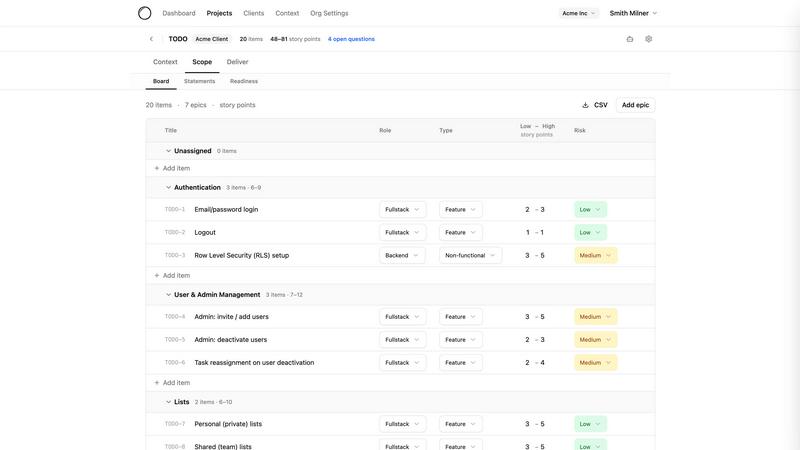
ScopeSnap's core intelligence lies in its ability to ingest unstructured discovery materials. By simply pasting in call transcripts, email threads, or meeting notes, the AI analyzes the content to automatically generate a structured project backlog. It identifies key themes and breaks them down into logical epics and individual scope items, creating an immediate, organized foundation for estimation and planning that would otherwise take hours to assemble manually.
Interactive Scope Refinement & Estimation Board
The platform provides a dynamic, interactive board where the AI-generated scope can be reviewed, edited, and refined. Users can assign roles, set time estimates for each task, and directly address the open questions and assumptions flagged by the AI. This collaborative environment allows for iterative refinement until every feature is well-understood and confidently estimated, ensuring complete alignment before presenting to the client.
Automated Proposal & SOW Document Creation
Once the scope is finalized, ScopeSnap eliminates the need to write proposals from scratch. With a single click, it automatically generates a polished, client-ready Proposal or Statement of Work document. This document is populated with the structured scope, estimates, assumptions, and defined deliverables, presenting a professional and comprehensive agreement that can be sent directly to the client for review and signature.
Centralized Discovery Context Hub
ScopeSnap serves as a single source of truth for all project discovery artifacts. It allows teams to consolidate all relevant materials--transcripts, notes, emails--in one place linked directly to the project scope. This ensures that every scope item and assumption is traceable back to the original client conversation, providing invaluable context for the team and strengthening the defensibility of the project's defined parameters.
Use Cases
MonsterOps
Implementing the Entrepreneurial Operating System (EOS)
For businesses adopting the EOS framework, MonsterOps serves as the definitive digital platform to operationalize its core components. It provides the structured tools for setting a clear vision, defining Rocks, conducting disciplined Level 10 meetings, and using the People Analyzer and Accountability Chart. This turns the EOS model from a conceptual framework into a living, breathing system embedded in the company's daily workflow.
Scaling Operations for Growth-Stage Companies
As a business expands beyond the startup phase, operational complexity multiplies. MonsterOps provides the scalable infrastructure needed to maintain alignment and control. It helps leadership systematize processes, maintain visibility across growing teams, and ensure that the company's culture and strategic focus remain intact during rapid growth, preventing the chaos that often accompanies scaling.
Improving Cross-Departmental Collaboration
MonsterOps breaks down internal silos by creating a shared operational language and a centralized platform for all teams. Marketing, sales, operations, and finance can view shared goals, track interdependent projects, and understand how their functions interlink. This transparency reduces friction, accelerates project timelines, and ensures all departments are rowing in the same direction toward common objectives.
Establishing Predictable Management Rhythms
For leadership teams stuck in a cycle of reactive management, MonsterOps instills a cadence of predictability. By enforcing regular meeting structures, consistent progress reviews, and systematic issue-solving processes, it moves the organization from ad-hoc crisis management to a calm, disciplined, and forward-looking operational rhythm. This allows leaders to work on the business, not just in it.
ScopeSnap
For Freelance Developers Securing New Projects
Independent developers can use ScopeSnap to quickly and professionally respond to client inquiries after discovery calls. Instead of spending a full day crafting an estimate and proposal, they can transform their notes into a structured scope and formal document in under an hour, impressing clients with their clarity and professionalism while dramatically speeding up their sales cycle.
For Software Agencies Standardizing Client Onboarding
Agencies handling multiple concurrent client engagements can implement ScopeSnap to standardize their scoping process. It ensures consistency in how project requirements are captured, broken down, and estimated across different project managers and teams, leading to more accurate forecasting, reduced scope creep, and a higher-quality, reliable client experience from the very first interaction.
For Consultants Defining Project Boundaries
Technical consultants who need to define the boundaries of an advisory or implementation engagement can leverage ScopeSnap to create clear Statements of Work. The AI helps ensure all deliverables, phases, and assumptions are explicitly documented, which is crucial for fixed-scope or time-boxed consulting agreements, protecting both the consultant and the client from misunderstandings.
For Development Teams Transitioning from Sales to Delivery
ScopeSnap bridges the gap between the sales conversation and the execution team. The detailed, structured backlog generated during the sales phase becomes the immediate foundation for the development team's sprint planning. This seamless handoff prevents information loss and gives developers a clear, pre-vetted task list to start building from, accelerating time-to-production.
Overview
About MonsterOps
MonsterOps represents a transformative leap forward in business management technology, designed as a comprehensive Business Operating System (BOS) specifically for the dynamic needs of small to mid-sized enterprises. In an era where operational complexity and team misalignment can stifle growth, MonsterOps provides a singular, unified workspace to consolidate the chaotic array of tools—such as disparate spreadsheets, document silos, and disconnected task applications—that plague modern organizations. Its core mission is to instill clarity, predictability, and strategic focus, enabling leadership teams to transition decisively from a reactive, day-to-day firefighting mode to a proactive, vision-driven operational cadence. The platform is meticulously engineered for founders, executives, and leadership teams who are committed to implementing structured operating frameworks, most notably the Entrepreneurial Operating System (EOS), though its adaptable architecture seamlessly supports any proprietary or established business methodology. By integrating real-time performance tracking with disciplined meeting rhythms and goal management, MonsterOps ensures every team member, from the C-suite to department leads, is aligned and empowered to execute the company's core vision, driving measurable results and sustainable scalability.
About ScopeSnap
ScopeSnap is an AI-powered platform designed to fundamentally transform the initial, often chaotic, phase of custom software development: project scoping and proposal creation. It directly addresses the critical pain point faced by freelance developers, consultants, and software agencies: the inefficient and risky transition from discovery conversations to a clear, actionable, and client-ready project definition. The core value proposition of ScopeSnap lies in its ability to automate and structure this process, turning scattered notes, call transcripts, and vague ideas into a meticulously organized project backlog, accurate time estimates, and professionally formatted proposals or statements of work (SOW). By leveraging artificial intelligence, ScopeSnap acts as a collaborative scoping partner that helps surface assumptions, identify open questions, and break down complex project ideas into discrete, estimatable tasks. This not only saves practitioners hours of manual, tedious work but also significantly de-risks projects by ensuring nothing is missed and scope is mutually understood before work begins. Ultimately, ScopeSnap empowers development professionals to move from ambiguous discussions to confident, transparent agreements with clients in a fraction of the traditional time, fostering trust and setting the stage for successful project delivery.
Frequently Asked Questions
MonsterOps FAQ
What is a Business Operating System (BOS)?
A Business Operating System (BOS) is a comprehensive set of tools, processes, and principles that align an entire organization around a shared vision and a set of disciplined practices for execution. It provides the framework for how a company sets goals, runs meetings, measures performance, and solves problems. MonsterOps is a digital platform that embodies and facilitates the implementation of such a system, bringing structure and clarity to daily operations.
Is MonsterOps only for companies using EOS?
While MonsterOps is expertly crafted to support and enhance the Entrepreneurial Operating System (EOS) framework, it is intentionally designed to be highly adaptable. Its core features—like goal tracking, meeting management, and KPI dashboards—are universal components of effective business management. Therefore, it can be successfully configured to support any structured operating model or a company's unique proprietary system.
How does MonsterOps improve team alignment?
MonsterOps improves alignment by making the company's vision, core goals (Rocks), and key performance metrics visible and accessible to everyone in a single workspace. It ensures that all meetings and discussions are centered on these priorities and that action items are clearly assigned and tracked. This creates a unified focus, where every team member understands how their individual contributions drive the collective success of the organization.
Can MonsterOps replace our existing project management or CRM tools?
MonsterOps is designed as an integrative command center rather than a direct replacement for specialized tools like a full-featured CRM or complex project management software. Its strength lies in consolidating high-level goals, metrics, and leadership rhythms. It works best when integrated with or used alongside your department-specific tools, providing the strategic oversight that connects the outputs of those tools to the company's overarching objectives.
ScopeSnap FAQ
What kind of input does ScopeSnap need to generate a scope?
ScopeSnap is designed to work with the raw, unstructured output from your discovery process. The most effective inputs include transcripts from discovery calls or meetings, email chains discussing requirements, and any notes you've taken. The AI analyzes this textual context to identify project goals, features, and requirements to build the initial structured backlog.
How accurate are the AI-generated estimates?
ScopeSnap uses AI to break down the project into logical, estimatable tasks, but the actual time or cost estimates are applied by you, the expert. The platform provides the structure and prompts for estimation, but it relies on your professional judgment to assign realistic values based on complexity, known technologies, and your team's velocity, ensuring the final numbers are credible.
Can I edit the scope and proposals that ScopeSnap creates?
Absolutely. ScopeSnap is designed as a collaborative starting point, not a rigid, automated output. The entire scope board is fully editable--you can add, remove, or modify tasks, change estimates, and rewrite descriptions. The generated proposals are also fully customizable, allowing you to adjust language, terms, and formatting to match your brand and the specific client engagement.
Is ScopeSnap suitable for very large or complex enterprise projects?
Yes, ScopeSnap is built to handle projects of varying complexity. For large enterprise projects, it excels at creating a high-level structured overview and identifying major workstreams or phases. It helps manage complexity by breaking down large ideas into core epics and surfacing critical assumptions and open questions early, which is essential for planning multi-stage engagements.
Alternatives
MonsterOps Alternatives
MonsterOps is a comprehensive Business Operating System (BOS) designed to bring order and strategic alignment to small and mid-sized businesses. It falls squarely within the productivity and management software category, aiming to consolidate strategy, meetings, and accountability into a single, unified workspace to replace the chaos of disparate tools. Users often explore alternatives for a variety of practical reasons. These can include budget constraints, the need for a different feature set, or a requirement for integration with other specific platforms. Some organizations may seek a tool more narrowly focused on a single function, while others might need a solution that scales differently or offers a distinct user experience. When evaluating alternatives, it's crucial to consider your core operational needs. Key factors include the platform's ability to support your chosen business methodology, the depth of its meeting and accountability features, and the clarity it provides through real-time performance tracking. The ideal solution should not only fit your current workflow but also adapt to your company's future growth and evolving strategic demands.
ScopeSnap Alternatives
ScopeSnap is a productivity and project management tool designed to streamline the initial phases of custom software development. It uses AI to help professionals transform unstructured discovery notes into clear project scopes, accurate estimates, and professional client proposals. This category of software is essential for consultants and agencies looking to reduce risk and save time during the critical scoping and sales process. Users may explore alternatives to ScopeSnap for various reasons. Common considerations include budget constraints and specific pricing models, the need for different or more advanced feature sets, or integration requirements with an existing tech stack. Some may seek a platform with a different user experience or one that caters to a broader or more niche range of project types beyond software development. When evaluating alternatives, it's crucial to assess how well a solution addresses the core challenge of turning vague ideas into actionable, estimatable plans. Key factors include the tool's ability to facilitate iterative scope refinement, the quality and customizability of its output documents, and the overall efficiency it brings to your proposal workflow. The right choice should align with your specific operational needs and business scale.