Mia vs Stable Commerce
Side-by-side comparison to help you choose the right tool.
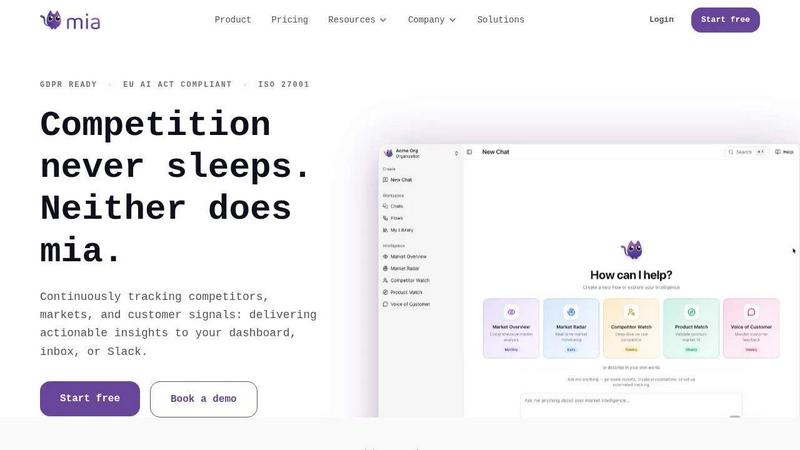
Mia delivers continuous AI-powered market intelligence to fuel your competitive growth strategy.
Last updated: March 4, 2026
Stable Commerce
Stable Commerce is an AI agent that builds and autonomously runs your entire online store from a single prompt.
Last updated: March 4, 2026
Visual Comparison
Mia

Stable Commerce
Feature Comparison
Mia
Voice of Customer Analysis
This module aggregates and analyzes customer sentiment from diverse sources such as reviews, social media, and support tickets. Using AI-powered analysis, it distills raw feedback into clear insights on customer satisfaction, pain points, and emerging requests. This allows product and marketing teams to prioritize their roadmap based on real, data-driven customer voices, ensuring resources are invested in features and improvements that truly matter to their audience.
Competitor Watch with Real-Time Alerts
Mia provides automated, continuous surveillance of your competitive landscape. It tracks competitors' product launches, feature updates, pricing changes, marketing campaigns, and public sentiment. The system delivers real-time alerts to your preferred channels, ensuring your team never misses a critical move. This proactive intelligence allows businesses to anticipate market shifts, counter competitive threats, and identify strategic opportunities for differentiation.
AI-Powered Market Radar
Going beyond competitor tracking, the Market Radar module conducts continuous, broad-spectrum market intelligence. It scans for industry trends, regulatory changes, technological advancements, and nascent opportunities before they become mainstream. This forward-looking analysis empowers strategic planning, helping businesses to pivot ahead of trends, enter new markets with confidence, and mitigate risks associated with market volatility.
One-Click Report Generation
Mia transforms complex data streams into professional, digestible reports with a single click. Users can generate comprehensive analyses on market position, competitor activity, or customer sentiment. These reports are fully editable and can be exported in multiple formats, including PDF, Word, and presentation slides, facilitating seamless sharing with stakeholders, investors, or internal teams to align strategy and drive consensus.
Stable Commerce
Prompt-to-Store Generator
This foundational feature allows users to generate a complete, live online store in under two minutes simply by describing what they want to sell. The AI agent interprets the prompt, automatically designs the storefront, configures necessary systems, and establishes the foundational structure. This eliminates weeks of setup work, making the initial launch phase almost instantaneous and removing barriers to entry for new entrepreneurs.
Autonomous Commerce Agent
Acting as a tireless, full-stack operations manager, the autonomous agent is the heart of the platform. It continuously orchestrates all connected systems—including storefronts, marketplaces, payment processors, analytics, and fulfillment APIs—without manual intervention. It analyzes real-time data, optimizes store performance, and ensures all workflows run smoothly 24/7, effectively replacing the need for multiple specialized team members or constant developer input.
Unified E-Commerce Stack
Stable Commerce provides a fully integrated, complete platform that consolidates every essential tool. This includes built-in inventory management, order processing, customer service tools, and enterprise-grade security with SSL and fraud protection. The platform seamlessly integrates with major payment gateways like Stripe and PayPal, creating a cohesive environment where all components are designed to work in harmony from the start.
Intelligent Optimization & Analytics
The platform goes beyond basic reporting by offering managed, intelligent analytics. The system tracks sales, customer behavior, and operational metrics in real time, then uses this data to autonomously suggest and implement optimizations. This continuous cycle of analysis and improvement aims to boost conversion rates, enhance efficiency, and maximize revenue without requiring the store owner to become a data analyst.
Use Cases
Mia
Startup Market Validation and Launch
For startups, Mia accelerates the go-to-market process by providing rapid validation of product-market fit. It analyzes target markets, identifies key competitors, and surfaces unmet customer needs. This intelligence allows founders to refine their value proposition, position their product effectively, and launch with a data-backed strategy, significantly reducing the risk and time associated with entering a new market.
SME Competitive Strategy Development
Small and medium-sized enterprises use Mia to level the playing field against larger competitors. By automating competitor and market tracking, SMEs gain the intelligence capabilities of an enterprise research team without the overhead. This enables them to identify competitors' weaknesses, discover underserved market niches, and make strategic decisions on pricing, marketing, and product development to compete more effectively.
Enterprise Strategic Portfolio Management
Large enterprises utilize Mia to monitor the broader market ecosystem affecting their portfolio of products and services. It provides a unified view of competitive threats, potential disruptors, and cross-industry trends. This enables corporate strategy teams to make informed decisions about R&D investment, mergers and acquisitions, and long-term strategic planning to protect and grow market share.
Product Management and Roadmap Prioritization
Product managers leverage Mia's Voice of Customer and Product Match analysis to guide development priorities. By systematically analyzing customer feedback alongside competitor feature sets and market gaps, teams can build data-driven roadmaps. This ensures that development resources are focused on initiatives that will deliver the highest impact on customer satisfaction and competitive advantage.
Stable Commerce
First-Time Entrepreneur Launch
An individual with a product idea but no technical or eCommerce experience can use Stable Commerce to articulate their vision in a prompt. Within minutes, they have a professional, mobile-responsive store complete with secure payments and basic analytics, allowing them to go from concept to live sales with zero coding or complex configuration, dramatically accelerating their market entry.
Scaling Small Business Operations
A growing online store overwhelmed by managing dozens of plugins, spreadsheets for analytics, and separate systems for logistics can consolidate everything onto Stable Commerce. The autonomous agent takes over the orchestration and optimization, freeing the owner from daily technical management and reducing operational overhead, which allows them to reallocate resources towards marketing and product development.
Product Import and Multi-Channel Selling
A seller looking to expand their reach can easily import up to 5 products (on the Free plan) or an unlimited number from marketplaces like eBay, Etsy, or Amazon directly into their Stable Commerce store. The unified stack simplifies managing this inventory across a single dashboard, making it an efficient hub for testing new products or aggregating listings from various sources.
Agency and Professional E-Commerce Management
Agencies or professional operators managing multiple client stores can leverage the Pro or Enterprise plans. The ability to run several stores under one dashboard, with high volumes of AI prompts and managed analytics, allows them to deliver consistent, optimized storefronts for clients at scale while significantly reducing the manual labor and development costs typically associated with client work.
Overview
About Mia
Mia is an AI-powered market intelligence platform engineered to transform the vast, chaotic landscape of market data into clear, actionable business strategy. It operates as a continuous, automated sentinel for businesses, tirelessly tracking competitors, market trends, and customer sentiment across a multitude of sources. This intelligence is synthesized and delivered directly to where teams work—be it a centralized dashboard, email inbox, or Slack channel—providing real-time insights that drive informed decision-making. Designed for organizations at every stage of growth, from agile startups to established enterprises, Mia democratizes high-level market intelligence, making it accessible without the traditional cost and complexity. Its core value proposition lies in accelerating growth by replacing weeks of manual research with minutes of automated analysis, enabling companies to validate markets, outmaneuver competitors, and prioritize product roadmaps with confidence. Crucially, Mia is built on a foundation of trust and compliance, adhering to GDPR, the EU AI Act, and ISO 27001 standards, ensuring that strategic growth never comes at the expense of data privacy or ethical governance.
About Stable Commerce
Stable Commerce represents a fundamental shift in the eCommerce paradigm, moving beyond traditional platform-as-a-service models to an AI-native infrastructure. It is an autonomous eCommerce operations (eComOps) framework designed to empower entrepreneurs, small businesses, and professional operators to launch and scale online stores with unprecedented simplicity and efficiency. At its core, Stable Commerce replaces the complex, fragmented ecosystem of plugins, developers, and manual integrations with a single, intelligent agent. This platform is built for anyone who wants to bypass the technical overhead of eCommerce, from first-time sellers with a simple idea to established merchants seeking to optimize and automate their operations. Its main value proposition is the radical reduction of time, cost, and complexity. By allowing users to generate a fully operational store from a simple prompt and then autonomously managing orchestration, analytics, and optimization, Stable Commerce enables business owners to focus purely on strategy, inventory, and customer relationships, transforming a traditionally labor-intensive process into a streamlined, automated engine for growth.
Frequently Asked Questions
Mia FAQ
How does Mia ensure data privacy and compliance?
Mia is built with a fundamental commitment to data security and regulatory compliance. The platform is fully aligned with the General Data Protection Regulation (GDPR) and the EU AI Act, ensuring transparent data processing and ethical AI use. Furthermore, Mia is certified under the ISO 27001 standard for information security management, providing an enterprise-grade framework for protecting all user data and intelligence processed within the system.
What is the setup process like for Mia?
The setup process for Mia is designed for speed and simplicity, taking minutes rather than days. Users begin by telling Mia about their business, defining their key competitors, and specifying the market signals they wish to track. The AI then configures the monitoring parameters and begins its continuous analysis. There is no need for complex data integration or manual source listing, allowing teams to start receiving actionable insights almost immediately.
Can Mia integrate with our existing workflow tools?
Yes, Mia is designed for seamless integration into existing workflows to ensure insights are actionable. The platform can deliver automated alerts and summarized reports directly into popular communication tools like Slack and Microsoft Teams, as well as into email inboxes. This ensures that critical market intelligence reaches the right team members in the tools they use daily, without requiring them to log into a separate dashboard.
How does Mia differ from generic AI chatbots like ChatGPT?
Unlike general-purpose conversational AI, Mia is a purpose-built market intelligence engine. While generic AI can answer prompts, Mia is specifically designed for continuous, automated tracking, analysis, and reporting on competitors, markets, and customers. It provides structured insights, one-click reports, sentiment analysis, and real-time alerts—capabilities that generic AI tools lack. Mia transforms data into business strategy, whereas generic AI assists with general tasks.
Stable Commerce FAQ
How quickly can I really launch a store?
You can launch a fully functional, basic online store in under two minutes. The process begins with you providing a simple text prompt describing your business or products. The AI agent then automatically generates the storefront, configures essential settings, and integrates core systems. Your store will be live and capable of accepting orders almost immediately after this brief setup.
What does the "Autonomous Agent" actually do?
The Autonomous Agent functions as your AI-powered operations manager. Once your store is live, it handles the ongoing orchestration of all connected tools (payments, analytics, fulfillment), monitors performance in real-time, and implements optimizations to improve sales and efficiency. It works continuously to ensure smooth operations, effectively automating tasks that would normally require constant manual oversight or a team of specialists.
Can I use my own domain name?
Yes, custom domain integration is available. The Free plan includes the default Stable Commerce subdomain, while the Basic plan includes support for 1 custom domain, and the Pro plan supports up to 5 custom domains. This allows you to brand your store with a professional web address that matches your business name, enhancing credibility and customer trust.
How does the pricing and "success fee" work?
Stable Commerce uses a hybrid pricing model. There is a monthly platform fee (Free, $29, or $79) that grants access to features, prompts, and store limits. The "success fee" is a small transaction fee applied only when you make a sale, aligning the platform's success with your own. This fee decreases as you move to higher plans (3% on Free, 2% on Basic, 0.5% on Pro), rewarding scale with better rates.
Alternatives
Mia Alternatives
Mia is an AI-powered market intelligence platform within the competitive landscape analysis and strategic marketing software category. It automates the tracking of competitors and market signals to deliver actionable insights, helping businesses fuel their growth strategies with data-driven decisions. Users often explore alternatives for a variety of reasons. These can include budget constraints and specific pricing model needs, a requirement for different or more specialized feature sets, or the necessity for deeper integration with an existing tech stack. The scale of a business, from a nimble startup to a large enterprise, also dictates different platform needs in terms of data volume, user seats, and advanced analytical capabilities. When evaluating an alternative, key considerations should include the depth and reliability of the data sources, the platform's ease of use and time-to-value, and its compliance with data privacy regulations. The core goal is to find a solution that not only gathers information but effectively translates complex market data into clear, strategic intelligence that aligns with your company's specific growth objectives and operational workflow.
Stable Commerce Alternatives
Stable Commerce is an AI-native eCommerce and automation platform designed to simplify the entire process of launching and managing an online store. Its core promise is to handle complex setup and optimization tasks through artificial intelligence, allowing entrepreneurs to focus on business growth rather than technical details. This positions it within the competitive landscape of modern, user-centric online retail solutions. Users explore alternatives for a variety of strategic reasons. Common motivations include seeking different pricing models or cost structures, requiring specific feature sets or integrations not offered, or needing a platform that aligns with a particular business scale or industry niche. The search for the right tool is often driven by the unique demands of one's products, target audience, and long-term operational vision. When evaluating alternatives, it's crucial to assess several key factors. Consider the total cost of ownership, including transaction fees and any hidden costs. Scrutinize the platform's scalability, customization capabilities, and the strength of its ecosystem, such as available payment gateways and third-party apps. Ultimately, the choice should balance immediate ease of use with the flexibility to support your business's future evolution.