
conceptviz vs Image3D AI
Side-by-side comparison to help you choose the right tool.

conceptviz
ConceptViz instantly transforms your ideas into clear, science-ready diagrams for effective teaching and learning.
Last updated: February 28, 2026

Image3D AI
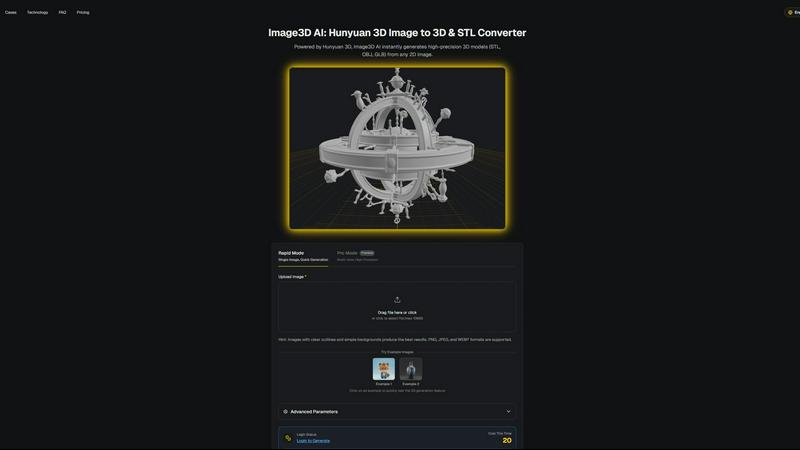
Image3D AI instantly transforms any 2D image into a high-quality 3D model for printing and game development.
Last updated: March 1, 2026
Visual Comparison
conceptviz
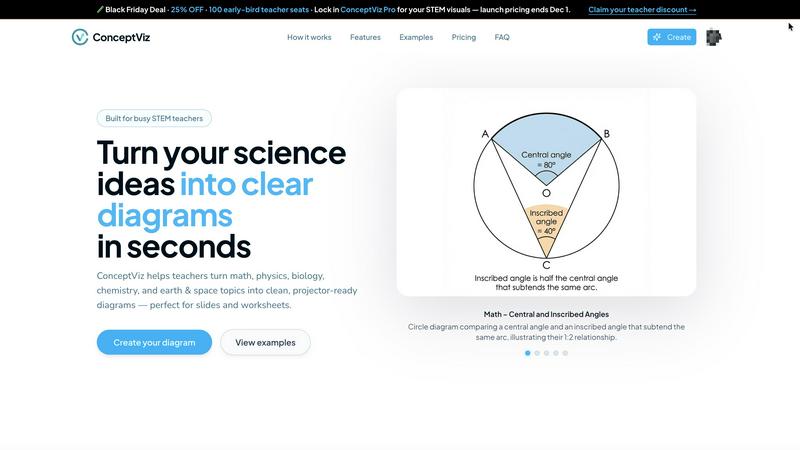
Image3D AI
Feature Comparison
conceptviz
Subject & Grade-Level Presets
ConceptViz is meticulously designed with the classroom in mind, offering a structured starting point through curated subject and grade-level presets. Users can select from core STEM disciplines like Physics, Biology, Chemistry, Earth & Space, and Math, each tuned to specific educational bands such as elementary, middle, and high school. This intelligent scaffolding ensures the generated diagrams are age-appropriate and conceptually aligned with standard curricula, eliminating guesswork and providing a reliable foundation that requires no prior design expertise from the user.
Projector-Ready Clarity & Design
Every diagram generated by ConceptViz is optimized for real-world educational environments. The platform prioritizes functional clarity over decorative flair, producing visuals with thick, legible lines, high-contrast colors, and strategically placed labels. Backgrounds are kept simple and minimal to reduce visual noise, ensuring that diagrams remain crisp and comprehensible even when projected on a large screen from the back of a classroom or printed on a standard worksheet.
Seamless Slide & Worksheet Integration
Understanding the workflow of educators, ConceptViz outputs are engineered for immediate utility. Diagrams are automatically generated in a widescreen aspect ratio ideal for presentation slides in PowerPoint or Google Slides. They are also provided with clean, light backgrounds perfect for printing. Users can download high-resolution PNG files and directly paste them into their existing teaching materials, creating a frictionless bridge between idea generation and classroom implementation.
Plain-English Description to Diagram
The most powerful feature is the intuitive AI interface that converts a user's natural language description into a precise diagram. By simply typing a request like "labeled plant cell cross-section for 8th grade" or "convex lens ray diagram with object between F and 2F," the platform interprets the instructional intent and generates a corresponding visual. This allows educators to create custom diagrams that match their exact teaching explanation, saving hours otherwise spent searching for or manually creating "almost right" images online.
Image3D AI
Powered by Hunyuan 3D Engine
Image3D AI is built upon the robust foundation of Tencent's Hunyuan 3D engine, a state-of-the-art AI technology specifically designed for 3D reconstruction. This engine enables the platform to perform advanced inference from a single 2D image, generating high-precision geometry and textures that rival manually crafted models. The integration of this professional technology into an accessible web interface is what sets the tool apart, delivering studio-quality results without requiring studio-level expertise or computational resources from the end-user.
Dual Generation Modes for Flexibility
The platform offers two distinct operational modes to cater to different project needs and quality requirements. Rapid Mode is optimized for speed and simplicity, generating a 3D model from a single uploaded image in approximately 60 seconds. For scenarios demanding the highest accuracy, such as product replication or detailed asset creation, Pro Mode utilizes multi-view images to perform a physically accurate 3D reconstruction, ensuring dimensional precision and superior detail from every angle.
Multi-Format Export for Any Workflow
Understanding that creators work across diverse software ecosystems, Image3D AI provides exports in all major industry-standard 3D file formats. Users can download their generated models as STL files for immediate 3D printing, OBJ files for editing in traditional 3D software like Blender or Maya, or GLB files for direct use in web applications, AR experiences, and modern game engines like Unity and Unreal Engine, complete with PBR material support.
Intuitive Interface with Guided Best Practices
The tool is designed for immediate usability, featuring a clean, drag-and-drop interface and offering free example images for instant testing without login. Beyond simplicity, it educates users through a comprehensive Best Practices Guide. This resource provides actionable tips on selecting optimal source images, understanding the strengths of each generation mode, and choosing the correct export format, significantly boosting the success rate and quality of conversions for both novices and professionals.
Use Cases
conceptviz
K-12 Classroom Lesson Preparation
Teachers can rapidly generate custom diagrams to enhance daily lessons, populate worksheets, and create engaging presentation slides. For instance, an elementary science teacher can create a clear "Push, Pull & Friction" diagram, while a high school physics instructor can generate a detailed "Block on Incline Free Body Diagram." This use case saves invaluable prep time and provides visuals that perfectly match the teacher's specific pedagogical approach and lesson objectives.
University-Level Instruction & Lectures
Professors and teaching assistants in higher education can use ConceptViz to develop sophisticated diagrams for complex topics in advanced chemistry, biology, physics, and engineering courses. Creating accurate visuals for concepts like acid-base titration setups, mitosis sequences, or mathematical theorems becomes a task of minutes, enhancing lecture clarity and supporting graduate-level instruction without requiring specialized illustration software.
Academic Research & Publication Support
Researchers and graduate students can leverage the tool to create clean, standardized figures for research papers, conference posters, and thesis documents. The ability to generate precise, high-resolution diagrams of experimental setups, theoretical models, or data schematics directly from a descriptive prompt streamlines the publication process and ensures visual consistency and professional quality in academic communications.
Student Study Aid & Project Creation
Students across all levels can use ConceptViz to create their own study guides, clarify challenging concepts through visual representation, and produce high-quality diagrams for school projects and presentations. This active creation process aids in comprehension and retention, empowering learners to visualize and internalize abstract STEM principles in a personally meaningful way.
Image3D AI
Game Development and Digital Content Creation
Game developers, animators, and VR/AR creators can rapidly prototype and produce game-ready 3D assets directly from concept art, sketches, or reference images. This accelerates the pre-production and asset creation pipeline, allowing small teams or indie developers to generate a wide variety of characters, props, and environmental assets with consistent quality, ready for texturing and import into engines like Unity or Unreal.
3D Printing and Prototyping
Hobbyists, engineers, and product designers can instantly convert sketches, diagrams, or photos of objects into printable STL files. This use case is invaluable for rapid prototyping, creating custom figurines, producing spare parts, or visualizing inventions in tangible form. The Geometry-focused generation mode ensures clean, manifold meshes that are optimized for reliable 3D printing without complex manual cleanup.
E-commerce and Product Visualization
Online retailers and marketers can transform flat product photographs into interactive 3D models and AR-ready assets. This enhances online shopping experiences by allowing customers to view products from every angle, inspect details, and even visualize items in their own space through augmented reality, leading to increased engagement, reduced return rates, and higher conversion rates.
Architecture, Design, and Education
Architects and interior designers can quickly generate basic 3D massing models from sketches or site photos for client presentations and early-stage design studies. Educators and students can also use the tool to create visual aids and models for STEM education, making abstract concepts tangible and fostering a hands-on understanding of spatial design and geometry without needing specialized 3D modeling skills.
Overview
About conceptviz
ConceptViz represents a paradigm shift in educational technology, specifically engineered to bridge the gap between complex scientific understanding and clear visual communication. At its core, it is an AI-powered diagram generation platform that transforms abstract STEM concepts into precise, publication-ready visual aids. It serves a critical need for educators, students, and researchers who require accurate, tailored diagrams but lack the time or specialized graphic design skills to create them from scratch. The tool democratizes the creation of high-quality educational visuals, moving beyond generic clipart to produce diagrams that align perfectly with specific curriculum standards, lesson plans, and research narratives. By allowing users to generate diagrams through simple, plain-English descriptions, ConceptViz dramatically reduces lesson preparation time and enhances the pedagogical impact of visual learning. Its value proposition is universal across the educational spectrum: from a K-12 teacher crafting a worksheet on plant biology to a university professor illustrating quantum mechanics or a researcher preparing a journal figure, ConceptViz provides an accessible, efficient, and reliable solution for turning intricate ideas into comprehensible visuals that foster deeper engagement and understanding.
About Image3D AI
Image3D AI represents a paradigm shift in the field of digital creation, democratizing the complex process of 3D modeling through the power of artificial intelligence. At its core, it is a sophisticated online platform that transforms ordinary 2D images into fully-realized, high-fidelity 3D models in a matter of seconds. This is made possible by leveraging Tencent's cutting-edge Hunyuan 3D engine, a professional-grade technology that interprets visual data to construct accurate volumetric representations. The tool is designed for a universal audience, eliminating the steep learning curve and significant time investment traditionally associated with 3D software. Whether you are a game developer needing rapid asset creation, a 3D printing enthusiast turning sketches into tangible objects, an e-commerce professional seeking interactive product displays, or an architect visualizing concepts, Image3D AI serves as your instant conduit from imagination to three-dimensional reality. Its primary value proposition is profound workflow acceleration and creative empowerment, allowing users to bypass technical barriers and focus purely on bringing their innovative ideas to life across various industries and applications.
Frequently Asked Questions
conceptviz FAQ
What subjects and grade levels does ConceptViz support?
ConceptViz is specifically built for STEM education, supporting core subjects including Physics, Biology, Chemistry, Earth & Space, and Mathematics. It is designed to cater to a wide range of educational levels, from elementary school through to high school and university-level instruction. The platform offers presets tuned for U.S. grade bands (elementary, middle, high) to ensure age-appropriate and curriculum-aligned diagram output.
Do I need any design or drawing skills to use ConceptViz?
No, you do not need any design or drawing skills whatsoever. ConceptViz is built precisely for educators and researchers who are experts in their field but not in graphic design. The entire process is driven by simple, plain-English descriptions of the diagram you need. The AI handles the complex task of layout, drawing, and labeling, delivering a professional-quality visual based solely on your descriptive prompt.
What format are the diagrams, and how do I use them in my materials?
Diagrams are generated as high-resolution PNG image files. They are automatically formatted with a widescreen aspect ratio ideal for presentation slides (e.g., PowerPoint, Google Slides) and feature clean, light backgrounds suitable for printing on worksheets. You can simply download the image file and paste or insert it directly into your preferred software, making integration into your existing teaching workflow seamless and instantaneous.
Is there a free trial or a free plan available?
Yes, ConceptViz offers a free tier that allows users to create diagrams without requiring a credit card. This includes access to generate diagrams with 4K Ultra HD quality. This free plan is designed to let educators and researchers experience the platform's core functionality and assess its value for their specific needs before considering any paid subscription or lifetime deal offers.
Image3D AI FAQ
What types of images work best with Image3D AI?
For optimal results, use high-contrast images with clear, well-defined outlines and a simple, uncluttered background. The subject should be in focus with good lighting. Images with blur, complex backgrounds, or objects that are partially obscured will yield less accurate 3D reconstructions. For converting real-world objects, providing multiple views (front, side, top) in Pro Mode is highly recommended for the most physically accurate model.
What is the difference between Rapid Mode and Pro Mode?
Rapid Mode uses AI inference to generate a 3D model from a single image quickly, typically within about 60 seconds. It's ideal for logos, sketches, and concepts where speed is prioritized. Pro Mode is designed for high-precision outcomes; it requires uploading multiple images of an object from different angles (multi-view). This allows the AI to perform a more accurate, dimensionally faithful reconstruction, making it the preferred choice for product photography, engineering parts, or any application where geometric accuracy is critical.
Which file format should I download for my project?
The choice depends on your intended use. Download the .STL format if your goal is 3D printing, as it is the universal standard for slicer software. Choose the .OBJ format if you plan to further edit the model in 3D modeling software like Blender, 3ds Max, or ZBrush. Select the .GLB format for web applications, augmented reality (AR), or modern game engines, as it is a compact, single-file format that contains the model, textures, and materials.
Is there a free trial or any way to test the tool?
Yes, Image3D AI offers a completely free way to test its core functionality. The website provides several "Example Images" that users can click on to instantly trigger the 3D generation process without any login, account creation, or credit cost. This allows anyone to experience the conversion speed and quality firsthand before committing to uploading their own images or purchasing credits.
Alternatives
conceptviz Alternatives
ConceptViz is a specialized AI-powered content creation and data visualization tool designed for the education sector, particularly STEM. It streamlines the process of transforming complex scientific ideas into clear, classroom-ready diagrams, saving educators and researchers valuable time. Users often explore alternatives for various reasons, such as budget constraints, the need for different feature sets like animation or collaborative editing, or a requirement for tools that serve broader design purposes beyond academic diagrams. The search for the right tool is a natural part of finding the perfect fit for one's specific workflow and objectives. When evaluating an alternative, key considerations include the tool's primary focus, its ease of use for non-designers, the quality and style of its output, integration capabilities with other platforms, and of course, its pricing model. The goal is to find a solution that effectively balances power, simplicity, and value for your unique educational or research needs.
Image3D AI Alternatives
Image3D AI is a specialized design tool that transforms 2D images into detailed 3D models, leveraging advanced AI to simplify a traditionally complex process. It caters to creators who need rapid asset generation for 3D printing, game development, and other digital projects, making professional-grade 3D modeling accessible to a wider audience. Users often explore alternatives for various practical reasons. These can include budget constraints, as pricing models differ significantly across the market. Others may seek specific technical features not offered, require integration with a particular software ecosystem, or need a solution that runs on a different platform or operating system. The search for the right tool is a natural part of finding the perfect fit for one's unique workflow and project demands. When evaluating alternatives, it's crucial to consider several key factors. Assess the core technology and the quality of the 3D output it produces. Examine the supported file formats for export to ensure compatibility with your intended use, whether for printing or digital rendering. Also, consider the user experience, the availability of different processing modes for speed versus detail, and the overall value proposition relative to the cost. The goal is to find a tool that aligns with your skill level, project requirements, and creative vision.