
HookMesh vs TrafficClaw
Side-by-side comparison to help you choose the right tool.

HookMesh provides reliable webhook delivery and a self-service portal to streamline your SaaS operations effortlessly.
Last updated: February 28, 2026

TrafficClaw
TrafficClaw transforms your SEO and analytics data into actionable insights through intuitive conversations, empowering you to grow your traffic.
Last updated: April 13, 2026
Visual Comparison
HookMesh
TrafficClaw
Feature Comparison
HookMesh
Reliable Delivery Infrastructure
HookMesh's foundation is its robust delivery engine, which ensures at-least-once delivery for every webhook event. This is achieved through a sophisticated combination of automatic retries with exponential backoff and jitter, preventing thundering herd problems and gracefully handling temporary endpoint failures. The system employs intelligent circuit breakers that automatically disable endpoints exhibiting persistent failures, protecting your system's health and queue integrity, and re-enables them upon signs of recovery. Furthermore, idempotency keys are utilized to guarantee that no event is processed multiple times even if delivery is retried, ensuring data consistency for your customers.
Customer Self-Service Portal
A standout feature is the fully embeddable customer portal, which transforms webhook management from a support burden into a customer empowerment tool. This portal provides your end-users with direct visibility and control over their webhook integrations. Customers can independently add, verify, and manage their destination endpoints. They gain access to detailed delivery logs containing full request and response data, eliminating the need for them to contact your support team to debug issues. Most notably, it includes a one-click replay function, allowing users to instantly retry failed webhook deliveries, drastically reducing resolution time and improving their operational autonomy.
Developer Experience & SDKs
HookMesh is built to be integrated in minutes, not months. It offers a clean, well-documented REST API that provides programmatic access to every facet of the system. To accelerate integration, HookMesh supplies official, fully-supported Software Development Kits (SDKs) for popular languages including JavaScript/Node.js, Python, and Go. These SDKs encapsulate best practices and simplify the process of sending events from your application down to just a few lines of code. Additionally, a webhook playground environment is provided, allowing developers to test event payloads, signatures, and endpoint configurations in a safe sandbox before deploying to production.
Comprehensive Visibility & Management
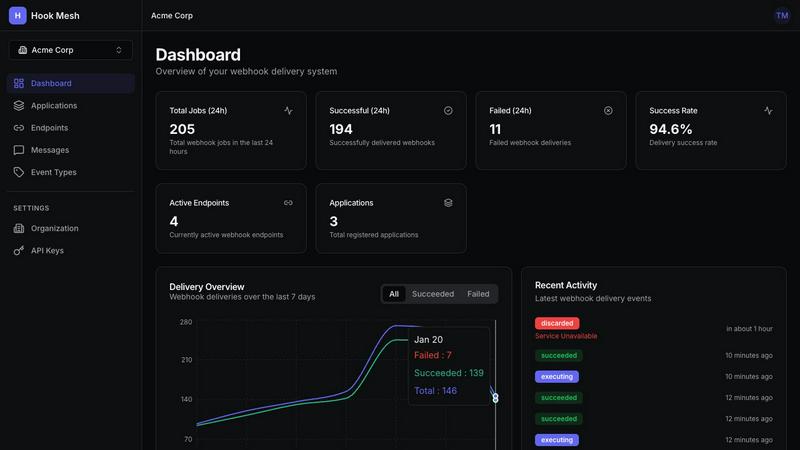
The platform offers deep operational transparency for both your internal team and your customers. You gain a centralized dashboard to monitor overall webhook volume, success rates, and system health. Every webhook event is logged with its complete journey, from ingestion to final delivery status, including all retry attempts and the exact HTTP request and response payloads. This end-to-end visibility is crucial for auditing, compliance, and rapid debugging, turning what is traditionally a black box of log files into a clear, actionable timeline of events.
TrafficClaw
AI Chat
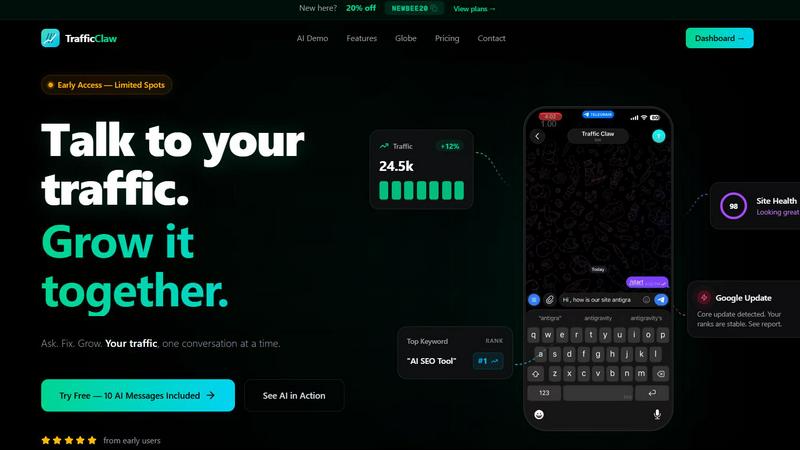
The AI Chat feature allows users to interact with their analytics through natural language queries. Users can ask specific questions about their traffic and receive instant, data-driven answers along with visual charts and actionable insights. This eliminates the need for time-consuming data interpretation and empowers users to make informed decisions quickly.
SEO Intelligence
TrafficClaw's SEO Intelligence feature analyzes a website's performance to uncover keyword gaps, content decay alerts, and issues of keyword cannibalization. Additionally, it includes an Advanced SEO Optimization (AEO) engine that helps users optimize their content for AI-driven search engines, ensuring that they stay ahead in the competitive landscape of online visibility.
Analytics Dashboard
The Analytics Dashboard serves as a comprehensive overview of real-time visitors, traffic trends, bounce rates, and conversion funnels. This centralized view allows users to monitor their website's performance at a glance, making it easier to identify patterns, track progress, and implement strategies for improvement without juggling multiple tools.
Site Audit
TrafficClaw offers a detailed Site Audit feature that conducts in-depth page-level examinations of a website's health. It provides performance scores based on Core Web Vitals and automatically suggests fixes for any identified issues. This proactive approach to site health allows users to maintain optimal performance and enhance user experience.
Use Cases
HookMesh
SaaS Application Event Notifications
Modern SaaS platforms, such as CRM, project management, or marketing automation tools, need to notify connected third-party applications or customer systems about key events like a new user sign-up, a completed transaction, or a updated record. HookMesh reliably delivers these JSON payloads, ensuring that downstream systems are activated in a timely manner. The self-service portal allows each customer to configure their own endpoints for these events, significantly reducing the configuration burden on the SaaS provider's support and engineering teams.
E-commerce and Payment Processing
E-commerce platforms and payment gateways must guarantee the delivery of critical order and payment status updates (e.g., order.completed, payment.failed, invoice.paid) to merchant systems for fulfillment, accounting, and customer communication. A failed webhook can mean a missed shipment or an unrecorded payment. HookMesh's guaranteed delivery with 48-hour retries and one-click replay ensures financial and operational data integrity, providing merchants with the reliability they depend on for their business operations.
DevOps and Infrastructure Automation
Development and operations teams use webhooks to trigger automated pipelines in CI/CD systems, update incident management platforms, or synchronize data across cloud services. The failure of a webhook from a source like GitHub, a monitoring tool, or a database can halt a deployment or obscure a critical alert. HookMesh ensures these automation triggers are delivered, with circuit breakers preventing a failing deployment script from causing cascading failures and queue backups across other automated processes.
Customer Data Synchronization
Companies that offer data aggregation or synchronization services, like customer data platforms (CDPs) or data warehouses, use webhooks to push updated user profiles, behavioral events, or dataset changes to subscribed business tools. Consistent, real-time data sync is vital for accurate analytics and personalized marketing. HookMesh manages the delivery to multiple customer endpoints, handling varying rates of acceptance and providing logs that help diagnose any data format or schema rejection issues on the receiving end.
TrafficClaw
Identifying Traffic Drops
Users experiencing unexpected drops in website traffic can leverage TrafficClaw to quickly diagnose the issue. By asking the AI directly, they receive targeted insights that could point to technical issues, content problems, or changes in search engine algorithms, allowing for swift corrective action.
Optimizing SEO Strategies
Digital marketers can utilize TrafficClaw's SEO Intelligence to refine their content strategies. By revealing keyword gaps and content performance issues, users can create targeted content that fills these gaps and improves their rankings, ultimately driving more organic traffic to their site.
Monitoring Website Health
Website owners can regularly use the Site Audit feature to ensure their site remains in top condition. By receiving automated performance scores and suggestions for improvement, they can proactively address issues before they affect user experience or search rankings.
Enhancing Content Creation
Content creators can harness the power of TrafficClaw’s content tools to generate SEO-optimized blog posts, create schema markup, and refine internal linking strategies. This feature simplifies the content creation process while ensuring that the output is aligned with best SEO practices, helping to attract more visitors.
Overview
About HookMesh
HookMesh is a comprehensive, developer-first platform engineered to solve the universal challenge of reliable webhook delivery for modern software-as-a-service (SaaS) products and digital platforms. At its core, HookMesh provides a battle-tested, managed infrastructure that abstracts away the immense technical complexity and operational overhead associated with building and maintaining an in-house webhook system. It is designed for development teams, product managers, and engineering leaders who need to provide real-time event notifications to their customers but wish to avoid the months of engineering effort required to implement robust retry logic, circuit breakers, and monitoring tools. The platform's primary value proposition is delivering unparalleled peace of mind by guaranteeing that critical business events—such as payment confirmations, data sync triggers, or user activity alerts—are delivered consistently and reliably. By handling the entire delivery lifecycle, from automatic retries with exponential backoff to providing customers with a self-service portal for endpoint management, HookMesh allows businesses to focus their resources on core product innovation rather than the undifferentiated heavy lifting of message queue management and failure debugging.
About TrafficClaw
TrafficClaw is an innovative AI-driven tool designed specifically for website owners, digital marketers, and SEO professionals who are frustrated by sudden drops in website traffic. In a landscape where data analysis often leads to confusion rather than clarity, TrafficClaw stands out by transforming complex analytics into straightforward answers. By seamlessly integrating with Google Analytics 4 (GA4) and Search Console, it allows users to engage in natural conversations about their traffic performance. Instead of sifting through generic advice found in blog posts, users can directly ask questions like "Why did my traffic drop?" and receive data-backed insights that illuminate the underlying issues. TrafficClaw not only identifies problems but also provides actionable solutions, enabling users to implement fixes and grow their traffic effectively. With its intuitive interface and real-time analytics, TrafficClaw democratizes data insights, making it accessible to anyone looking to improve their online presence and traffic metrics.
Frequently Asked Questions
HookMesh FAQ
How does HookMesh ensure webhooks are not delivered more than once?
HookMesh guarantees at-least-once delivery, meaning an event will be delivered at least once, but to prevent duplicates, it employs idempotency keys. When you send an event, you can provide a unique idempotency key. HookMesh's system uses this key to track the event. If a delivery attempt fails and is retried, the platform recognizes the key and ensures the same event payload is not processed and delivered a second time to the customer's endpoint, maintaining data integrity.
Can my customers really manage webhooks without our support team?
Absolutely. The embeddable Customer Portal is designed specifically for this purpose. Your customers can log in to their dedicated portal to add new webhook endpoints (with UI for entering URLs and secret keys), view the complete history of delivery attempts for each event, inspect the exact JSON sent and the HTTP response received, and instantly retry any failed delivery with a single click. This shifts the operational responsibility to the endpoint owner, dramatically reducing support tickets.
What happens if a customer's endpoint is down for an extended period?
HookMesh's retry logic is persistent and intelligent. It will attempt to deliver a webhook for up to 48 hours using an exponential backoff strategy with jitter. If the endpoint continues to fail, the circuit breaker pattern is activated, temporarily pausing delivery to that specific endpoint to protect your queue. Once the endpoint begins responding successfully again, the circuit breaker resets, and delivery resumes. You and your customer are notified of disabled endpoints.
Is there a free plan to try HookMesh?
Yes, HookMesh offers a generous Free tier to get started. It includes 5,000 webhook deliveries per month at no cost and includes all core features like automatic retries, circuit breakers, the customer portal, and access to SDKs. This plan also includes 7-day log retention. No credit card is required to sign up, allowing teams to fully integrate and test the service in their development and staging environments before committing to a paid plan.
TrafficClaw FAQ
How does TrafficClaw analyze my data?
TrafficClaw connects directly to your Google Analytics 4 and Search Console accounts, automatically loading your data. The AI then analyzes this data in real time, allowing for immediate insights and recommendations based on your specific traffic patterns.
Is my data secure with TrafficClaw?
Yes, your data is completely secure. TrafficClaw uses Google OAuth for authentication, ensuring that your information remains private and accessible only to you. Additionally, the platform does not store your data beyond its analysis.
How quickly can I set up TrafficClaw?
Setting up TrafficClaw is incredibly quick and user-friendly. With a simple sign-in using your Google account, the auto-detection feature recognizes your GA4 properties and Search Console sites, making the setup process typically take less than 30 seconds.
Can I use TrafficClaw for multiple websites?
Absolutely. TrafficClaw allows users to connect multiple Google Analytics and Search Console accounts, making it ideal for agencies or individuals managing several websites. You can easily switch between accounts to monitor performance and gain insights across all your projects.
Alternatives
HookMesh Alternatives
HookMesh is a specialized platform in the development and API management category, designed to provide reliable webhook delivery for SaaS companies. It eliminates the need for teams to build and maintain complex in-house webhook infrastructure, offering a managed service that handles retries, debugging, and customer self-service. Users may explore alternatives for various reasons, including budget constraints, specific feature requirements not covered, or a preference for a different deployment model like self-hosting. The need for deeper integration with an existing tech stack or a different pricing structure can also prompt a search for other solutions. When evaluating alternatives, key considerations should include the reliability of delivery guarantees, the quality of developer experience and documentation, the availability of customer-facing tools for endpoint management, and the overall security and compliance posture. The goal is to find a solution that matches your technical requirements and business model without compromising on core delivery assurance.
TrafficClaw Alternatives
TrafficClaw is an innovative tool designed to bridge the gap between users and their SEO and analytics data, allowing for intuitive interaction with complex datasets. As a part of the AI Assistants and Analytics & Data categories, TrafficClaw enables users to ask straightforward questions regarding their web traffic, such as the reasons behind fluctuations, and receive actionable insights. This conversational approach transforms the often overwhelming world of SEO into a more accessible experience. Users often seek alternatives to TrafficClaw for a variety of reasons, including pricing concerns, specific feature requirements, or compatibility with particular platforms. The pursuit of alternatives can stem from the need for enhanced functionality, more robust integrations, or simply a desire to explore different user experiences. When considering an alternative, it is essential to evaluate factors such as ease of use, the breadth of features, customer support, and the ability to adapt to evolving analytics needs.