
Changeflow vs DevHub
Side-by-side comparison to help you choose the right tool.

Changeflow
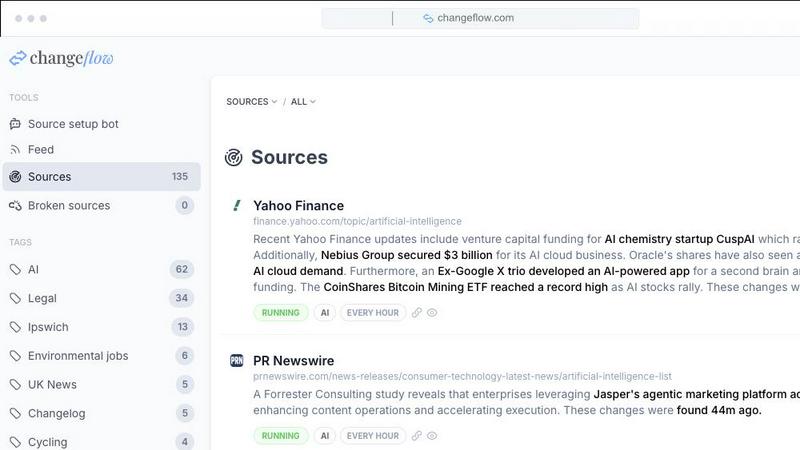
Changeflow uses AI to track and summarize only the critical website changes that matter to your business.
Last updated: March 4, 2026

DevHub is the premier platform where developers discover, submit, and discuss the latest essential tools and innovative.
Last updated: February 28, 2026
Visual Comparison
Changeflow
DevHub
Feature Comparison
Changeflow
AI-Powered Contextual Intelligence
Changeflow's core AI engine does not just detect textual differences; it understands the semantic meaning and context of changes on a page. It filters out irrelevant updates like ad rotations, timestamp refreshes, or minor formatting shifts, focusing only on substantive alterations that align with your described interests. This results in precise, actionable alerts that save you from wasting time deciphering screenshots or reading entire pages to find what truly changed.
Natural Language Setup & Smart Link Following
Setting up monitoring requires no technical expertise, RSS feeds, or complex configuration. You simply describe what you want to track in plain English and provide a starting URL. Changeflow's AI agent can then intelligently follow links from that page, read the target content, determine its relevance based on your instructions, and build a comprehensive, dynamic feed of updates from an entire network of pages, all automated from a single, simple description.
Enterprise-Grade Page Unblocking & Reliability
Built on over a decade of experience, Changeflow features sophisticated anti-blocking technology that reliably accesses content behind login walls, JavaScript-heavy applications, and other complex structures. With a 99.9% success rate on pages where competitors fail, it ensures continuous, uninterrupted monitoring for mission-critical sources like regulatory portals, court dockets, and competitor sites, providing peace of mind for compliance and business intelligence teams.
Collaborative Workspaces & Forensic Change Analysis
The platform is built for team collaboration with shared workspaces that keep everyone synchronized. Coupled with powerful forensic tools like Site Version Control, teams can navigate timestamped archives of any monitored page to see a complete historical record. The interactive change viewer highlights exact modifications, allowing for deep-dive analysis and audit trails, which is essential for legal, compliance, and competitive intelligence documentation.
DevHub
Community-Powered Discovery
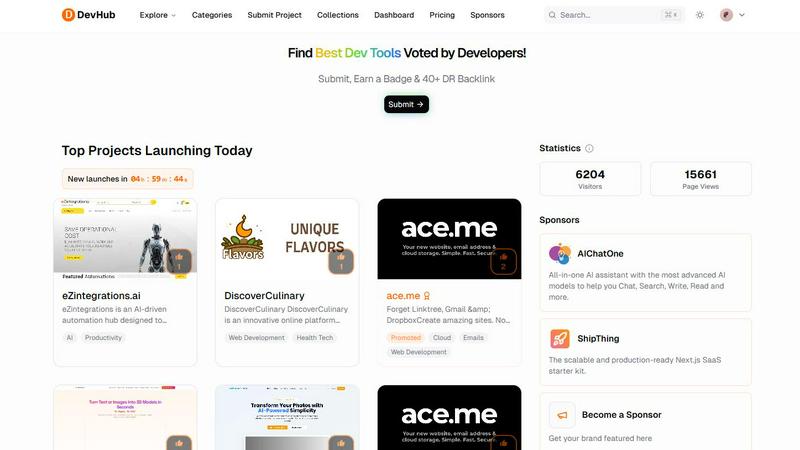
DevHub's foundation is its user-driven submission and voting system. This feature transforms the platform from a static directory into a living, breathing ecosystem. Developers can submit any tech tool or service, and the community collectively votes, ensuring that the most useful, innovative, and reliable resources rise to the top. This democratic process guarantees that the "Top Projects" and trending tools genuinely reflect the community's needs and interests, saving everyone time in their search for quality solutions.
Curated Categories & Collections
To facilitate targeted exploration, DevHub organizes the vast array of submissions into intuitive categories such as AI, SaaS, Mobile Development, and Productivity. Additionally, the platform features curated "Collections," which are thematic groupings of tools. This structured navigation allows users to drill down into specific niches or discover handpicked selections for particular workflows, making it effortless to find exactly what you need without sifting through unrelated content.
Real-Time Project Launches
The platform highlights "Top Projects Launching Today" with a live countdown timer, creating a sense of event and immediacy. This feature is invaluable for early adopters, investors, and developers who want to be among the first to explore and support groundbreaking new tools and services as they enter the market, offering a unique window into the cutting edge of tech innovation.
Contributor Recognition & Benefits
DevHub incentivizes high-quality contributions through a recognition system. Users who submit projects can "Earn a Badge & 40+ DR Backlink," acknowledging their role as a curator and providing tangible SEO value for their own projects or websites. This system rewards active community members and encourages the submission of legitimate, high-potential tools, thereby enriching the platform's resource pool for all users.
Use Cases
Changeflow
Competitive Intelligence & Pricing Monitoring
Business and marketing teams use Changeflow to automatically track competitor websites for changes in pricing, product specifications, promotional offers, and strategic announcements. The AI filters out noise and delivers summarized alerts, enabling companies to react swiftly to market movements and adjust their strategies proactively, ensuring they never miss a critical update that could impact market share or revenue.
Legal & Regulatory Compliance Tracking
Legal librarians and compliance officers at top-tier firms monitor court dockets, regulatory bodies (like the SEC, FDA, or FTC), and legislation portals. Changeflow reliably accesses these often-complex sites, detects new filings, guidance updates, or case citations, and provides clear summaries. This ensures teams are immediately aware of new obligations, deadlines, or legal precedents, mitigating risk and maintaining rigorous compliance standards.
News & Brand Mention Monitoring
Communications and PR teams leverage Changeflow to follow news sites, industry blogs, and review platforms for mentions of their company, executives, or key products. By turning these pages into an intelligent feed, the platform surfaces relevant articles and discussions in real-time, allowing teams to manage brand reputation, engage with media, and measure the impact of their campaigns effectively.
Market Research & Due Diligence
Investment analysts, consultants, and business development professionals monitor industry reports, company websites, and market data sources for signals of change, such as executive turnover, partnership announcements, or financial updates. Changeflow's ability to follow links and summarize key information from vast networks of pages transforms scattered public data into a structured stream of actionable intelligence for research and decision-making.
DevHub
For Developers Seeking Optimal Tools
A developer tasked with choosing a new database, testing framework, or API service can bypass endless search engine results and biased reviews. By browsing DevHub's voted categories and reading authentic community discussions, they can quickly identify trusted, peer-recommended options that have been vetted by fellow professionals, significantly streamlining their research and decision-making process.
For Founders & Makers Launching Products
A startup founder launching a new SaaS product can submit it to DevHub to gain initial visibility and traction within a targeted tech-savvy audience. The platform acts as a launchpad, where early votes and positive discussions can generate crucial early adopters, valuable feedback, and backlinks, providing a powerful boost in a product's critical early stages.
For Tech Enthusiasts & Learners
Individuals looking to stay updated on industry trends or expand their technical knowledge can use DevHub as a daily digest of innovation. By exploring new launches and reading the rationale behind community votes and comments, they gain insight into what makes a tool valuable, emerging technology patterns, and the practical needs of the development community.
For Community Managers & Evangelists
A developer advocate or community manager for a large tech company can use DevHub to monitor the perception of their tools, engage in discussions to provide support, and discover complementary or competing services. It serves as a vital pulse-check on the developer ecosystem, enabling proactive community engagement and strategic market awareness.
Overview
About Changeflow
Changeflow is an advanced web monitoring and change detection platform engineered to transform the overwhelming task of tracking online information into a manageable, intelligent, and actionable process. It moves far beyond simple page-watching tools that merely alert you "something changed." Instead, Changeflow employs sophisticated AI to read, comprehend, and contextualize web page content, delivering concise summaries of only the meaningful updates that matter to your specific objectives. The platform is designed for professionals and teams who rely on timely, accurate information from the web to make critical business decisions, ensure compliance, and maintain competitive advantage. Its core value proposition lies in eliminating manual checks, reducing informational noise, and providing reliable, AI-filtered intelligence from even the most complex and challenging websites, all through an intuitive, natural language interface. Trusted by Fortune 500 and Am Law 200 firms, Changeflow combines enterprise-grade reliability with powerful, user-centric features to save thousands of customer hours and monitor over a billion pages with a remarkable 99.9% success rate at accessing content other tools cannot reach.
About DevHub
DevHub is a comprehensive, community-driven platform meticulously designed for the global developer and technology enthusiast community. It serves as a central hub for discovering, evaluating, and discussing the vast ecosystem of tools, libraries, frameworks, APIs, and SaaS products that define the modern technological landscape. The platform's core mission is to democratize innovation by providing a space where the most valuable and impactful tech solutions can surface through collective intelligence. Users are empowered to actively shape this ecosystem by submitting new projects they've built or discovered and by voting on existing submissions, ensuring that visibility is earned through genuine community merit. Beyond discovery, DevHub fosters meaningful engagement through discussions, allowing for deeper analysis, shared experiences, and collaborative problem-solving. Whether you are a seasoned engineer seeking the next breakthrough tool to optimize your stack, a founder launching a new product, or a newcomer eager to learn about current trends, DevHub offers an inclusive and dynamic environment to stay informed, contribute knowledge, and connect with a worldwide network of peers who are equally passionate about the future of technology.
Frequently Asked Questions
Changeflow FAQ
How does Changeflow differ from traditional website monitoring tools?
Traditional tools typically take screenshots or detect raw HTML changes, flooding you with alerts for every minor update, including irrelevant ones. Changeflow uses AI to understand the content and context of a page. It reads the page like a human would, identifies what the substantive changes are based on your instructions, and provides a concise summary of only the important updates, dramatically reducing noise and saving you significant time.
Can Changeflow monitor websites that require a login or are built with complex JavaScript?
Yes, this is a key strength of the platform. Changeflow employs advanced, enterprise-grade anti-blocking and rendering technology developed over a decade. It can navigate login walls, execute JavaScript, and handle dynamic content with a 99.9% success rate, reliably monitoring pages that are inaccessible to many other simpler monitoring tools, which is crucial for tracking secure portals, web applications, and modern interactive sites.
How do I set up a monitoring task, and is it technically complex?
Setup is intentionally simple and requires no technical skills. You describe what you care about in plain English (e.g., "Monitor this competitor's homepage for price changes on their flagship product") and provide the starting URL. Changeflow's AI agent interprets your request, handles the configuration, and begins intelligent tracking. You can also use the chatbot to add multiple pages rapidly or import large lists via CSV for bulk operations.
How are notifications delivered, and can they be integrated into other workflows?
Notifications are delivered to your centralized Changeflow dashboard feed and can be sent via email to multiple addresses. For advanced workflow integration, the platform offers API access and compatibility with Zapier, allowing you to push alerts and summaries into thousands of other business applications like Slack, Microsoft Teams, CRM systems, or internal databases, ensuring critical information reaches the right place at the right time.
DevHub FAQ
How does the voting system work on DevHub?
The voting system is a core mechanic designed to surface quality content. Any registered user can upvote projects they find valuable, useful, or promising. Projects with higher votes gain more prominence on category pages, the homepage, and in "Top Projects" lists. This community-driven curation ensures the platform's content is constantly refined by its users' collective expertise and experience.
What are the benefits of submitting my project to DevHub?
Submitting your project offers multiple benefits. Primarily, it exposes your tool to a large, targeted audience of developers and early adopters who are actively seeking new solutions. Successful submissions can drive traffic, generate valuable user feedback, and create early buzz. Furthermore, submitters can earn a profile badge and a quality backlink, which aids in search engine optimization and establishes credibility.
Is there a cost to use DevHub for browsing or submitting?
Based on the available information, the core functions of DevHub—browsing categories, voting on projects, and participating in discussions—appear to be free. The platform also offers a "Submit Project" feature, and while some platforms charge for this, the current context does not specify any submission fees, suggesting it is likely a free community contribution model.
How are the "Collections" different from "Categories"?
Categories are broad, fundamental classifications like "AI" or "Mobile Development" that all submissions are tagged with for basic filtering. Collections, however, are more nuanced and curated. They are thematic lists compiled by the DevHub team or community, such as "Best Developer Tools for Startups" or "Open-Source Alternatives," designed to tell a specific story or solve a particular problem beyond simple categorization.
Alternatives
Changeflow Alternatives
Changeflow is an AI-driven market and competitor insights platform, specializing in intelligent web monitoring and change detection. It belongs to the broader category of business intelligence and productivity tools designed to automate competitive analysis and regulatory tracking. Users may explore alternatives for various reasons, such as budget constraints, specific feature requirements not covered by their current plan, or a need for deeper integration with existing enterprise platforms like CRM or project management software. Others might seek simpler tools for basic website diffs or more specialized solutions for niche use cases like social media listening. When evaluating alternatives, key considerations include the depth of AI analysis, the ability to handle complex, JavaScript-heavy sites and login-protected content, the flexibility of alerting and reporting features, and the overall value in terms of time saved versus cost. The ideal solution should not only detect changes but also contextualize them, turning raw data into actionable business intelligence.
DevHub Alternatives
DevHub is a community-driven platform within the developer tools and resources discovery category. It serves as a central hub where technology professionals can explore, submit, and discuss the latest software tools, libraries, and services, all curated through a collaborative voting system. Users may seek alternatives for various reasons, including specific feature requirements, different pricing models, a need for a more specialized or broader focus, or a preference for a different community dynamic or user interface. The search often stems from a desire to find a platform that aligns more closely with their individual workflow or discovery habits. When evaluating alternatives, key considerations include the depth and quality of the community, the platform's categorization and search capabilities, the transparency of its ranking or recommendation algorithms, and the overall user experience. The ideal platform should not only surface relevant tools but also foster meaningful engagement and knowledge sharing among its users.