
Agent to Agent Testing Platform vs RedVeil
Side-by-side comparison to help you choose the right tool.

Agent to Agent Testing Platform
TestMu AI is the unified platform that autonomously validates AI agents for safety and performance across all.
Last updated: February 28, 2026

RedVeil
RedVeil delivers rapid AI-driven penetration testing to identify vulnerabilities and generate actionable reports in.
Last updated: February 28, 2026
Visual Comparison
Agent to Agent Testing Platform
RedVeil
Feature Comparison
Agent to Agent Testing Platform
Autonomous Multi-Agent Test Generation
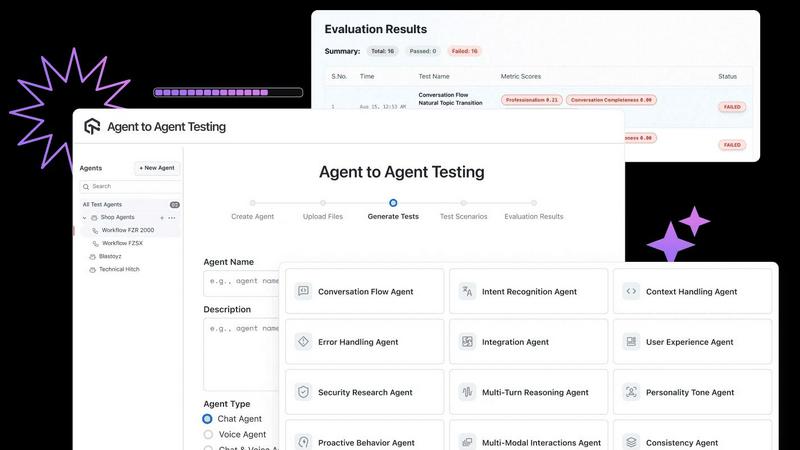
The platform employs a sophisticated ensemble of over 17 specialized AI agents, each designed to probe different aspects of an agent's performance. These synthetic agents autonomously generate and execute a vast array of test scenarios, simulating diverse personas and interaction patterns. This goes far beyond scripted tests, dynamically creating conversations to uncover subtle failures in intent recognition, reasoning, tone, escalation logic, and agent handoffs that would be missed by traditional or manual testing methods.
True Multi-Modal Understanding and Testing
Moving beyond text-only evaluation, the platform offers true multi-modal testing capabilities. Testers can define requirements or upload Product Requirement Documents (PRDs) that include diverse inputs like images, audio files, and video. The testing framework gauges the AI agent's expected output against these rich, real-world inputs, ensuring the agent under test can accurately interpret and respond to the full spectrum of communication modalities it will encounter in production.
Diverse Persona Simulation for Real-World Validation
To ensure AI agents perform effectively for all user types, the platform provides a library of diverse, configurable personas. Testers can leverage personas such as the "International Caller," "Digital Novice," or "Frustrated Customer" to simulate a wide range of end-user behaviors, cultural contexts, technical proficiencies, and emotional states. This feature guarantees that the agent's performance is robust and empathetic across the entire spectrum of its intended user base.
Actionable Evaluation with Risk Scoring
Following test execution, the platform delivers deep, actionable insights through detailed evaluation reports. It analyzes key business metrics, conversational flow, and interaction dynamics, providing scores on critical dimensions like effectiveness, accuracy, empathy, and professionalism. Crucially, it includes a regression testing suite with intelligent risk scoring, which highlights potential areas of concern and prioritizes critical issues, allowing teams to optimize their debugging and improvement efforts efficiently.
RedVeil
AI-Driven Penetration Testing
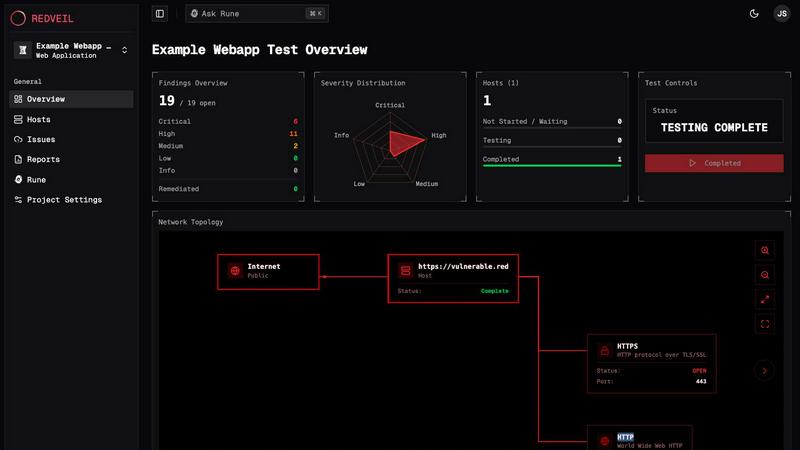
RedVeil employs intelligent AI agents that are capable of reasoning through multi-step attack chains, simulating human-like vulnerabilities assessments. This ensures a thorough examination of your systems with the precision and speed that manual testing cannot match.
One-Click Retesting
The One-Click Retesting feature allows users to quickly verify the remediation of identified vulnerabilities. This flexibility enables teams to address issues as they arise, ensuring that security measures keep pace with rapid code deployments, ultimately enhancing security without unnecessary delays.
Compliance-Ready Reporting
With RedVeil, generating professional audit-ready reports is simplified to a one-click process. These reports are tailored for various compliance standards, including SOC 2, ISO 27001, and PCI-DSS, ensuring that organizations can easily meet regulatory requirements without extensive additional work.
Guided Remediation Support
RedVeil provides clear context, reproduction steps, and remediation guidance for each identified issue. This feature empowers security teams and developers alike to understand vulnerabilities deeply and implement effective fixes, fostering a culture of continuous improvement in security practices.
Use Cases
Agent to Agent Testing Platform
Pre-Production Validation of Customer Service Chatbots
Enterprises can deploy the platform to rigorously validate new or updated customer service chatbots before a full production rollout. By simulating thousands of synthetic customer interactions—from simple FAQ queries to complex, multi-issue troubleshooting—teams can identify failures in logic, inappropriate tones, hallucinated information, and compliance violations, ensuring a reliable and professional customer experience from day one.
Compliance and Safety Assurance for Voice Assistants
For voice-activated agents in sensitive industries like finance or healthcare, the platform is critical for ensuring compliance and safety. It autonomously tests for policy adherence, data privacy leaks, and biased responses within voice conversations. The framework validates proper escalation to human agents when necessary and checks that all verbal interactions meet strict regulatory and ethical standards, mitigating legal and reputational risk.
End-to-End Regression Testing for AI Agent Updates
Development teams can integrate the platform into their CI/CD pipelines to perform comprehensive regression testing every time an AI agent's model, prompts, or knowledge base is updated. The autonomous test suite re-runs a battery of scenarios to catch regressions in performance, intent recognition, or conversational flow. The integrated risk scoring helps teams quickly understand the impact of changes and prioritize fixes.
Performance Benchmarking Across Multiple AI Agents
Organizations evaluating different AI models or vendor solutions can use the platform as an objective benchmarking tool. By running the same battery of standardized test scenarios—assessing metrics like bias, toxicity, hallucination rates, and task effectiveness—against multiple agents, teams can gather quantitative, comparable data to make informed decisions about which AI agent best meets their quality and performance thresholds.
RedVeil
Rapid Security Assessments for Agile Teams
RedVeil is particularly beneficial for agile software development teams that deploy code frequently. By enabling rapid penetration tests, teams can ensure that new features do not introduce vulnerabilities, helping maintain a secure software environment.
Compliance Verification
Organizations aiming for compliance with industry standards can utilize RedVeil to perform regular penetration tests and generate necessary reports. This ensures that compliance requirements are met efficiently, reducing the risk of non-compliance penalties.
Continuous Security Monitoring
RedVeil allows businesses to retest their systems regularly whenever there are changes in their environment. This proactive approach to security enables teams to identify and mitigate risks before they can be exploited, ensuring ongoing protection.
Training and Development for Security Teams
Security teams can leverage RedVeil's detailed reporting and guided remediation features as a training tool. By understanding how vulnerabilities were identified and how to fix them, teams can enhance their skills and knowledge, ultimately leading to a more robust security posture.
Overview
About Agent to Agent Testing Platform
The Agent to Agent Testing Platform represents a fundamental evolution in quality assurance, purpose-built for the unique challenges of the agentic AI era. As AI systems transition from static, rule-based tools to dynamic, autonomous agents, traditional testing methodologies become obsolete. This platform is a first-of-its-kind, AI-native framework designed to validate the behavior, reliability, and safety of AI agents—including chatbots, voice assistants, and phone caller agents—within real-world, multi-turn conversational environments. It moves beyond simple prompt checks to evaluate complex interactions across chat, voice, and multimodal experiences, ensuring agents perform as intended before they are deployed into production. The core value proposition lies in its autonomous, multi-agent testing approach, which leverages a suite of specialized AI agents to simulate thousands of diverse user interactions, uncovering critical edge cases, policy violations, and long-tail failures that manual testing cannot feasibly detect. It is engineered for enterprises and development teams who are serious about deploying trustworthy, robust, and effective AI agentic systems at scale, providing a unified platform for comprehensive behavioral validation, risk assessment, and performance optimization.
About RedVeil
RedVeil is an innovative AI-powered penetration testing platform designed to meet the demands of modern software development and security needs. Traditional penetration testing often involves lengthy processes and substantial costs, which can hinder fast-paced engineering teams. RedVeil revolutionizes this approach by combining the analytical reasoning of human hackers with the rapid execution capabilities of artificial intelligence. With RedVeil, users can initiate a comprehensive and autonomous penetration test within minutes, allowing for swift identification of vulnerabilities and actionable insights. This platform is ideal for organizations seeking to enhance their cybersecurity posture while maintaining agility in their development cycles, providing an efficient solution that produces audit-ready reports in just hours.
Frequently Asked Questions
Agent to Agent Testing Platform FAQ
What makes Agent-to-Agent Testing different from traditional software QA?
Traditional QA is designed for deterministic, rule-based software with predictable inputs and outputs. Agentic AI, however, is non-deterministic and operates in open-ended conversational spaces. Agent-to-Agent Testing is built for this paradigm, using AI agents to test other AI agents through dynamic, multi-turn conversations. It evaluates emergent behaviors, contextual understanding, and ethical alignment—dimensions that static test scripts cannot effectively assess, providing validation for the autonomy and unpredictability inherent in modern AI systems.
What types of AI agents can be tested with this platform?
The platform is designed as a unified testing solution for a wide range of AI agent implementations. This includes text-based conversational agents (chatbots), voice assistants (like IVR systems or smart device assistants), phone caller agents that handle inbound/outbound calls, and hybrid multimodal agents that process combinations of text, image, audio, and video inputs. Essentially, any AI system that engages in interactive dialogue with users can be validated.
How does the platform handle test scenario creation?
Test scenario creation is both automated and customizable. The platform's core AI agents can autonomously generate diverse, production-like test cases based on high-level requirements or uploaded documentation. Additionally, users have access to a library of hundreds of pre-built scenarios and can create fully custom scenarios tailored to specific business processes, user journeys, or edge cases they need to validate, offering flexibility and comprehensive coverage.
Can the platform integrate with existing development workflows?
Yes, the platform is built for seamless integration into modern DevOps and MLOps pipelines. It offers native integration with TestMu AI's HyperExecute for large-scale, parallel test execution in the cloud, fitting directly into CI/CD cycles. This allows teams to automatically trigger agent validation suites on every code or model commit, receiving actionable evaluation reports and risk scores within minutes to maintain continuous quality assurance.
RedVeil FAQ
Does RedVeil perform a real penetration test?
Yes, RedVeil conducts genuine penetration tests using AI-driven agents that simulate the actions of human attackers, identifying real vulnerabilities within your systems.
How many penetration tests can I do with my annual subscription?
The number of penetration tests you can conduct varies by subscription tier. For instance, the Perimeter plan allows for up to 500 Agent Ops annually, accommodating multiple tests throughout the year.
Is there a chance that my web application or network could go down during the test?
RedVeil is designed to minimize the risk of downtime during assessments. However, as with any penetration testing, it is advisable to monitor critical systems closely during the testing period.
Can I use RedVeil's penetration test reports to meet the requirements of my compliance?
Absolutely. RedVeil generates audit-ready reports that are suitable for various compliance requirements, including SOC 2, ISO 27001, and PCI-DSS, helping ensure your organization remains compliant with industry standards.
Alternatives
Agent to Agent Testing Platform Alternatives
Agent to Agent Testing Platform is a pioneering solution in the AI-native quality assurance category, specifically designed to validate the complex, autonomous behavior of AI agents across diverse channels like chat, voice, and phone. It addresses the critical need for a dynamic testing framework that traditional, static software QA methods cannot fulfill. Users often explore alternatives for various reasons, including budget constraints, specific feature requirements not covered by a single platform, or the need for a solution that integrates seamlessly with their existing technology stack and development workflows. The search for the right tool is a common step in the procurement process. When evaluating alternatives, it is crucial to look for a solution that offers comprehensive, multi-turn conversation validation, scalable automated testing capabilities, and robust security and compliance risk detection. The ideal platform should provide deep behavioral analysis beyond simple prompt checks, ensuring AI agents perform reliably and safely in production environments.
RedVeil Alternatives
RedVeil is an innovative solution in the realm of penetration testing, leveraging the capabilities of agentic AI to provide on-demand services that identify vulnerabilities in software systems. As organizations increasingly adopt agile methodologies and deploy code at a rapid pace, traditional penetration testing methods often fall short, leading users to seek alternatives that can deliver effective results more efficiently. Common reasons for exploring alternatives include concerns about pricing, the need for specific features that align with unique organizational requirements, or compatibility with existing platforms and workflows. When evaluating potential alternatives, users should consider factors such as the speed of testing, the depth and quality of the findings, the flexibility of scheduling, and the comprehensiveness of the reporting capabilities.