
Activepieces vs Agent to Agent Testing Platform
Side-by-side comparison to help you choose the right tool.

Activepieces
Activepieces empowers teams to automate workflows seamlessly across apps with no coding required, enhancing.
Last updated: March 1, 2026

Agent to Agent Testing Platform
TestMu AI is the unified platform that autonomously validates AI agents for safety and performance across all.
Last updated: February 28, 2026
Visual Comparison
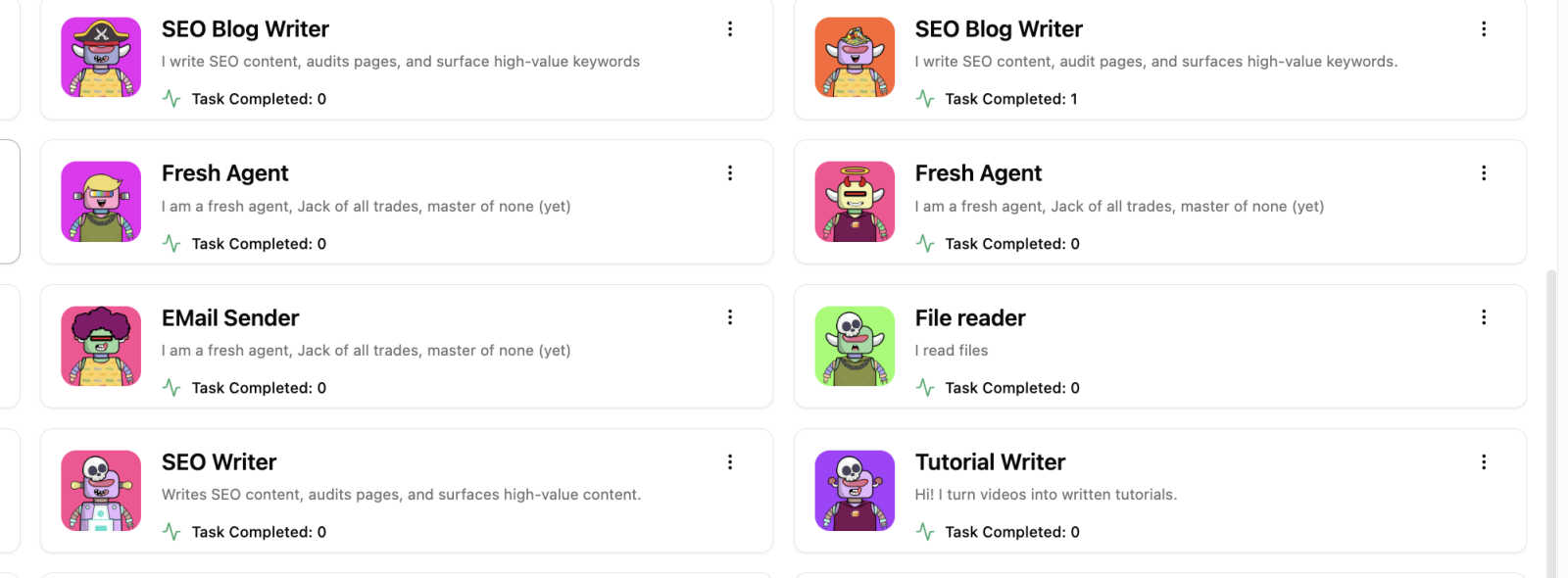
Activepieces
Agent to Agent Testing Platform
Feature Comparison
Activepieces
Visual Flow Builder
Activepieces features an intuitive visual flow builder that allows users to design workflows effortlessly. This drag-and-drop interface simplifies the creation of complex automations, making it accessible for users without technical expertise.
Extensive Integration Support
With over 638 integrations available, Activepieces connects seamlessly with numerous applications and services. Users can automate tasks across diverse platforms like Gmail, Slack, and HubSpot, ensuring comprehensive workflow automation tailored to their needs.
AI Agent Creation
The platform enables users to build sophisticated AI agents designed to operate autonomously or collaboratively. These agents can handle intricate tasks, such as lead qualification and customer communication, increasing overall productivity.
Control & Governance
Activepieces provides robust control and governance features, including role-based access control and audit logs. This ensures that enterprises can maintain security and compliance while empowering teams to leverage AI tools effectively.
Agent to Agent Testing Platform
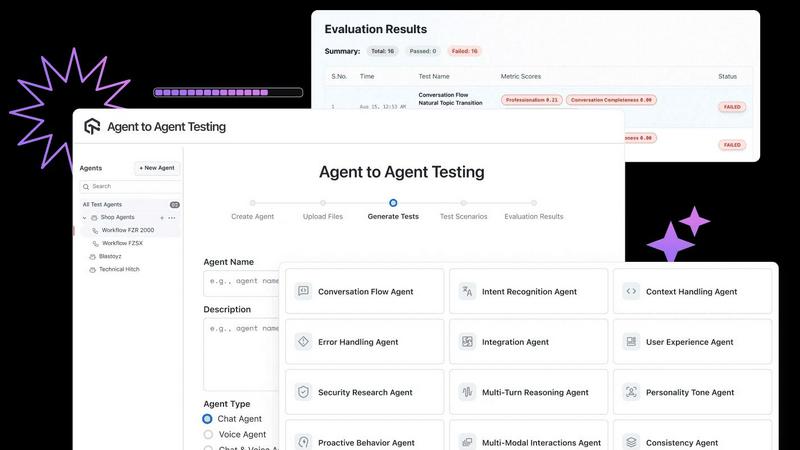
Autonomous Multi-Agent Test Generation
The platform employs a sophisticated ensemble of over 17 specialized AI agents, each designed to probe different aspects of an agent's performance. These synthetic agents autonomously generate and execute a vast array of test scenarios, simulating diverse personas and interaction patterns. This goes far beyond scripted tests, dynamically creating conversations to uncover subtle failures in intent recognition, reasoning, tone, escalation logic, and agent handoffs that would be missed by traditional or manual testing methods.
True Multi-Modal Understanding and Testing
Moving beyond text-only evaluation, the platform offers true multi-modal testing capabilities. Testers can define requirements or upload Product Requirement Documents (PRDs) that include diverse inputs like images, audio files, and video. The testing framework gauges the AI agent's expected output against these rich, real-world inputs, ensuring the agent under test can accurately interpret and respond to the full spectrum of communication modalities it will encounter in production.
Diverse Persona Simulation for Real-World Validation
To ensure AI agents perform effectively for all user types, the platform provides a library of diverse, configurable personas. Testers can leverage personas such as the "International Caller," "Digital Novice," or "Frustrated Customer" to simulate a wide range of end-user behaviors, cultural contexts, technical proficiencies, and emotional states. This feature guarantees that the agent's performance is robust and empathetic across the entire spectrum of its intended user base.
Actionable Evaluation with Risk Scoring
Following test execution, the platform delivers deep, actionable insights through detailed evaluation reports. It analyzes key business metrics, conversational flow, and interaction dynamics, providing scores on critical dimensions like effectiveness, accuracy, empathy, and professionalism. Crucially, it includes a regression testing suite with intelligent risk scoring, which highlights potential areas of concern and prioritizes critical issues, allowing teams to optimize their debugging and improvement efforts efficiently.
Use Cases
Activepieces
Streamlining Lead Qualification
Sales teams can utilize Activepieces to create AI agents that automatically qualify leads based on predefined criteria. This reduces manual effort and ensures that only the most promising leads are pursued, ultimately increasing conversion rates.
Enhancing Customer Communication
Activepieces can facilitate personalized communication by deploying AI agents that respond to customer inquiries across various channels. This automation improves response times and customer satisfaction while freeing up human resources for more complex tasks.
Automating Reporting Processes
Organizations can use Activepieces to automate the generation and distribution of reports. By setting up flows that gather data from multiple sources, users can save time and ensure that stakeholders receive timely insights without manual intervention.
Optimizing Project Management
Project managers can leverage Activepieces to create customized workflows that track project milestones and deadlines. AI agents can send reminders, update stakeholders, and ensure that projects stay on schedule, enhancing overall efficiency.
Agent to Agent Testing Platform
Pre-Production Validation of Customer Service Chatbots
Enterprises can deploy the platform to rigorously validate new or updated customer service chatbots before a full production rollout. By simulating thousands of synthetic customer interactions—from simple FAQ queries to complex, multi-issue troubleshooting—teams can identify failures in logic, inappropriate tones, hallucinated information, and compliance violations, ensuring a reliable and professional customer experience from day one.
Compliance and Safety Assurance for Voice Assistants
For voice-activated agents in sensitive industries like finance or healthcare, the platform is critical for ensuring compliance and safety. It autonomously tests for policy adherence, data privacy leaks, and biased responses within voice conversations. The framework validates proper escalation to human agents when necessary and checks that all verbal interactions meet strict regulatory and ethical standards, mitigating legal and reputational risk.
End-to-End Regression Testing for AI Agent Updates
Development teams can integrate the platform into their CI/CD pipelines to perform comprehensive regression testing every time an AI agent's model, prompts, or knowledge base is updated. The autonomous test suite re-runs a battery of scenarios to catch regressions in performance, intent recognition, or conversational flow. The integrated risk scoring helps teams quickly understand the impact of changes and prioritize fixes.
Performance Benchmarking Across Multiple AI Agents
Organizations evaluating different AI models or vendor solutions can use the platform as an objective benchmarking tool. By running the same battery of standardized test scenarios—assessing metrics like bias, toxicity, hallucination rates, and task effectiveness—against multiple agents, teams can gather quantitative, comparable data to make informed decisions about which AI agent best meets their quality and performance thresholds.
Overview
About Activepieces
Activepieces is an innovative open-source platform designed to democratize the creation and deployment of intelligent, autonomous AI agents. This transformative ecosystem empowers users, regardless of their technical background, to automate complex and repetitive workflows without any coding requirements. At its core, Activepieces features a visual, intuitive builder that allows users to create "Flows" and sophisticated "AI Agents" that connect seamlessly with over 621 applications and services, including popular tools like Gmail, Slack, and various CRMs and databases. Whether you are a non-technical business user looking to enhance efficiency or a developer seeking a customizable and secure automation framework, Activepieces caters to a universal audience. Its main value proposition transcends basic task automation by enabling collaborative, multi-agent systems. Here, AI agents can operate independently or work together to manage intricate processes such as lead qualification, personalized outreach, and client onboarding. With the integration of Model Context Protocols (MCPs), Activepieces further enhances its capabilities, allowing users to convert popular large language models (LLMs) into actionable agents. Whether operating in the cloud, self-hosted, or embedded into other platforms, Activepieces provides a robust, enterprise-ready solution for building AI-powered systems that boost operational efficiency, reduce human error, and unlock unprecedented levels of productivity.
About Agent to Agent Testing Platform
The Agent to Agent Testing Platform represents a fundamental evolution in quality assurance, purpose-built for the unique challenges of the agentic AI era. As AI systems transition from static, rule-based tools to dynamic, autonomous agents, traditional testing methodologies become obsolete. This platform is a first-of-its-kind, AI-native framework designed to validate the behavior, reliability, and safety of AI agents—including chatbots, voice assistants, and phone caller agents—within real-world, multi-turn conversational environments. It moves beyond simple prompt checks to evaluate complex interactions across chat, voice, and multimodal experiences, ensuring agents perform as intended before they are deployed into production. The core value proposition lies in its autonomous, multi-agent testing approach, which leverages a suite of specialized AI agents to simulate thousands of diverse user interactions, uncovering critical edge cases, policy violations, and long-tail failures that manual testing cannot feasibly detect. It is engineered for enterprises and development teams who are serious about deploying trustworthy, robust, and effective AI agentic systems at scale, providing a unified platform for comprehensive behavioral validation, risk assessment, and performance optimization.
Frequently Asked Questions
Activepieces FAQ
How does Activepieces support non-technical users?
Activepieces is designed with a user-friendly, visual interface that allows non-technical users to create automations and workflows without writing any code. This accessibility empowers anyone in the organization to leverage AI tools.
Can I host Activepieces on my own servers?
Yes, Activepieces offers a self-hosting option that allows organizations to run the platform on their own infrastructure. This ensures data security and compliance with specific regulatory requirements.
What types of applications can I integrate with Activepieces?
Activepieces supports integration with over 638 applications, including popular platforms like Gmail, Slack, Notion, and various CRMs. This extensive connectivity allows users to automate workflows across their entire tech stack.
Is there a trial available for Activepieces?
Yes, Activepieces offers a free trial for users to explore the platform's features and capabilities. Interested users can start with the trial to experience firsthand how Activepieces can enhance their workflows before committing to a plan.
Agent to Agent Testing Platform FAQ
What makes Agent-to-Agent Testing different from traditional software QA?
Traditional QA is designed for deterministic, rule-based software with predictable inputs and outputs. Agentic AI, however, is non-deterministic and operates in open-ended conversational spaces. Agent-to-Agent Testing is built for this paradigm, using AI agents to test other AI agents through dynamic, multi-turn conversations. It evaluates emergent behaviors, contextual understanding, and ethical alignment—dimensions that static test scripts cannot effectively assess, providing validation for the autonomy and unpredictability inherent in modern AI systems.
What types of AI agents can be tested with this platform?
The platform is designed as a unified testing solution for a wide range of AI agent implementations. This includes text-based conversational agents (chatbots), voice assistants (like IVR systems or smart device assistants), phone caller agents that handle inbound/outbound calls, and hybrid multimodal agents that process combinations of text, image, audio, and video inputs. Essentially, any AI system that engages in interactive dialogue with users can be validated.
How does the platform handle test scenario creation?
Test scenario creation is both automated and customizable. The platform's core AI agents can autonomously generate diverse, production-like test cases based on high-level requirements or uploaded documentation. Additionally, users have access to a library of hundreds of pre-built scenarios and can create fully custom scenarios tailored to specific business processes, user journeys, or edge cases they need to validate, offering flexibility and comprehensive coverage.
Can the platform integrate with existing development workflows?
Yes, the platform is built for seamless integration into modern DevOps and MLOps pipelines. It offers native integration with TestMu AI's HyperExecute for large-scale, parallel test execution in the cloud, fitting directly into CI/CD cycles. This allows teams to automatically trigger agent validation suites on every code or model commit, receiving actionable evaluation reports and risk scores within minutes to maintain continuous quality assurance.
Alternatives
Activepieces Alternatives
Activepieces is an innovative open-source platform designed to harness the power of AI for automating tasks across a wide range of applications, catering to users who prefer a no-code approach. It allows individuals and organizations to create intelligent, autonomous AI agents that can manage intricate workflows, making it appealing to both non-technical users and developers alike. Many users seek alternatives to Activepieces for various reasons, including pricing structures, specific feature sets, or the need for compatibility with certain platforms. When considering alternatives, it’s essential to evaluate factors such as ease of use, the breadth of integrations, customization options, and overall scalability to ensure the chosen solution aligns with specific automation needs and business objectives.
Agent to Agent Testing Platform Alternatives
Agent to Agent Testing Platform is a pioneering solution in the AI-native quality assurance category, specifically designed to validate the complex, autonomous behavior of AI agents across diverse channels like chat, voice, and phone. It addresses the critical need for a dynamic testing framework that traditional, static software QA methods cannot fulfill. Users often explore alternatives for various reasons, including budget constraints, specific feature requirements not covered by a single platform, or the need for a solution that integrates seamlessly with their existing technology stack and development workflows. The search for the right tool is a common step in the procurement process. When evaluating alternatives, it is crucial to look for a solution that offers comprehensive, multi-turn conversation validation, scalable automated testing capabilities, and robust security and compliance risk detection. The ideal platform should provide deep behavioral analysis beyond simple prompt checks, ensuring AI agents perform reliably and safely in production environments.