
ScopeGuard vs ScopeSnap
Side-by-side comparison to help you choose the right tool.

ScopeGuard uses AI to track scope creep and protect your freelance revenue from unpaid work.
Last updated: February 28, 2026

ScopeSnap
ScopeSnap uses AI to transform your project discovery notes into structured scopes and client-ready proposals in minutes.
Last updated: March 18, 2026
Visual Comparison
ScopeGuard

ScopeSnap
Feature Comparison
ScopeGuard
AI-Powered Scope Analysis
At the heart of ScopeGuard is its sophisticated artificial intelligence engine, which provides instant, accurate analysis of project boundaries. Users can paste contract text, upload PDFs, or import proposals, and the AI instantly extracts and catalogs scope items. When a client makes a new request, the AI compares it against the defined project scope with 95% accuracy, delivering an instant verdict on whether the request is in or out of scope, effectively acting as a vigilant contract lawyer.
Seamless Chrome Extension
ScopeGuard integrates directly into your daily workflow with its powerful Chrome extension. This tool allows freelancers to check scope compliance from any webpage, whether it's an email, project management tool, or messaging platform. With a simple right-click, users can import contract text or verify client requests instantly, ensuring that scope monitoring is always just a click away without disrupting their established work processes.
Built-In Client Approval Portal
The platform streamlines the often-awkward process of requesting additional payment. ScopeGuard generates secure, professional approval links that can be sent directly to clients. Clients can review the out-of-scope request and its associated cost, then approve it with a single click. This formalizes the change request process, creates a clear audit trail, and significantly increases the likelihood of getting paid for extra work.
Centralized Revenue Protection Dashboard
ScopeGuard provides a single, real-time command center where freelancers can monitor all their projects. The dashboard offers a clear overview of unbilled work, pending client approvals, and potential scope creep across every engagement. This holistic view ensures that no dollar slips through the cracks, transforming project management from reactive to proactively profit-protecting.
ScopeSnap
AI-Powered Scope Generation
ScopeSnap's core intelligence lies in its ability to ingest unstructured discovery materials. By simply pasting in call transcripts, email threads, or meeting notes, the AI analyzes the content to automatically generate a structured project backlog. It identifies key themes and breaks them down into logical epics and individual scope items, creating an immediate, organized foundation for estimation and planning that would otherwise take hours to assemble manually.
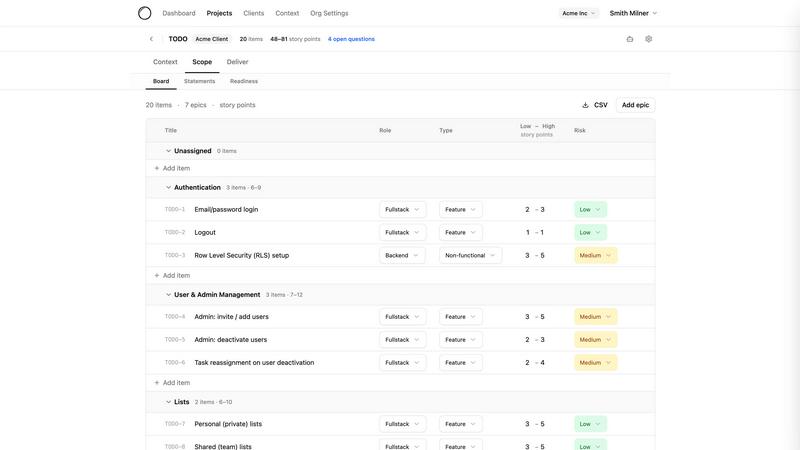
Interactive Scope Refinement & Estimation Board
The platform provides a dynamic, interactive board where the AI-generated scope can be reviewed, edited, and refined. Users can assign roles, set time estimates for each task, and directly address the open questions and assumptions flagged by the AI. This collaborative environment allows for iterative refinement until every feature is well-understood and confidently estimated, ensuring complete alignment before presenting to the client.
Automated Proposal & SOW Document Creation
Once the scope is finalized, ScopeSnap eliminates the need to write proposals from scratch. With a single click, it automatically generates a polished, client-ready Proposal or Statement of Work document. This document is populated with the structured scope, estimates, assumptions, and defined deliverables, presenting a professional and comprehensive agreement that can be sent directly to the client for review and signature.
Centralized Discovery Context Hub
ScopeSnap serves as a single source of truth for all project discovery artifacts. It allows teams to consolidate all relevant materials--transcripts, notes, emails--in one place linked directly to the project scope. This ensures that every scope item and assumption is traceable back to the original client conversation, providing invaluable context for the team and strengthening the defensibility of the project's defined parameters.
Use Cases
ScopeGuard
For Web and Graphic Designers
Designers frequently face iterative client requests that blur the lines of initial mockups and deliverables. ScopeGuard allows them to paste their original design brief and contract. When a client asks for "just one more revision" or an additional page layout, the AI instantly determines if this falls outside the agreed scope, enabling the designer to confidently initiate a change order and get paid for the extra creative work.
For Marketing Consultants and Copywriters
Marketing projects often evolve with new content formats or campaign extensions. A consultant can use ScopeGuard to define the scope of a social media campaign. If the client later requests an unplanned white paper or a series of extra email newsletters, ScopeGuard identifies this as out-of-scope work, allowing the consultant to formally present the additional value and secure approval before proceeding.
For Software Developers and Programmers
Development projects are highly susceptible to feature creep. A developer can upload their project specification into ScopeGuard. When feature requests or "small tweaks" arise during development, the Chrome extension can instantly check them against the original spec. This provides objective, data-backed evidence to discuss timeline and budget adjustments with the client, protecting the developer from unbilled hours of complex work.
For Freelancers Managing Multiple Retainer Clients
For freelancers on monthly retainers, defining what is included within the fixed fee is critical. ScopeGuard helps meticulously document the retainer's boundaries. Any request that exceeds the monthly allotment of hours or predefined tasks is flagged. This makes it easy to track overage charges and provide clients with transparent, justifiable invoices for additional services rendered.
ScopeSnap
For Freelance Developers Securing New Projects
Independent developers can use ScopeSnap to quickly and professionally respond to client inquiries after discovery calls. Instead of spending a full day crafting an estimate and proposal, they can transform their notes into a structured scope and formal document in under an hour, impressing clients with their clarity and professionalism while dramatically speeding up their sales cycle.
For Software Agencies Standardizing Client Onboarding
Agencies handling multiple concurrent client engagements can implement ScopeSnap to standardize their scoping process. It ensures consistency in how project requirements are captured, broken down, and estimated across different project managers and teams, leading to more accurate forecasting, reduced scope creep, and a higher-quality, reliable client experience from the very first interaction.
For Consultants Defining Project Boundaries
Technical consultants who need to define the boundaries of an advisory or implementation engagement can leverage ScopeSnap to create clear Statements of Work. The AI helps ensure all deliverables, phases, and assumptions are explicitly documented, which is crucial for fixed-scope or time-boxed consulting agreements, protecting both the consultant and the client from misunderstandings.
For Development Teams Transitioning from Sales to Delivery
ScopeSnap bridges the gap between the sales conversation and the execution team. The detailed, structured backlog generated during the sales phase becomes the immediate foundation for the development team's sprint planning. This seamless handoff prevents information loss and gives developers a clear, pre-vetted task list to start building from, accelerating time-to-production.
Overview
About ScopeGuard
ScopeGuard is a revolutionary AI-powered platform engineered to solve one of the most persistent and financially draining challenges in the freelance and independent contractor economy: scope creep. Scope creep, the insidious expansion of project requirements beyond the original agreement, is a silent profit killer, with industry data revealing that the average freelancer forfeits over $5,000 annually to unbilled extra work. ScopeGuard directly confronts this issue by providing a comprehensive, intelligent system to define, monitor, and bill for project scope changes. It acts as a digital contract guardian, empowering service providers to confidently manage client requests and ensure they are compensated for every hour of work performed. The core value proposition is transformative: it turns ambiguous, unbilled labor into clearly defined, client-approved, and invoiced revenue. By integrating seamlessly into existing workflows via a browser extension and a centralized dashboard, ScopeGuard moves beyond simple time tracking to intelligently analyze project boundaries, facilitate transparent client communication, and automate the billing process for out-of-scope tasks. Ultimately, it is dedicated to safeguarding a freelancer's most valuable assets—their time and their earnings.
About ScopeSnap
ScopeSnap is an AI-powered platform designed to fundamentally transform the initial, often chaotic, phase of custom software development: project scoping and proposal creation. It directly addresses the critical pain point faced by freelance developers, consultants, and software agencies: the inefficient and risky transition from discovery conversations to a clear, actionable, and client-ready project definition. The core value proposition of ScopeSnap lies in its ability to automate and structure this process, turning scattered notes, call transcripts, and vague ideas into a meticulously organized project backlog, accurate time estimates, and professionally formatted proposals or statements of work (SOW). By leveraging artificial intelligence, ScopeSnap acts as a collaborative scoping partner that helps surface assumptions, identify open questions, and break down complex project ideas into discrete, estimatable tasks. This not only saves practitioners hours of manual, tedious work but also significantly de-risks projects by ensuring nothing is missed and scope is mutually understood before work begins. Ultimately, ScopeSnap empowers development professionals to move from ambiguous discussions to confident, transparent agreements with clients in a fraction of the traditional time, fostering trust and setting the stage for successful project delivery.
Frequently Asked Questions
ScopeGuard FAQ
How does the AI scope checking work?
ScopeGuard's AI is trained to understand the language of project proposals, contracts, and work agreements. When you input your project scope, it parses the text to identify key deliverables, tasks, and boundaries. When a client request is submitted for analysis, the AI compares the semantic meaning and intent of the request against the cataloged scope items, determining alignment with high accuracy. It does not store your sensitive contract data after processing.
How does client approval work?
When the AI identifies an out-of-scope request, ScopeGuard enables you to generate a secure, shareable link. This link leads to a professional summary page for your client, detailing the original scope, the new request, and the proposed fee or adjustment. The client can review this and click a button to approve it digitally. This approval is then logged in your dashboard, creating a formal record and triggering the next steps, such as invoice generation.
Is my contract data secure?
Yes, security is a paramount concern. ScopeGuard employs enterprise-grade security protocols. Your sensitive contract and proposal documents are processed with high levels of encryption. As stated, the AI performs its analysis without permanently storing the raw text of your contracts on its servers, ensuring your confidential business agreements remain protected.
How is this different from time tracking tools?
Traditional time tracking tools only record how long you work; they do not judge whether that work was part of the original agreement. ScopeGuard complements time trackers by adding a layer of intelligent contract analysis. It answers the critical question: "Should this time be billed to the original project, or is it a new billable item?" It focuses on the definition of work, not just its duration, ensuring you bill for the right things.
ScopeSnap FAQ
What kind of input does ScopeSnap need to generate a scope?
ScopeSnap is designed to work with the raw, unstructured output from your discovery process. The most effective inputs include transcripts from discovery calls or meetings, email chains discussing requirements, and any notes you've taken. The AI analyzes this textual context to identify project goals, features, and requirements to build the initial structured backlog.
How accurate are the AI-generated estimates?
ScopeSnap uses AI to break down the project into logical, estimatable tasks, but the actual time or cost estimates are applied by you, the expert. The platform provides the structure and prompts for estimation, but it relies on your professional judgment to assign realistic values based on complexity, known technologies, and your team's velocity, ensuring the final numbers are credible.
Can I edit the scope and proposals that ScopeSnap creates?
Absolutely. ScopeSnap is designed as a collaborative starting point, not a rigid, automated output. The entire scope board is fully editable--you can add, remove, or modify tasks, change estimates, and rewrite descriptions. The generated proposals are also fully customizable, allowing you to adjust language, terms, and formatting to match your brand and the specific client engagement.
Is ScopeSnap suitable for very large or complex enterprise projects?
Yes, ScopeSnap is built to handle projects of varying complexity. For large enterprise projects, it excels at creating a high-level structured overview and identifying major workstreams or phases. It helps manage complexity by breaking down large ideas into core epics and surfacing critical assumptions and open questions early, which is essential for planning multi-stage engagements.
Alternatives
ScopeGuard Alternatives
ScopeGuard is an AI-powered platform within the project management and freelance operations category, designed to protect service providers from revenue loss due to scope creep. It intelligently monitors project boundaries and facilitates the billing of out-of-scope work, transforming ambiguous requests into billable revenue. Users may explore alternatives for various reasons, including budget constraints, specific feature requirements not covered by a single solution, or the need for integration with a particular set of existing tools. The search often stems from a desire to find a system that aligns perfectly with an individual's workflow, business model, and client management philosophy. When evaluating alternatives, key considerations should include the tool's core methodology for defining and tracking scope, its ability to integrate seamlessly into your daily communication channels, and the robustness of its features for client communication and change order management. The ideal solution should not only identify scope deviations but also provide a clear, professional framework for addressing them and protecting your profitability.
ScopeSnap Alternatives
ScopeSnap is a productivity and project management tool designed to streamline the initial phases of custom software development. It uses AI to help professionals transform unstructured discovery notes into clear project scopes, accurate estimates, and professional client proposals. This category of software is essential for consultants and agencies looking to reduce risk and save time during the critical scoping and sales process. Users may explore alternatives to ScopeSnap for various reasons. Common considerations include budget constraints and specific pricing models, the need for different or more advanced feature sets, or integration requirements with an existing tech stack. Some may seek a platform with a different user experience or one that caters to a broader or more niche range of project types beyond software development. When evaluating alternatives, it's crucial to assess how well a solution addresses the core challenge of turning vague ideas into actionable, estimatable plans. Key factors include the tool's ability to facilitate iterative scope refinement, the quality and customizability of its output documents, and the overall efficiency it brings to your proposal workflow. The right choice should align with your specific operational needs and business scale.