
Fusedash vs iGPT
Side-by-side comparison to help you choose the right tool.

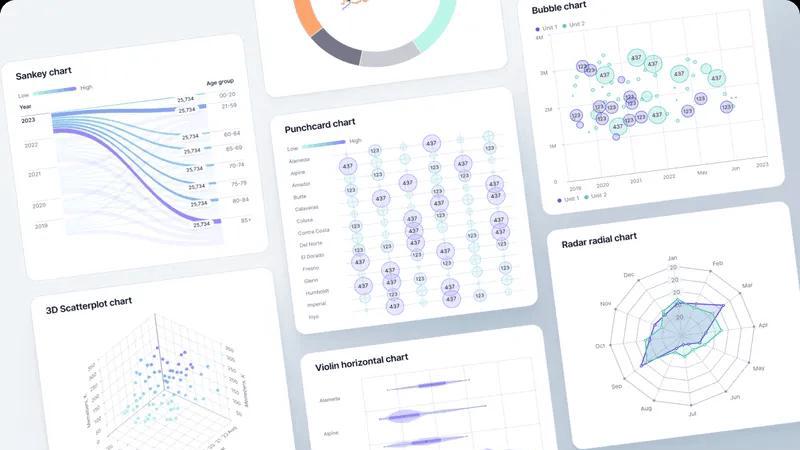
Fusedash transforms raw data into clear dashboards and charts for instant team insights and action.
Last updated: March 4, 2026

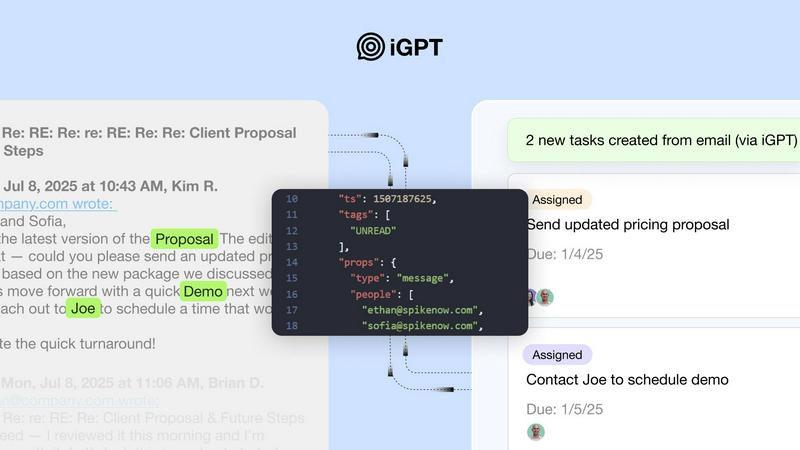
iGPT transforms messy email data into trusted, context-aware answers for enterprise workflows and AI agents.
Last updated: March 1, 2026
Visual Comparison
Fusedash
iGPT
Feature Comparison
Fusedash
Unified AI Visualization Workspace
Fusedash consolidates the entire data reporting workflow into one intuitive environment. Instead of juggling separate tools for dashboards, charts, maps, and reports, teams can create all these views from the same connected dataset. This unified approach means you build your data logic and KPIs a single time, then deploy them across interactive dashboards for monitoring, detailed charts for analysis, narrative reports for stakeholders, and even real-time monitoring interfaces. The platform's flexibility allows for custom layouts, filters, and time ranges, ensuring each audience gets the precise view they need without duplicating effort or compromising data consistency.
AI-Powered Chart Generator
This feature accelerates the initial step of data exploration and presentation. Users can instantly generate clear, accurate visualizations by simply uploading a CSV file or connecting to an API. The AI assists in selecting the most appropriate chart type for the data, applying meaningful comparisons, and refining labels to ensure the visual tells the correct story. These AI-generated charts can serve as powerful standalone visuals for quick reports or be seamlessly integrated into larger, more comprehensive dashboards, providing a fast track from raw data to understandable insight.
Intelligent Data Chat & Exploration
Fusedash incorporates a conversational AI interface that allows users to interact with their data using plain language. When unsure where to begin or needing a specific breakdown, users can ask questions like "What were sales by region last quarter?" or "Show me a breakdown of user churn by plan." The smart chat interprets these queries, explores the data, and provides suggested metrics, charts, and visual breakdowns. Crucially, these insights can be instantly transformed into permanent, shareable dashboard views, making advanced data analysis accessible to every team member regardless of their technical expertise.
Flexible Data Integration & Management
The platform is built to handle diverse data sources with ease, eliminating the need to rebuild analyses across different systems. Users can upload static CSVs, connect live data via APIs, and even enrich their views with relevant public datasets for added context, such as geographic or market data. Fusedash acts as a central hub where these datasets are organized, combined for unified views, and—most importantly—made reusable across every chart, dashboard, and report. This ensures data integrity and saves significant time in data preparation and management.
iGPT
Unified Intelligence Endpoint
iGPT consolidates the entire complexity of email intelligence into one simple API call. Instead of managing separate systems for retrieval, context building, and reasoning, developers send a single natural language request. This unified endpoint handles semantic and keyword search, thread reconstruction, attachment processing, and optimal context shaping automatically, delivering a ready-to-use, structured response in seconds. This dramatically reduces development time and maintenance overhead.
Advanced Context Engineering Framework (CEF)
At the heart of iGPT is a sophisticated framework that automatically engineers the perfect context from chaotic email data. It intelligently processes and indexes messages and attachments in real-time, reconstructs full conversation threads across participants and time, and extracts text and data from documents like PDFs and spreadsheets. The system then optimizes this information for your LLM, eliminating the need for manual prompt tuning and ensuring responses are deeply contextual and accurate.
Enterprise-Grade Security & Auditability
iGPT is built with a zero-trust security model from the ground up. It guarantees zero data training, meaning your information is never used to improve models. It employs strict OAuth-based Role-Based Access Control (RBAC) for every request and operates on a zero data retention policy, processing inferences solely in memory. Furthermore, it provides a comprehensive audit trail, ensuring every answer is fully traceable back to its source messages and attachments for complete compliance.
Real-Time Ingestion & Hybrid Retrieval
The platform ensures your AI agents operate on the most current information by indexing new emails and attachments instantly as they arrive. Its retrieval system employs a powerful hybrid approach, combining semantic understanding, keyword matching, and configurable filters. These results are then intelligently scored and reranked within a single pipeline, ensuring the most relevant snippets from vast mailboxes are surfaced with high precision and speed.
Use Cases
Fusedash
Executive Leadership Reporting
For C-suite executives and department heads, Fusedash provides a high-level, consistent view of organizational health. Leaders can access a unified dashboard that combines financial, operational, and customer KPIs from various sources into a single narrative. The storytelling and reporting features add crucial context to the numbers, explaining what changed, why it matters, and what the proposed next steps are. This eliminates the need for manually compiled slide decks and ensures all leadership discussions are grounded in the same verified data.
Marketing Campaign Performance Analysis
Marketing teams can use Fusedash to move beyond scattered analytics tools. They can connect data from ad platforms, CRM systems, and web analytics into one workspace to build comprehensive campaign dashboards. The AI chart generator helps quickly visualize conversion trends and ROI, while the ability to drill down allows them to segment performance by channel, audience, or geographic region. This enables rapid, data-driven optimization of campaigns and clear reporting of results to stakeholders.
Operational Real-Time Monitoring
Operations and support teams require live visibility into key processes. Fusedash's real-time interface capabilities allow for the creation of live monitoring dashboards that track metrics like system uptime, ticket volume, or supply chain status. Teams can see issues as they emerge, and the drill-down functionality helps quickly diagnose root causes by examining specific time periods or operational segments, enabling faster response and resolution.
Cross-Departmental Strategic Alignment
Fusedash acts as the single source of truth that bridges departmental silos. Sales, finance, and product teams can all build their specific views—from sales pipelines and revenue charts to user engagement maps—from the same core dataset with consistent metric definitions. This shared foundation prevents conflicts arising from different data interpretations, fosters transparency, and aligns all teams around common organizational goals and KPIs, driving cohesive strategic action.
iGPT
AI-Powered Email Assistants
Organizations can build intelligent agents that draft, prioritize, summarize, and act on email with full historical and attachment context. These assistants can manage inboxes, highlight urgent threads, and generate draft replies based on the complete conversation history and related files, turning individual productivity tools into powerful, context-aware copilots for entire teams.
Automated Workflow & Task Management
iGPT enables the automation of routine workflow processes directly from email threads. It can automatically parse conversations to identify decisions, extract action items, assign owners, and set deadlines. It can also flag stalled discussions or pending approvals, seamlessly turning email dialogues into structured tasks in project management or CRM systems without manual intervention.
Customer Support & Success Copilots
Support and customer success teams can leverage iGPT to instantly rebuild a customer's entire story. The API can analyze long, complex email chains with multiple participants and shifting tones, alongside all attached tickets and documents, to provide support agents with a immediate, comprehensive summary of the issue, past interactions, and agreed-upon solutions, drastically reducing resolution time.
Compliance, Auditing, & CRM Intelligence
For compliance-sensitive industries, iGPT creates an immutable link between AI-generated insights and their source material. It can trace feedback, approvals, and rationale directly back to the original email and attachment, providing a clear audit trail. Similarly, sales teams can use it to extract deal momentum, key decisions, and stakeholder sentiment directly from email threads to enrich CRM records.
Overview
About Fusedash
Fusedash represents a paradigm shift in how modern organizations interact with their data, moving beyond fragmented tools to a unified, intelligent workspace. It is an AI-powered data visualization platform engineered to transform raw, connected data into clear, actionable insights that drive alignment and decisive action. At its core, Fusedash solves the pervasive problem of data inconsistency and manual reporting fatigue by providing a single source of truth. Teams can define their key metrics and KPIs once and then reuse those consistent definitions across every dashboard, chart, map, and narrative report. This ensures that everyone from executive leadership and marketing teams to operations specialists is interpreting the same trusted numbers, eliminating conflicting data stories and endless cycles of reconciliation. Designed for agility, Fusedash empowers users to not only monitor real-time performance through dynamic interfaces but also to deeply understand the 'why' behind the numbers by drilling down into specific segments, regions, or time periods. By integrating advanced AI capabilities like natural language data chat and smart visualization assistance, it dramatically lowers the barrier to sophisticated data exploration. Fusedash is the comprehensive solution for teams seeking to replace a patchwork of disconnected tools with a cohesive platform that turns data into a strategic asset for storytelling, monitoring, and informed decision-making.
About iGPT
iGPT is a pioneering email intelligence API engineered to bridge the critical gap between enterprise email data and modern AI-driven workflows. In a business landscape where email remains the central nervous system for communication, collaboration, and decision-making, traditional AI systems often fail to navigate its inherent complexity—long threads, nested attachments, and fragmented conversations. iGPT solves this by providing a secure, auditable, and unified gateway that transforms raw, messy email data into trusted, context-aware intelligence. Designed for forward-thinking enterprises, it serves as the foundational layer for agentic systems, enabling them to access, comprehend, and act upon information locked within email exchanges and their associated documents. Its core value proposition lies in simplifying the immense technical challenge of email context engineering, offering a single API call that replaces the need for manual parsing, chunking, indexing, and complex prompt tuning. This empowers organizations across sales, customer success, recruiting, and compliance to deploy sophisticated AI assistants and automation with confidence, enhancing productivity, streamlining operations, and maintaining stringent standards of privacy and data governance.
Frequently Asked Questions
Fusedash FAQ
What types of data sources can I connect to Fusedash?
Fusedash is designed for flexibility in data integration. You can start by uploading static data files like CSVs or Excel sheets. For live, updating data, you can connect directly to a wide variety of sources using API connections. The platform also allows you to combine multiple datasets, including enriching your views with public data, to create comprehensive and context-rich analyses without needing to switch between different tools.
How does the AI Chart Generator work?
The AI Chart Generator simplifies the initial visualization process. After you provide your dataset via CSV or API, the AI analyzes the structure and content of your data. It then suggests the most appropriate and effective chart types (e.g., line charts for trends, bar charts for comparisons) to represent your information clearly. You maintain full control to refine the suggestions, add filters, apply comparisons, and adjust labels to ensure the final visual accurately communicates the intended story.
Can I control who sees which dashboards and reports?
Yes, Fusedash is built for collaborative yet controlled sharing. You can create different views—from high-level executive dashboards to detailed team-specific reports—from the same consistent data. These views can then be shared with specific stakeholders, teams, or the entire organization. This ensures that each audience receives information tailored to their needs while maintaining underlying data integrity and security permissions.
What is the benefit of having dashboards and reports in one workspace?
The primary benefit is efficiency and consistency. Traditionally, teams build dashboards in one tool and then manually recreate the data in slides or documents for reporting, leading to errors and version control issues. Fusedash eliminates this duplication. You build your metrics once, and then use them for both real-time monitoring dashboards and narrative, context-driven reports. This "define once, use everywhere" philosophy saves immense time and guarantees that everyone is aligned with the same numbers and insights.
iGPT FAQ
How does iGPT ensure the security and privacy of our email data?
iGPT is architected with enterprise-grade security as a core principle. It adheres to a strict zero data training policy, so your data is never used to train or improve any AI models. All processing is done with OAuth-enforced Role-Based Access Control, and the system operates on a zero data retention model—inputs, prompts, and outputs are processed in memory and never stored. Full audit trails ensure all activity is traceable and compliant.
What makes iGPT different from building our own email parsing and retrieval system?
Building a robust, in-house email intelligence system requires significant investment in parsing complex MIME structures, chunking text, managing vector databases, continuously tuning retrieval algorithms, and engineering prompts for context. iGPT abstracts all this complexity away. It provides a single, unified API that handles real-time ingestion, hybrid retrieval, thread reconstruction, and automatic context shaping, allowing your team to focus on building agent logic rather than maintaining fragile data pipelines.
Can iGPT process attachments, and what file types are supported?
Yes, deep attachment processing is a fundamental capability. iGPT automatically extracts text, data, and structural information from a wide variety of documents attached to emails. This includes common formats such as PDFs, Word documents, Excel spreadsheets, PowerPoint presentations, and plain text files, integrating their content seamlessly into the contextual understanding of the email thread.
How quickly can we integrate iGPT and start getting results?
Integration is designed to be immediate and straightforward. iGPT provides a comprehensive SDK, a live playground for testing API requests and responses in real-time, and support for popular frameworks like LangChain. You can connect your email data sources, and with a single API call, begin receiving contextual answers, often seeing first results in a matter of minutes, not weeks.
Alternatives
Fusedash Alternatives
Fusedash is an AI-powered data visualization and business intelligence platform. It serves as a unified workspace where teams can transform raw data from various sources into consistent dashboards, interactive charts, and narrative reports. The core aim is to create a single, trusted source of truth that drives organizational alignment and informed action. Users often explore alternatives for a variety of practical reasons. These can include budget constraints, the need for specific integrations with an existing tech stack, or requirements for more advanced or niche analytical capabilities. Some teams may also seek solutions with different user experience philosophies or deployment options, such as on-premise versus cloud-based models. When evaluating alternatives, it's crucial to consider several key factors. Look for a platform's ability to connect to your essential data sources and its scalability as your data grows. Assess the ease of use for both creators and viewers, the depth of visualization and reporting features, and the strength of collaboration tools. Ultimately, the right choice should empower your entire team with consistent, accessible insights that streamline decision-making.
iGPT Alternatives
iGPT is a specialized business intelligence platform that transforms enterprise email data into actionable, context-aware insights. It serves as a secure API for integrating AI-driven analysis directly into sales, customer success, and compliance workflows, enabling smarter agentic systems and more efficient operations. Users often explore alternatives for a variety of strategic reasons. These can include specific budget constraints, the need for different feature sets beyond email intelligence, or requirements for integration with a broader or different set of existing platforms and data sources within their tech stack. The search for a different solution is a natural part of finding the optimal fit for an organization's unique operational landscape. When evaluating potential solutions, key considerations should include the depth and security of data handling, the flexibility and power of the API for custom integrations, and the system's ability to provide transparent, auditable insights. The ideal platform will not only offer robust intelligence but will also align with stringent compliance standards and adapt seamlessly to evolving business processes.