
echoloc vs Fallom
Side-by-side comparison to help you choose the right tool.

Echoloc uncovers buying signals in job posts, enabling sales teams to target companies ready to invest.
Last updated: February 28, 2026

Fallom provides complete observability and control for your AI agents and LLM applications.
Last updated: February 28, 2026
Visual Comparison
echoloc
Fallom
Feature Comparison
echoloc
Real-Time Job Posting Analysis
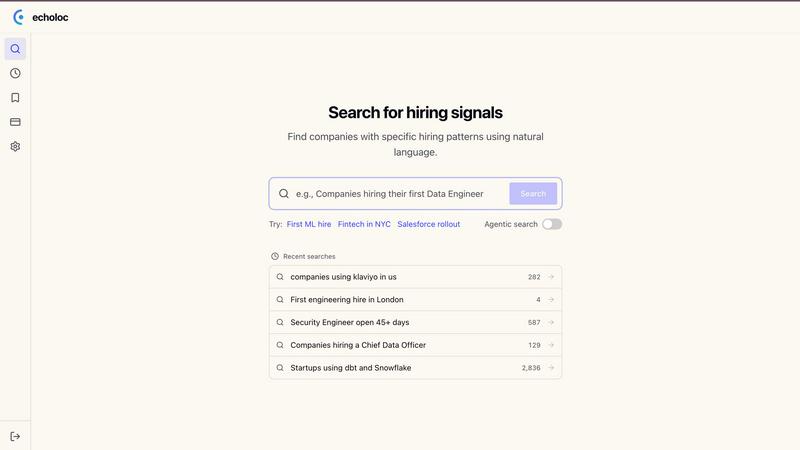
Echoloc provides real-time analysis of job postings, transforming them into actionable insights. By continuously tracking and updating job listings, the platform ensures that sales teams have access to the latest hiring signals indicating imminent spending trends. This dynamic feature allows professionals to act quickly on emerging opportunities.
Evidence-Based Results
Every match on Echoloc includes snippets of job postings that serve as evidence for the identified signals. This transparency eliminates guesswork, allowing sales teams to understand the context and relevance of each opportunity. With proof included, sales professionals can tailor their outreach effectively and engage potential buyers with confidence.
Advanced Search Functionality
Echoloc's advanced search functionality allows users to query job postings in plain English. Instead of navigating complex filters, sales professionals can simply describe what they are looking for, such as "companies hiring their first VP of Sales." This user-friendly feature makes it easy to discover valuable leads quickly and efficiently.
Comprehensive Company Tracking
The platform tracks over 30 million companies, providing a vast database for sales professionals to explore. This extensive tracking capability enables users to identify trends across various industries and pinpoint companies that are likely to invest in their products or services. By focusing on relevant signals, sales teams can prioritize their efforts and enhance their outreach strategies.
Fallom
End-to-End LLM Tracing
Fallom provides complete, real-time observability for every LLM call and AI agent interaction. It captures the full context of each operation, including the exact input prompts, model-generated outputs, all intermediate tool and function calls with their arguments and results, token consumption, latency breakdowns, and precise cost data. This granular, waterfall-style tracing is essential for understanding complex, multi-step workflows, diagnosing failures, and identifying performance bottlenecks that simple logs cannot reveal.
Enterprise Compliance & Audit Trails
The platform is built from the ground up to support the stringent requirements of regulated industries. Fallom automatically generates immutable, detailed audit trails for every AI interaction, providing the necessary documentation for compliance with frameworks like the EU AI Act, SOC 2, and GDPR. Features include comprehensive input/output logging, model versioning tracking, user consent recording, and configurable privacy modes that allow for metadata-only logging to protect sensitive data while maintaining full telemetry.
Cost Attribution & Spend Management
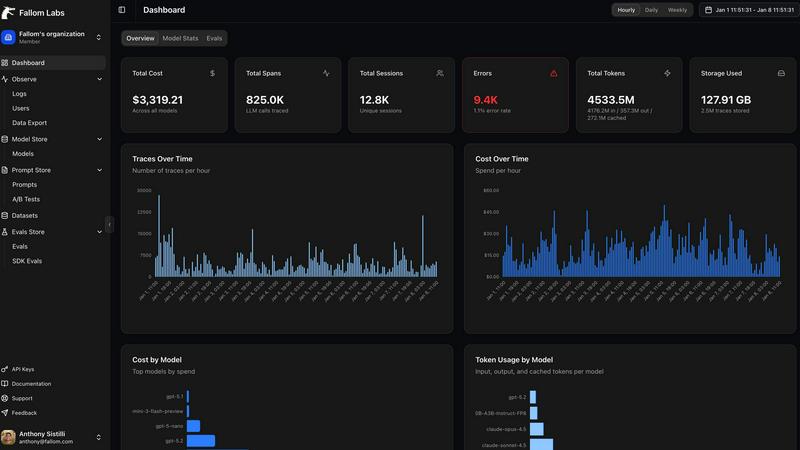
Fallom delivers unparalleled transparency into AI operational costs. It automatically attributes spend across multiple dimensions, including per model, per API call, per user, per team, or per customer. This allows for accurate budgeting, internal chargebacks, and identifying cost-optimization opportunities. Real-time dashboards and visualizations help teams monitor their monthly burn, compare model costs, and control unpredictable expenses before they escalate.
Model Management & A/B Testing
The platform enables safe and data-driven model evolution. Teams can conduct live A/B tests by splitting traffic between different models or prompt versions, comparing their performance on key metrics like cost, latency, and quality evaluations. Coupled with a integrated Prompt Store for version control, this allows organizations to systematically roll out improvements, validate new models in production, and instantly deploy winning configurations with confidence.
Use Cases
echoloc
Identifying Growth Opportunities
Sales teams can utilize Echoloc to identify companies that are in a growth phase, such as those hiring their first technical roles. By targeting these organizations, sales professionals can position their solutions effectively, catering to businesses that are likely to increase their technology budgets.
Prioritizing Outreach Strategies
With real-time insights on hiring spikes, sales representatives can prioritize their outreach strategies based on urgency and relevance. For instance, a company that is rapidly expanding its engineering team may require immediate solutions, making it an ideal target for sales engagements.
Tailoring Engagement Approaches
Echoloc allows sales teams to tailor their engagement approaches based on specific hiring signals. By understanding the motivations behind a company's hiring decisions, sales professionals can craft personalized messages that resonate with potential buyers, increasing the chances of successful conversions.
Staying Ahead of Competitors
By catching buyer intent early, Echoloc empowers sales teams to stay ahead of competitors who may rely on traditional intent data. This proactive approach ensures that organizations can engage with potential buyers before their needs are widely known, giving them a competitive edge in the market.
Fallom
Debugging Complex AI Agent Workflows
When a multi-step AI agent—involving sequential LLM calls, database queries, and API tool usage—fails or behaves unexpectedly, traditional logging is insufficient. Fallom’s end-to-end tracing allows developers to visually follow the entire execution path, inspect the state at each step, see the exact inputs and outputs of every tool call, and pinpoint precisely where and why an error occurred, drastically reducing mean time to resolution (MTTR).
Ensuring Regulatory Compliance for AI Products
For companies operating in finance, healthcare, or any sector bound by regulations like the EU AI Act, demonstrating accountability is non-negotiable. Fallom provides the necessary audit trail, documenting every AI decision, the model version used, user interactions, and data handling. This creates a verifiable record that proves due diligence, supports compliance audits, and helps build trustworthy, transparent AI systems.
Optimizing AI Performance and Cost Efficiency
Organizations scaling their AI usage often face ballooning, opaque costs and latency issues. Fallom’s detailed metrics allow teams to analyze which models, prompts, or users are driving the highest spend and latency. Engineers can use this data to optimize prompts, switch to more cost-effective models for certain tasks, cache frequent responses, and right-size their AI infrastructure, leading to direct improvements in unit economics and user experience.
Managing Production AI Rollouts and Experiments
Safely introducing a new LLM model or a major prompt update into a live application is risky. Fallom’s A/B testing and evaluation framework allows product teams to roll out changes to a small percentage of traffic, compare the new version’s performance against the baseline on real-world data, and monitor for regressions in accuracy or hallucinations before committing to a full deployment, minimizing operational risk.
Overview
About echoloc
Echoloc is an innovative platform that revolutionizes the way sales professionals identify and engage potential buyers. By leveraging advanced analytics on job postings, Echoloc uncovers hidden buying signals that indicate when companies are gearing up to invest in new technologies or services. This sophisticated approach allows sales development representatives (SDRs), account executives (AEs), and revenue teams to discover opportunities well before they surface in traditional intent data sources. For example, when a company advertises for its first data engineer or expands its sales team, it is a clear indicator of growth and impending expenditure. With Echoloc, sales professionals can depend on concrete evidence derived from job descriptions, ensuring their outreach is both timely and informed. This capability not only enhances targeting but also positions teams ahead of competitors by recognizing buyer intent before it becomes widely recognized. Overall, Echoloc empowers organizations to make smarter, data-driven decisions that significantly increase their chances of closing deals.
About Fallom
Fallom is the definitive AI-native observability platform engineered for the complex realities of production-level large language model (LLM) and AI agent workloads. As artificial intelligence transitions from experimental prototypes to being deeply integrated into core business operations, the need for comprehensive visibility and control becomes paramount. Fallom answers this critical need by providing engineering, product, and compliance teams with the tools required to operate with confidence. It transcends basic logging by offering end-to-end tracing for every LLM interaction, capturing a complete picture that includes the full prompt, the generated output, every tool and function call, token usage, latency metrics, and precise per-call cost data. This granular insight is indispensable for debugging intricate, multi-step agentic workflows, optimizing performance for speed and cost, and governing unpredictable AI spend. Built on the open standard of OpenTelemetry, Fallom ensures teams are never locked into a proprietary ecosystem, offering a unified SDK for instrumentation in minutes. Designed for enterprise scale and rigor, it provides not just technical observability but also the session-level context, detailed audit trails, model versioning, and user consent tracking necessary to meet stringent compliance standards like the EU AI Act, SOC 2, and GDPR. Fallom empowers organizations to build, deploy, and scale reliable, governable, and cost-effective AI applications.
Frequently Asked Questions
echoloc FAQ
How does Echoloc analyze job postings?
Echoloc uses advanced algorithms to analyze job postings in real time, identifying key hiring signals that indicate when companies are likely to invest in new technologies or services.
What types of signals can I expect to find?
Users can discover various signals such as hiring spikes, first hires, urgent pain points, and geo expansions, all of which provide insights into a company's growth and spending potential.
Is there a limit to the number of job postings I can search?
Echoloc offers extensive access to over 10 million job postings, allowing users to conduct comprehensive searches without limitations, ensuring they can find relevant opportunities.
Can I export the results from my searches?
Yes, Echoloc allows users to export their search results, enabling sales teams to keep a comprehensive record of potential leads and integrate them into their outreach processes seamlessly.
Fallom FAQ
How does Fallom differ from traditional application monitoring tools?
Traditional Application Performance Monitoring (APM) tools are built for conventional software, focusing on metrics like CPU usage, HTTP request latency, and database queries. They lack the native concepts required for AI: prompts, completions, token usage, model costs, and multi-step agent reasoning. Fallom is purpose-built for the AI stack, providing semantic understanding of LLM calls, tool executions, and the unique cost and compliance dimensions of generative AI, offering insights that generic tools cannot.
Is my data secure and private with Fallom?
Yes, Fallom is designed with enterprise-grade security and privacy controls. It offers a configurable Privacy Mode that allows you to disable full content capture for sensitive interactions, logging only metadata (like timings and token counts) while still providing crucial observability. Data is encrypted in transit and at rest, and the platform's compliance features, including audit trails and access controls, help you meet stringent data protection standards like GDPR.
How difficult is it to integrate Fallom into my existing AI application?
Integration is designed to be straightforward and fast. Fallom provides a unified SDK based on the OpenTelemetry standard. For most applications, developers can instrument their LLM calls and tool usage in under five minutes. The platform works with all major model providers (OpenAI, Anthropic, Google, etc.) and AI frameworks, ensuring there is no vendor lock-in and you can maintain your existing AI infrastructure.
Can Fallom help me reduce my overall LLM API costs?
Absolutely. Cost optimization is a core strength. By providing detailed, per-call cost attribution, Fallom helps you identify the most expensive operations, users, or model choices. You can analyze patterns, A/B test more cost-effective models for specific tasks, optimize inefficient prompts that consume excessive tokens, and set up alerts for unexpected spend spikes, enabling proactive cost management and significant savings.
Alternatives
echoloc Alternatives
Echoloc is an innovative platform that falls under the Business & Finance category, specifically designed to assist sales professionals in identifying potential buyers by analyzing job postings. By uncovering hidden buying signals, Echoloc enables teams to target accounts that are likely to invest in new technologies or services, creating a significant advantage in the competitive sales landscape. Users often seek alternatives to Echoloc for various reasons, including pricing concerns, feature requirements, or the need for a specific platform that better aligns with their operational needs. When searching for an alternative, it is essential to consider factors such as the comprehensiveness of the data provided, usability, integration capabilities with existing tools, and the overall effectiveness in delivering actionable insights that can enhance sales strategies and outreach efforts.
Fallom Alternatives
Fallom is an AI-native observability platform, a specialized category of development tool designed to monitor, debug, and govern production-level large language model and AI agent applications. Users may explore alternatives for various reasons, including budget constraints, specific feature requirements not covered by their current solution, or a need for a platform that integrates more seamlessly with their existing technology stack and operational workflows. When evaluating different solutions in this space, it is crucial to consider several key factors. The depth of tracing and granularity of data captured for each LLM interaction is fundamental for effective debugging. Equally important are the platform's scalability, its approach to data privacy and security, and the robustness of its compliance features, such as audit trails and consent tracking, which are essential for enterprise deployments. The ideal alternative should not only provide technical visibility but also align with your organization's long-term strategy for AI governance and cost management. It should empower teams to move from experimentation to reliable, controlled production deployments with confidence.