
Agenta vs qtrl.ai
Side-by-side comparison to help you choose the right tool.

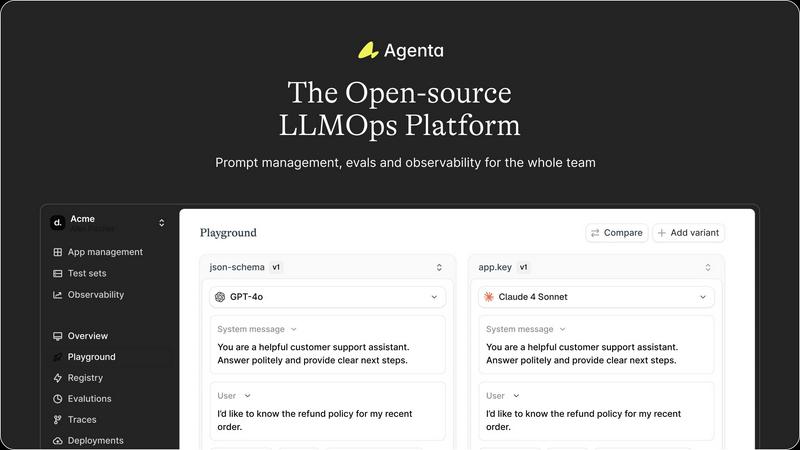
Agenta is the open-source platform that helps teams build and manage reliable AI applications together.
Last updated: March 1, 2026

qtrl.ai
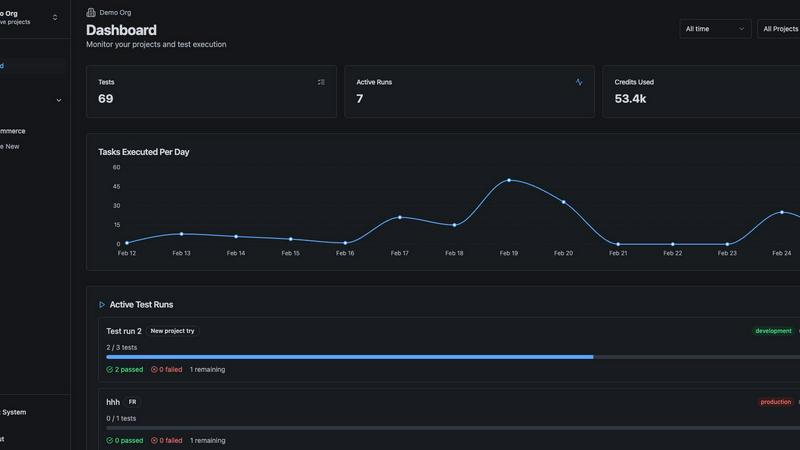
qtrl.ai empowers QA teams to scale testing with AI while ensuring full control, governance, and seamless integration.
Last updated: March 4, 2026
Visual Comparison
Agenta
qtrl.ai
Feature Comparison
Agenta
Unified Playground for Experimentation
Agenta provides a centralized playground where teams can experiment with different prompts, models, and parameters side-by-side in a single interface. This eliminates the need for scattered tools and documents, allowing for direct comparison and rapid iteration. Foundational to its design is complete version history for all prompts, ensuring every change is tracked and reversible, fostering a systematic approach to development rather than ad-hoc "vibe testing."
Comprehensive Evaluation Framework
The platform replaces guesswork with evidence through a robust evaluation system. Teams can create automated test suites using LLM-as-a-judge, custom code evaluators, or built-in metrics. Crucially, Agenta enables evaluation of full agentic traces, assessing each intermediate reasoning step, not just the final output. It also seamlessly integrates human evaluation workflows, allowing domain experts and product managers to provide qualitative feedback directly within the platform.
Production Observability and Debugging
Agenta offers deep observability by tracing every LLM request in production, making it possible to pinpoint exact failure points when issues arise. Teams can annotate these traces collaboratively and, with a single click, turn any problematic trace into a test case for the playground, closing the feedback loop. This capability is augmented by live monitoring to detect performance regressions and gather real user feedback.
Collaborative Workflow for Cross-Functional Teams
Designed as a single source of truth, Agenta breaks down silos between developers, product managers, and domain experts. It provides a safe, code-free UI for experts to edit and experiment with prompts. The platform ensures full parity between its API and UI, enabling both programmatic and manual workflows to integrate into one central hub, empowering the entire team to participate in experiments, evaluations, and debugging.
qtrl.ai
Autonomous QA Agents
qtrl.ai features autonomous QA agents that can execute testing instructions on demand or continuously. These agents are capable of running tests at scale across multiple environments while adhering to defined rules, ensuring reliable results. With real browser execution instead of mere simulations, the agents provide accurate and meaningful testing outcomes.
Enterprise-Grade Test Management
This platform offers centralized management of test cases, plans, and runs, ensuring full traceability and comprehensive audit trails. It supports both manual and automated workflows, making it adaptable to the specific needs of any team. Designed with compliance in mind, qtrl.ai enables organizations to maintain robust governance throughout their QA processes.
Progressive Automation
qtrl.ai supports a progressive automation model, allowing teams to start with human-written test instructions. As teams gain confidence, they can transition to AI-generated tests that are fully reviewable. This feature includes suggestions for new tests based on coverage gaps, empowering teams to enhance their testing strategies while maintaining control.
Adaptive Memory
The adaptive memory component of qtrl.ai builds a living knowledge base of the application under test. It learns from test execution and previous issues, enabling smarter, context-aware test generation. With each interaction, the platform becomes more effective, streamlining the QA process and improving overall testing accuracy.
Use Cases
Agenta
Streamlining Enterprise LLM Application Development
Large organizations developing customer-facing AI assistants or internal copilots use Agenta to bring structure to their development process. It enables cross-functional teams to collaborate efficiently, moving from disjointed prototyping in Slack and sheets to a governed lifecycle with version control, systematic evaluation against business metrics, and smooth handoff from experimentation to stable, observable deployment.
Implementing Rigorous AI Quality Assurance
Teams that require high reliability and consistency, such as those in legal, financial, or healthcare sectors, leverage Agenta to build a rigorous QA pipeline for their LLM applications. They use the platform to create comprehensive evaluation datasets, run automated and human-in-the-loop evaluations on every proposed change, and monitor production performance to ensure no regressions slip through, thereby building evidence-based trust in their AI systems.
Debugging and Optimizing Complex AI Agents
Developers building sophisticated multi-step agents with frameworks like LangChain use Agenta's observability features to debug complex failures. By examining detailed traces of each step in an agent's reasoning, teams can quickly identify where a chain fails, save those instances as tests, and iteratively refine prompts and logic in the playground until robustness is achieved.
Enabling Domain Expert Collaboration
Companies where subject matter experts (e.g., doctors, lawyers, analysts) are crucial for validating AI output use Agenta to democratize the development process. The platform's intuitive UI allows these non-technical experts to directly participate in prompt engineering, run evaluations, and provide annotated feedback on real production traces, ensuring the AI aligns closely with specialized domain knowledge.
qtrl.ai
Product-Led Engineering Teams
Product-led engineering teams can leverage qtrl.ai to enhance their QA processes by automating testing while ensuring that quality remains a top priority. The platform’s combination of test management and AI-driven automation supports rapid development cycles without sacrificing oversight.
QA Teams Scaling Beyond Manual Testing
For QA teams that are transitioning from manual testing to more automated approaches, qtrl.ai provides a structured pathway. It enables teams to start with manual processes and gradually adopt automation, ensuring a smooth transition that minimizes risks associated with sudden changes.
Companies Modernizing Legacy QA Workflows
Organizations looking to modernize their outdated QA workflows can utilize qtrl.ai to integrate advanced testing strategies. The platform’s features allow for the automation of existing processes while maintaining essential compliance and audit capabilities necessary for enterprise environments.
Enterprises Requiring Governance and Traceability
Large enterprises with strict governance and audit requirements can benefit from qtrl.ai’s comprehensive test management capabilities. The platform ensures that all testing activities are traceable and transparent, allowing organizations to maintain compliance while improving the efficiency of their QA efforts.
Overview
About Agenta
Agenta is an open-source LLMOps platform engineered to solve the fundamental challenge of building reliable, production-grade applications with large language models. It serves as a unified operating system for AI development teams, bridging the critical gap between experimental prototyping and stable deployment. The platform is designed for collaborative teams comprising developers, product managers, and subject matter experts who need to move beyond scattered, ad-hoc workflows. Its core value proposition lies in centralizing the entire LLM application lifecycle—from prompt experimentation and rigorous evaluation to comprehensive observability—into a single, coherent platform. By replacing guesswork with evidence-based processes, Agenta empowers organizations to systematically iterate on prompts, validate changes against automated and human evaluations, and swiftly debug issues using real production data. It is model-agnostic and framework-friendly, integrating seamlessly with popular tools like LangChain and LlamaIndex, thereby preventing vendor lock-in and providing the essential infrastructure to implement LLMOps best practices at scale. Agenta transforms the chaotic process of AI development into a structured, collaborative, and data-driven discipline.
About qtrl.ai
qtrl.ai is an innovative quality assurance platform designed to empower software teams by streamlining their QA processes while maintaining robust control and governance. This platform stands out by integrating enterprise-grade test management with advanced AI-driven automation, creating a centralized hub where teams can efficiently organize test cases, plan test runs, and track quality metrics through real-time dashboards. By providing clear visibility into testing outcomes, qtrl.ai enables engineering leads and QA managers to identify what has been tested, what is passing, and where potential risks may exist.
The unique strength of qtrl.ai lies in its gradual implementation of intelligent automation. Unlike other platforms that may adopt a risky black-box approach, qtrl allows teams to begin with manual test management, progressively introducing autonomous agents as they become ready. These agents can generate UI tests from simple English descriptions, adapt to application changes, and execute tests across various browsers and environments at scale. This makes qtrl.ai ideal for product-led engineering teams, QA groups transitioning from manual testing, organizations modernizing outdated workflows, and enterprises requiring stringent compliance and auditability. Ultimately, qtrl.ai aims to bridge the gap between the slow pace of manual testing and the complexities of traditional automation, offering a reliable pathway to faster and smarter quality assurance.
Frequently Asked Questions
Agenta FAQ
Is Agenta truly open-source?
Yes, Agenta is a fully open-source platform. The core codebase is publicly available on GitHub, allowing users to inspect, modify, and contribute to the software. This open model ensures transparency, prevents vendor lock-in, and allows the community to influence the product's roadmap while providing the freedom to self-host the platform.
How does Agenta integrate with existing AI stacks?
Agenta is designed to be model-agnostic and framework-friendly. It offers seamless integrations with popular LLM providers (like OpenAI), orchestration frameworks (such as LangChain and LlamaIndex), and can be extended with custom evaluators. This flexibility allows teams to incorporate Agenta into their existing workflows without disrupting their current toolchain.
Can non-technical team members really use Agenta effectively?
Absolutely. A key design principle of Agenta is to bridge the gap between technical and non-technical roles. Product managers and domain experts can use the web UI to experiment with prompts in the playground, configure and view evaluation results, and annotate production traces—all without writing a single line of code, fostering true collaborative development.
What is the difference between Agenta and simple prompt management tools?
While basic tools might help version prompts, Agenta provides a complete LLMOps lifecycle platform. It combines prompt management with integrated evaluation (automated and human), full production observability with trace debugging, and collaborative workflows. This holistic approach ensures that prompts are not just managed but are systematically improved, validated, and monitored within the context of the entire application.
qtrl.ai FAQ
What makes qtrl.ai different from traditional QA tools?
qtrl.ai distinguishes itself by combining enterprise-grade test management with progressive AI automation. It allows teams to gradually adopt automation while maintaining control and governance, unlike traditional tools that may be either too rigid or overly reliant on black-box AI.
Can qtrl.ai integrate with existing tools?
Yes, qtrl.ai is designed to work seamlessly with your existing tools and workflows. It supports integration with various CI/CD pipelines and requirements management systems, ensuring a smooth transition and continuous quality feedback loops.
How does qtrl.ai ensure data security during testing?
qtrl.ai prioritizes security by maintaining governance through defined autonomy levels and full agent visibility. Sensitive information, such as environment variables and encrypted secrets, is securely managed, ensuring that they are not exposed to AI agents during testing.
Is qtrl.ai suitable for small teams?
Absolutely. qtrl.ai is versatile and scalable, making it suitable for teams of all sizes. Whether you are a small startup or a large enterprise, the platform can adapt to your specific needs, facilitating growth and efficiency in your QA processes.
Alternatives
Agenta Alternatives
Agenta is an open-source LLMOps platform designed to help development teams build and manage reliable AI applications. It falls into the category of development tools focused on the operational lifecycle of large language models, providing a unified system for experimentation, evaluation, and deployment. Users may explore alternatives for various reasons, including specific budget constraints, the need for different feature sets like advanced monitoring or native CI/CD integration, or a preference for a managed service over self-hosted open-source software. Organizational requirements around scalability, security compliance, and existing tech stack compatibility also drive the search for other solutions. When evaluating alternatives, key considerations should include the platform's approach to collaborative experimentation, the robustness of its evaluation and testing frameworks, and its observability capabilities for production applications. The ideal tool should align with your team's workflow, support the LLM frameworks you use, and provide a clear path from prototype to stable, monitored deployment.
qtrl.ai Alternatives
qtrl.ai is a cutting-edge quality assurance platform that integrates AI technology to help software teams enhance their testing processes while maintaining governance and control. It is particularly effective for organizations looking to streamline their quality assurance efforts through intelligent automation and robust test management capabilities. As teams evolve, they often seek alternatives to qtrl.ai for various reasons, such as pricing structures, feature sets, or specific platform compatibility requirements that better align with their unique operational needs. When considering alternatives to qtrl.ai, users should evaluate several key factors. It's essential to assess the scalability of the solution, the flexibility of its automation features, and the ability to maintain visibility and control over testing processes. Additionally, understanding the level of support provided and how well the platform integrates with existing tools can significantly impact the overall effectiveness of a chosen QA solution.