
Agenta vs diffray
Side-by-side comparison to help you choose the right tool.

Agenta is the open-source platform that helps teams build and manage reliable AI applications together.
Last updated: March 1, 2026

diffray
Diffray uses multi-agent AI to catch real bugs in code reviews, not just nitpicks.
Last updated: February 28, 2026
Visual Comparison
Agenta
diffray
Feature Comparison
Agenta
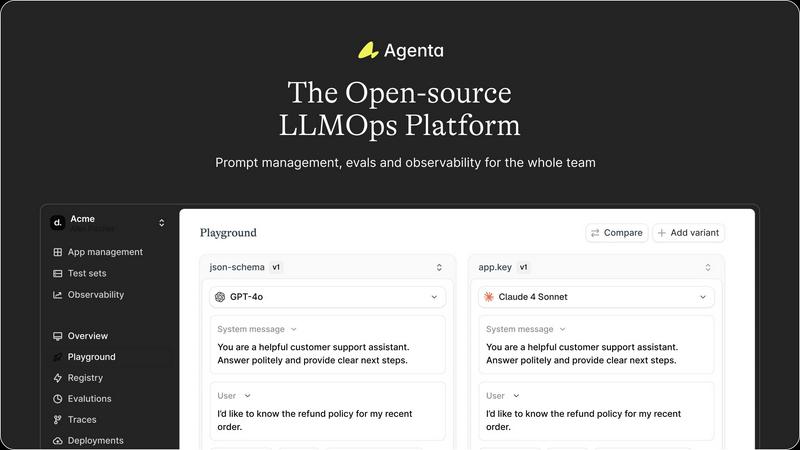
Unified Playground for Experimentation
Agenta provides a centralized playground where teams can experiment with different prompts, models, and parameters side-by-side in a single interface. This eliminates the need for scattered tools and documents, allowing for direct comparison and rapid iteration. Foundational to its design is complete version history for all prompts, ensuring every change is tracked and reversible, fostering a systematic approach to development rather than ad-hoc "vibe testing."
Comprehensive Evaluation Framework
The platform replaces guesswork with evidence through a robust evaluation system. Teams can create automated test suites using LLM-as-a-judge, custom code evaluators, or built-in metrics. Crucially, Agenta enables evaluation of full agentic traces, assessing each intermediate reasoning step, not just the final output. It also seamlessly integrates human evaluation workflows, allowing domain experts and product managers to provide qualitative feedback directly within the platform.
Production Observability and Debugging
Agenta offers deep observability by tracing every LLM request in production, making it possible to pinpoint exact failure points when issues arise. Teams can annotate these traces collaboratively and, with a single click, turn any problematic trace into a test case for the playground, closing the feedback loop. This capability is augmented by live monitoring to detect performance regressions and gather real user feedback.
Collaborative Workflow for Cross-Functional Teams
Designed as a single source of truth, Agenta breaks down silos between developers, product managers, and domain experts. It provides a safe, code-free UI for experts to edit and experiment with prompts. The platform ensures full parity between its API and UI, enabling both programmatic and manual workflows to integrate into one central hub, empowering the entire team to participate in experiments, evaluations, and debugging.
diffray
Multi-Agent AI Architecture
Unlike single-model AI review tools, diffray leverages a team of over 30 specialized AI agents, each trained as an expert in a specific domain. This includes dedicated agents for security vulnerabilities, performance anti-patterns, language-specific best practices, bug detection, and even SEO for relevant codebases. This collaborative, expert-driven approach ensures that feedback is not generic but is precisely targeted and highly relevant to the specific type of issue being examined, dramatically increasing the accuracy and usefulness of every comment.
Full-Codebase Contextual Analysis
diffray moves beyond simple line-by-line diff analysis. Its agents intelligently investigate the full context of your repository. They cross-reference new changes against existing code patterns, library usage, architectural decisions, and established conventions within the project. This deep contextual understanding allows diffray to distinguish between a genuine mistake and an intentional design pattern, providing suggestions that are truly relevant to your project's unique environment and significantly reducing false positives.
High-Signal, Actionable Feedback
The platform is engineered to prioritize quality over quantity. By combining domain expertise with deep contextual awareness, diffray filters out the noise that plagues other tools. It delivers concise, actionable insights that developers can immediately understand and act upon. This transforms the AI from a source of alert fatigue into a trusted advisor, enabling developers to focus their cognitive energy on complex problem-solving rather than sifting through low-value suggestions.
Seamless GitHub Integration & Privacy Commitment
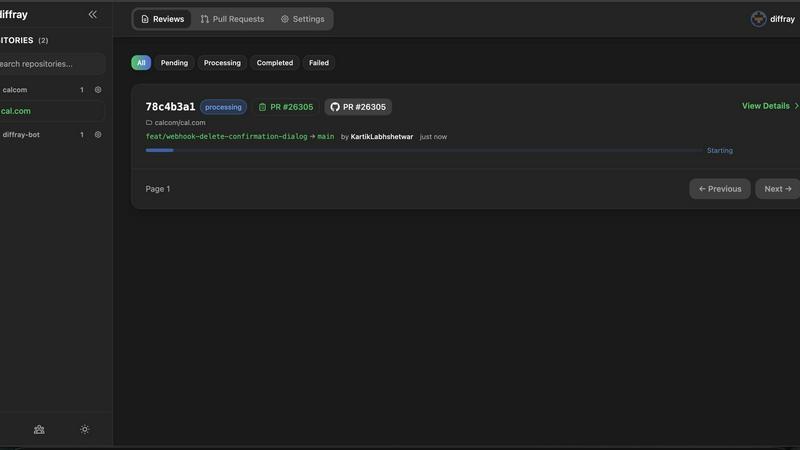
diffray integrates directly into your existing GitHub workflow, appearing as a native participant in your pull request review process. Setup is minimal, requiring no disruptive changes to developer habits. Furthermore, the platform is built with a fundamental commitment to code privacy and security, ensuring your intellectual property remains protected. This combination of effortless integration and strong security principles makes it a viable and trustworthy tool for teams of all sizes, from fast-moving startups to large enterprises.
Use Cases
Agenta
Streamlining Enterprise LLM Application Development
Large organizations developing customer-facing AI assistants or internal copilots use Agenta to bring structure to their development process. It enables cross-functional teams to collaborate efficiently, moving from disjointed prototyping in Slack and sheets to a governed lifecycle with version control, systematic evaluation against business metrics, and smooth handoff from experimentation to stable, observable deployment.
Implementing Rigorous AI Quality Assurance
Teams that require high reliability and consistency, such as those in legal, financial, or healthcare sectors, leverage Agenta to build a rigorous QA pipeline for their LLM applications. They use the platform to create comprehensive evaluation datasets, run automated and human-in-the-loop evaluations on every proposed change, and monitor production performance to ensure no regressions slip through, thereby building evidence-based trust in their AI systems.
Debugging and Optimizing Complex AI Agents
Developers building sophisticated multi-step agents with frameworks like LangChain use Agenta's observability features to debug complex failures. By examining detailed traces of each step in an agent's reasoning, teams can quickly identify where a chain fails, save those instances as tests, and iteratively refine prompts and logic in the playground until robustness is achieved.
Enabling Domain Expert Collaboration
Companies where subject matter experts (e.g., doctors, lawyers, analysts) are crucial for validating AI output use Agenta to democratize the development process. The platform's intuitive UI allows these non-technical experts to directly participate in prompt engineering, run evaluations, and provide annotated feedback on real production traces, ensuring the AI aligns closely with specialized domain knowledge.
diffray
Accelerating Pull Request Reviews for Engineering Teams
Development teams use diffray to drastically reduce the time spent on manual code review cycles. By automatically surfacing critical issues, security flaws, and performance concerns as soon as a PR is opened, diffray allows human reviewers to focus on higher-level architecture, design patterns, and knowledge sharing. This leads to faster merge times, increased developer velocity, and more consistent code quality across the entire team without adding bureaucratic overhead.
Enforcing Code Quality and Best Practices at Scale
For engineering leads and architects, diffray acts as a scalable, always-on guardian of code quality. It consistently enforces project-specific and industry-wide best practices, coding standards, and architectural patterns across every pull request, regardless of the reviewer's individual expertise. This ensures a uniformly high-quality codebase, reduces technical debt accumulation, and accelerates the onboarding of new developers by providing immediate, contextual feedback aligned with team standards.
Proactive Security and Vulnerability Prevention
Security teams and developers leverage diffray's specialized security agents to shift vulnerability detection left in the development lifecycle. The platform proactively identifies potential security anti-patterns, insecure API usage, and common vulnerability exposures (CVEs) in dependencies directly within the developer's workflow. This allows teams to remediate risks before code is merged, preventing security flaws from ever reaching production and building a more robust security posture proactively.
Maintaining Open Source Project Health
Maintainers of open-source projects utilize diffray's free tier to manage contributions from a diverse and global community. The platform helps efficiently review external pull requests by automatically checking for common issues, ensuring contributions adhere to project conventions, and identifying potential bugs or performance regressions. This helps maintain high standards of quality and security while reducing the maintainer's review burden and fostering a healthier, more sustainable open-source ecosystem.
Overview
About Agenta
Agenta is an open-source LLMOps platform engineered to solve the fundamental challenge of building reliable, production-grade applications with large language models. It serves as a unified operating system for AI development teams, bridging the critical gap between experimental prototyping and stable deployment. The platform is designed for collaborative teams comprising developers, product managers, and subject matter experts who need to move beyond scattered, ad-hoc workflows. Its core value proposition lies in centralizing the entire LLM application lifecycle—from prompt experimentation and rigorous evaluation to comprehensive observability—into a single, coherent platform. By replacing guesswork with evidence-based processes, Agenta empowers organizations to systematically iterate on prompts, validate changes against automated and human evaluations, and swiftly debug issues using real production data. It is model-agnostic and framework-friendly, integrating seamlessly with popular tools like LangChain and LlamaIndex, thereby preventing vendor lock-in and providing the essential infrastructure to implement LLMOps best practices at scale. Agenta transforms the chaotic process of AI development into a structured, collaborative, and data-driven discipline.
About diffray
diffray represents a fundamental evolution in AI-powered code review, moving beyond the limitations of generic, single-model tools. It is a sophisticated platform designed for development teams who are serious about code quality, security, and developer productivity. At its core, diffray employs a revolutionary multi-agent architecture, where over 30 specialized AI agents—each an expert in a distinct domain like security vulnerabilities, performance bottlenecks, bug patterns, best practices, or SEO—collaboratively analyze pull requests. This targeted approach stands in stark contrast to traditional tools that use one model for everything, which often results in a flood of noisy, irrelevant comments that developers learn to ignore. The primary value proposition of diffray is delivering actionable, high-signal feedback that developers can actually use. By understanding not just the diff but the full context of your codebase, diffray's agents investigate rather than speculate. They cross-reference changes against existing patterns, libraries, and architectural decisions to provide precise, context-aware suggestions. The result is a transformative developer experience: teams report cutting PR review time dramatically while catching three times more genuine issues with 87% fewer false positives. diffray is built for professional engineering teams across startups and enterprises who want to leverage AI not as a source of distraction, but as a reliable, intelligent partner in maintaining robust and clean code. It integrates seamlessly with GitHub, offers a free tier for open-source projects, and ensures your code's privacy is never compromised.
Frequently Asked Questions
Agenta FAQ
Is Agenta truly open-source?
Yes, Agenta is a fully open-source platform. The core codebase is publicly available on GitHub, allowing users to inspect, modify, and contribute to the software. This open model ensures transparency, prevents vendor lock-in, and allows the community to influence the product's roadmap while providing the freedom to self-host the platform.
How does Agenta integrate with existing AI stacks?
Agenta is designed to be model-agnostic and framework-friendly. It offers seamless integrations with popular LLM providers (like OpenAI), orchestration frameworks (such as LangChain and LlamaIndex), and can be extended with custom evaluators. This flexibility allows teams to incorporate Agenta into their existing workflows without disrupting their current toolchain.
Can non-technical team members really use Agenta effectively?
Absolutely. A key design principle of Agenta is to bridge the gap between technical and non-technical roles. Product managers and domain experts can use the web UI to experiment with prompts in the playground, configure and view evaluation results, and annotate production traces—all without writing a single line of code, fostering true collaborative development.
What is the difference between Agenta and simple prompt management tools?
While basic tools might help version prompts, Agenta provides a complete LLMOps lifecycle platform. It combines prompt management with integrated evaluation (automated and human), full production observability with trace debugging, and collaborative workflows. This holistic approach ensures that prompts are not just managed but are systematically improved, validated, and monitored within the context of the entire application.
diffray FAQ
How is diffray different from other AI code review tools?
diffray fundamentally differs through its multi-agent architecture. While most tools use a single, generalized AI model to comment on everything, diffray deploys a team of over 30 specialized agents, each an expert in a specific domain like security, performance, or bug detection. This allows for deeper, more accurate analysis. Furthermore, diffray analyzes your full codebase for context, leading to more relevant suggestions and far fewer false positives compared to tools that only look at the diff in isolation.
What programming languages and frameworks does diffray support?
diffray is designed with broad compatibility in mind. Its multi-agent system includes specialists for all major programming languages and popular frameworks. The platform continuously evolves, with agents trained on the latest language features, library updates, and framework-specific best practices. For the most current and detailed list of supported languages, it is recommended to check the official diffray documentation.
Is my source code kept private and secure with diffray?
Absolutely. Code privacy and security are foundational principles for diffray. The platform is built with enterprise-grade security measures to ensure your intellectual property is protected. Your code is analyzed in a secure environment, and diffray is committed to not storing or misusing your source code. You retain full ownership and control of your code at all times.
How do I get started with diffray for my team?
Getting started is straightforward. diffray offers a seamless integration with GitHub. You can typically begin by installing the diffray GitHub App on your organization or personal account, selecting the repositories you wish to enable it for, and configuring your review preferences. The platform often provides a free tier or trial, allowing teams to experience the benefits on their own codebase with minimal setup effort before committing to a paid plan.
Alternatives
Agenta Alternatives
Agenta is an open-source LLMOps platform designed to help development teams build and manage reliable AI applications. It falls into the category of development tools focused on the operational lifecycle of large language models, providing a unified system for experimentation, evaluation, and deployment. Users may explore alternatives for various reasons, including specific budget constraints, the need for different feature sets like advanced monitoring or native CI/CD integration, or a preference for a managed service over self-hosted open-source software. Organizational requirements around scalability, security compliance, and existing tech stack compatibility also drive the search for other solutions. When evaluating alternatives, key considerations should include the platform's approach to collaborative experimentation, the robustness of its evaluation and testing frameworks, and its observability capabilities for production applications. The ideal tool should align with your team's workflow, support the LLM frameworks you use, and provide a clear path from prototype to stable, monitored deployment.
diffray Alternatives
diffray is a sophisticated AI-powered code review platform that represents a significant advancement in the development tool category. It moves beyond basic linting and static analysis by employing a multi-agent architecture, where over thirty specialized AI experts collaboratively analyze pull requests to catch genuine bugs, security flaws, and performance issues with high precision. Users may explore alternatives to diffray for various reasons, including budget constraints, specific integration requirements with platforms like GitLab or Bitbucket, or a preference for tools with different feature emphases, such as those focused solely on security scanning or simpler, single-model AI assistance. The needs of a solo developer differ greatly from those of a large enterprise team, driving a diverse market of solutions. When evaluating alternatives, key considerations should include the depth and accuracy of the AI analysis, the tool's ability to understand full codebase context to reduce false positives, integration capabilities with your existing development workflow, and robust data security and privacy policies. The ultimate goal is to find a solution that enhances developer productivity without becoming a source of noisy distractions.