
Blueberry vs HookMesh
Side-by-side comparison to help you choose the right tool.

Blueberry
Blueberry unifies your editor, terminal, and browser into one seamless workspace for efficient web app development.
Last updated: February 28, 2026

HookMesh provides reliable webhook delivery and a self-service portal to streamline your SaaS operations effortlessly.
Last updated: February 28, 2026
Visual Comparison
Blueberry
HookMesh
Feature Comparison
Blueberry
Integrated Workspace
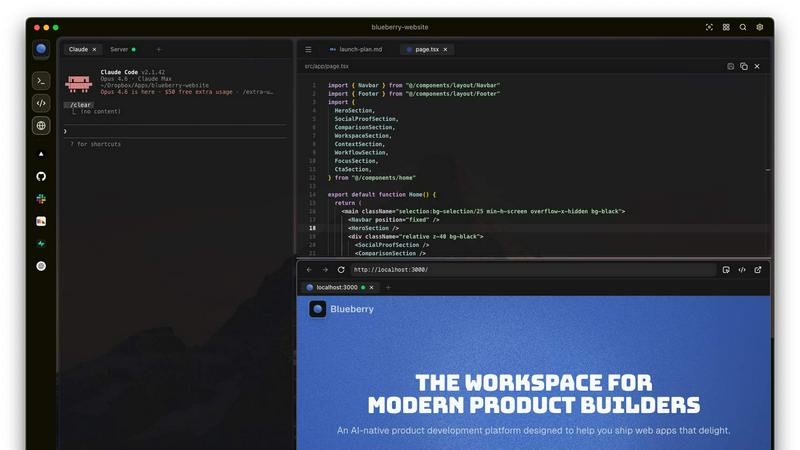
Blueberry combines a terminal, code editor, and preview browser into one cohesive workspace. This integration allows developers to manage their projects without the need to switch between different applications, enhancing focus and productivity.
Real-Time AI Context
With Blueberry's MCP server, users can connect AI models like Claude and Codex directly to their workspace. This feature ensures that the AI has full context of the project, including open files and terminal outputs, enabling smarter and more context-aware interactions.
Pinned Apps
Developers can dock essential applications such as GitHub, Linear, Figma, and PostHog within the Blueberry workspace. These pinned apps load alongside the project, sharing live context with the AI, which further streamlines the development process.
Visual Context Tools
Blueberry provides features like screenshot capture and element selection directly from the preview browser. This allows developers to give their AI visual context, enhancing the effectiveness of AI interactions and feedback during the development process.
HookMesh
Reliable Delivery Infrastructure
HookMesh's foundation is its robust delivery engine, which ensures at-least-once delivery for every webhook event. This is achieved through a sophisticated combination of automatic retries with exponential backoff and jitter, preventing thundering herd problems and gracefully handling temporary endpoint failures. The system employs intelligent circuit breakers that automatically disable endpoints exhibiting persistent failures, protecting your system's health and queue integrity, and re-enables them upon signs of recovery. Furthermore, idempotency keys are utilized to guarantee that no event is processed multiple times even if delivery is retried, ensuring data consistency for your customers.
Customer Self-Service Portal
A standout feature is the fully embeddable customer portal, which transforms webhook management from a support burden into a customer empowerment tool. This portal provides your end-users with direct visibility and control over their webhook integrations. Customers can independently add, verify, and manage their destination endpoints. They gain access to detailed delivery logs containing full request and response data, eliminating the need for them to contact your support team to debug issues. Most notably, it includes a one-click replay function, allowing users to instantly retry failed webhook deliveries, drastically reducing resolution time and improving their operational autonomy.
Developer Experience & SDKs
HookMesh is built to be integrated in minutes, not months. It offers a clean, well-documented REST API that provides programmatic access to every facet of the system. To accelerate integration, HookMesh supplies official, fully-supported Software Development Kits (SDKs) for popular languages including JavaScript/Node.js, Python, and Go. These SDKs encapsulate best practices and simplify the process of sending events from your application down to just a few lines of code. Additionally, a webhook playground environment is provided, allowing developers to test event payloads, signatures, and endpoint configurations in a safe sandbox before deploying to production.
Comprehensive Visibility & Management
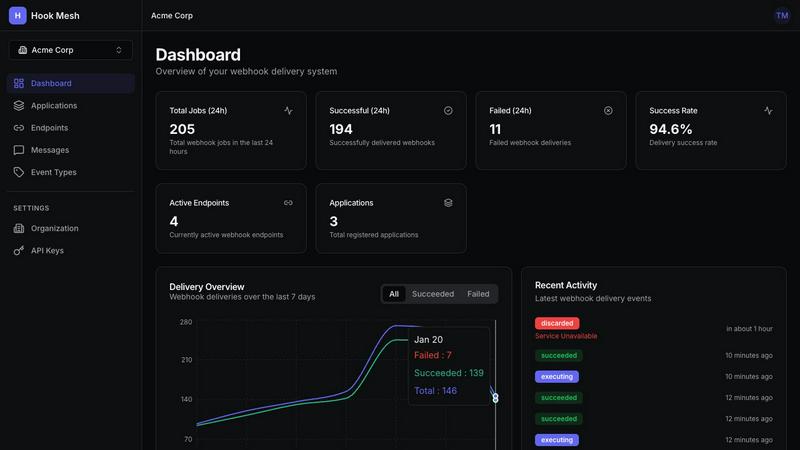
The platform offers deep operational transparency for both your internal team and your customers. You gain a centralized dashboard to monitor overall webhook volume, success rates, and system health. Every webhook event is logged with its complete journey, from ingestion to final delivery status, including all retry attempts and the exact HTTP request and response payloads. This end-to-end visibility is crucial for auditing, compliance, and rapid debugging, turning what is traditionally a black box of log files into a clear, actionable timeline of events.
Use Cases
Blueberry
Streamlined Development
Blueberry is ideal for developers looking to streamline their workflow. By integrating all necessary tools into one workspace, developers can focus on coding and testing their web applications without interruptions.
Enhanced Collaboration
With pinned apps and live context sharing, teams can collaborate more effectively. Developers can work alongside designers and project managers within the same environment, ensuring that everyone is on the same page.
AI-Assisted Programming
Blueberry's real-time AI context allows for enhanced programming assistance. Developers can ask questions to their AI models while viewing their code and terminal output, leading to quicker problem-solving and more efficient coding.
Responsive Design Testing
The built-in preview browser enables developers to test their applications across various devices, including desktop, tablet, and mobile. This feature ensures that applications are responsive and user-friendly before deployment.
HookMesh
SaaS Application Event Notifications
Modern SaaS platforms, such as CRM, project management, or marketing automation tools, need to notify connected third-party applications or customer systems about key events like a new user sign-up, a completed transaction, or a updated record. HookMesh reliably delivers these JSON payloads, ensuring that downstream systems are activated in a timely manner. The self-service portal allows each customer to configure their own endpoints for these events, significantly reducing the configuration burden on the SaaS provider's support and engineering teams.
E-commerce and Payment Processing
E-commerce platforms and payment gateways must guarantee the delivery of critical order and payment status updates (e.g., order.completed, payment.failed, invoice.paid) to merchant systems for fulfillment, accounting, and customer communication. A failed webhook can mean a missed shipment or an unrecorded payment. HookMesh's guaranteed delivery with 48-hour retries and one-click replay ensures financial and operational data integrity, providing merchants with the reliability they depend on for their business operations.
DevOps and Infrastructure Automation
Development and operations teams use webhooks to trigger automated pipelines in CI/CD systems, update incident management platforms, or synchronize data across cloud services. The failure of a webhook from a source like GitHub, a monitoring tool, or a database can halt a deployment or obscure a critical alert. HookMesh ensures these automation triggers are delivered, with circuit breakers preventing a failing deployment script from causing cascading failures and queue backups across other automated processes.
Customer Data Synchronization
Companies that offer data aggregation or synchronization services, like customer data platforms (CDPs) or data warehouses, use webhooks to push updated user profiles, behavioral events, or dataset changes to subscribed business tools. Consistent, real-time data sync is vital for accurate analytics and personalized marketing. HookMesh manages the delivery to multiple customer endpoints, handling varying rates of acceptance and providing logs that help diagnose any data format or schema rejection issues on the receiving end.
Overview
About Blueberry
Blueberry is an innovative macOS application designed for modern product builders, integrating a code editor, terminal, and browser into a singular, focused workspace. By consolidating these essential tools, Blueberry eliminates the hassle of switching between multiple applications, allowing developers to concentrate on coding and shipping web applications with ease. Built with a user-friendly interface, Blueberry is particularly beneficial for developers who utilize AI models like Claude, Codex, and Gemini, as it provides these models with real-time access to files, terminal output, and live previews. This seamless integration means that developers can interact with their AI tools without the tediousness of copy-pasting context. Currently in its beta phase, Blueberry is available for free on macOS, making it accessible for developers looking to enhance productivity and streamline their workflow.
About HookMesh
HookMesh is a comprehensive, developer-first platform engineered to solve the universal challenge of reliable webhook delivery for modern software-as-a-service (SaaS) products and digital platforms. At its core, HookMesh provides a battle-tested, managed infrastructure that abstracts away the immense technical complexity and operational overhead associated with building and maintaining an in-house webhook system. It is designed for development teams, product managers, and engineering leaders who need to provide real-time event notifications to their customers but wish to avoid the months of engineering effort required to implement robust retry logic, circuit breakers, and monitoring tools. The platform's primary value proposition is delivering unparalleled peace of mind by guaranteeing that critical business events—such as payment confirmations, data sync triggers, or user activity alerts—are delivered consistently and reliably. By handling the entire delivery lifecycle, from automatic retries with exponential backoff to providing customers with a self-service portal for endpoint management, HookMesh allows businesses to focus their resources on core product innovation rather than the undifferentiated heavy lifting of message queue management and failure debugging.
Frequently Asked Questions
Blueberry FAQ
What platforms is Blueberry available on?
Currently, Blueberry is available exclusively for macOS users. It is designed to enhance the development experience on Apple computers.
Is Blueberry really free during beta?
Yes, Blueberry is completely free during its beta phase, allowing developers to try out its features without any cost. This is an excellent opportunity for users to explore its capabilities.
Can I use Blueberry with any AI model?
Yes, Blueberry supports various AI models, including Claude, Codex, and Gemini, through its integrated MCP server, providing flexibility for developers to choose their preferred tools.
How does Blueberry enhance productivity?
By consolidating essential development tools into one workspace, Blueberry minimizes distractions and interruptions, allowing developers to focus on building and shipping high-quality web applications.
HookMesh FAQ
How does HookMesh ensure webhooks are not delivered more than once?
HookMesh guarantees at-least-once delivery, meaning an event will be delivered at least once, but to prevent duplicates, it employs idempotency keys. When you send an event, you can provide a unique idempotency key. HookMesh's system uses this key to track the event. If a delivery attempt fails and is retried, the platform recognizes the key and ensures the same event payload is not processed and delivered a second time to the customer's endpoint, maintaining data integrity.
Can my customers really manage webhooks without our support team?
Absolutely. The embeddable Customer Portal is designed specifically for this purpose. Your customers can log in to their dedicated portal to add new webhook endpoints (with UI for entering URLs and secret keys), view the complete history of delivery attempts for each event, inspect the exact JSON sent and the HTTP response received, and instantly retry any failed delivery with a single click. This shifts the operational responsibility to the endpoint owner, dramatically reducing support tickets.
What happens if a customer's endpoint is down for an extended period?
HookMesh's retry logic is persistent and intelligent. It will attempt to deliver a webhook for up to 48 hours using an exponential backoff strategy with jitter. If the endpoint continues to fail, the circuit breaker pattern is activated, temporarily pausing delivery to that specific endpoint to protect your queue. Once the endpoint begins responding successfully again, the circuit breaker resets, and delivery resumes. You and your customer are notified of disabled endpoints.
Is there a free plan to try HookMesh?
Yes, HookMesh offers a generous Free tier to get started. It includes 5,000 webhook deliveries per month at no cost and includes all core features like automatic retries, circuit breakers, the customer portal, and access to SDKs. This plan also includes 7-day log retention. No credit card is required to sign up, allowing teams to fully integrate and test the service in their development and staging environments before committing to a paid plan.
Alternatives
Blueberry Alternatives
Blueberry is a versatile Mac application that integrates an editor, terminal, and web browser into a single, focused workspace. This innovative approach streamlines the development process by allowing users to connect various models like Claude or Codex, enabling a seamless flow of information across files, terminal outputs, and live previews. With Blueberry, developers can enhance their productivity by eliminating the need to switch between multiple windows. Users often seek alternatives to Blueberry for various reasons, including budget constraints, different feature requirements, or compatibility with other operating systems. When searching for an alternative, it’s essential to consider factors such as usability, integration capabilities with other tools, and the specific functionalities that align with your workflow. A thoughtful evaluation can help ensure that the chosen solution meets your needs effectively.
HookMesh Alternatives
HookMesh is a specialized platform in the development and API management category, designed to provide reliable webhook delivery for SaaS companies. It eliminates the need for teams to build and maintain complex in-house webhook infrastructure, offering a managed service that handles retries, debugging, and customer self-service. Users may explore alternatives for various reasons, including budget constraints, specific feature requirements not covered, or a preference for a different deployment model like self-hosting. The need for deeper integration with an existing tech stack or a different pricing structure can also prompt a search for other solutions. When evaluating alternatives, key considerations should include the reliability of delivery guarantees, the quality of developer experience and documentation, the availability of customer-facing tools for endpoint management, and the overall security and compliance posture. The goal is to find a solution that matches your technical requirements and business model without compromising on core delivery assurance.