
dmaya vs Image3D AI
Side-by-side comparison to help you choose the right tool.

dmaya
dMaya is an AI design platform that streamlines UI creation, client collaboration, and code export, empowering teams to design efficiently.
Last updated: April 13, 2026

Image3D AI
Image3D AI instantly transforms any 2D image into a high-quality 3D model for printing and game development.
Last updated: March 1, 2026
Visual Comparison
dmaya
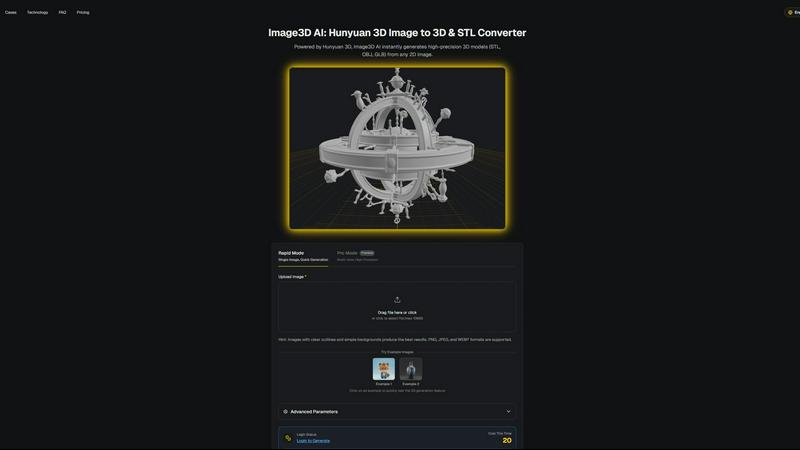
Image3D AI
Feature Comparison
dmaya
AI-Powered Design Generation
dMaya's core feature is its ability to generate production-ready UI designs in mere seconds. By simply describing what you need in plain language, the platform creates complete layouts and responsive variants, allowing teams to focus on creativity rather than tedious manual design work.
Multi-Screen Canvas
The multi-screen canvas feature allows users to work across both desktop and mobile frames simultaneously. This infinite canvas mimics the flexibility of design tools like Figma, enabling users to drag, zoom, and organize their screens effortlessly while benefiting from AI-assisted design capabilities.
Built for Teams & Collaboration
Designed with collaboration in mind, dMaya facilitates real-time teamwork. Users can invite team members, share projects with clients, and leave comments, ensuring that everyone is aligned. Role-based access controls keep the workflow organized, allowing for efficient collaboration among designers, developers, and stakeholders.
Client Presentation Mode
dMaya offers a dedicated client presentation mode that enables users to share polished, interactive previews through a single link. This feature eliminates the need for clients to create accounts, simplifying the feedback process. Users can collect client insights and iterate on designs without ever leaving the platform.
Image3D AI
Powered by Hunyuan 3D Engine
Image3D AI is built upon the robust foundation of Tencent's Hunyuan 3D engine, a state-of-the-art AI technology specifically designed for 3D reconstruction. This engine enables the platform to perform advanced inference from a single 2D image, generating high-precision geometry and textures that rival manually crafted models. The integration of this professional technology into an accessible web interface is what sets the tool apart, delivering studio-quality results without requiring studio-level expertise or computational resources from the end-user.
Dual Generation Modes for Flexibility
The platform offers two distinct operational modes to cater to different project needs and quality requirements. Rapid Mode is optimized for speed and simplicity, generating a 3D model from a single uploaded image in approximately 60 seconds. For scenarios demanding the highest accuracy, such as product replication or detailed asset creation, Pro Mode utilizes multi-view images to perform a physically accurate 3D reconstruction, ensuring dimensional precision and superior detail from every angle.
Multi-Format Export for Any Workflow
Understanding that creators work across diverse software ecosystems, Image3D AI provides exports in all major industry-standard 3D file formats. Users can download their generated models as STL files for immediate 3D printing, OBJ files for editing in traditional 3D software like Blender or Maya, or GLB files for direct use in web applications, AR experiences, and modern game engines like Unity and Unreal Engine, complete with PBR material support.
Intuitive Interface with Guided Best Practices
The tool is designed for immediate usability, featuring a clean, drag-and-drop interface and offering free example images for instant testing without login. Beyond simplicity, it educates users through a comprehensive Best Practices Guide. This resource provides actionable tips on selecting optimal source images, understanding the strengths of each generation mode, and choosing the correct export format, significantly boosting the success rate and quality of conversions for both novices and professionals.
Use Cases
dmaya
Agencies
Agencies can leverage dMaya to pitch faster and win more clients. By generating design concepts during discovery calls and presenting multiple directions to stakeholders in a matter of hours rather than weeks, agencies can streamline their workflow and enhance client engagement.
Product Teams
Product teams can utilize dMaya to accelerate their design process, moving from ideation to sign-off without the burden of engineering resources. The platform fosters collaboration across design, product, and engineering teams, allowing for version comparisons and reducing the gap between design and development.
Freelancers
Freelancers can take advantage of dMaya to enhance their productivity and profitability. By delivering high-quality designs without extending their working hours, freelancers can accommodate more projects, thereby maximizing their earnings and client satisfaction.
Startups
Startups can benefit from dMaya's rapid design capabilities, allowing them to iterate quickly on their product concepts. By obtaining client feedback early in the process, startups can ensure that their designs resonate with their target audience, leading to a more successful product launch.
Image3D AI
Game Development and Digital Content Creation
Game developers, animators, and VR/AR creators can rapidly prototype and produce game-ready 3D assets directly from concept art, sketches, or reference images. This accelerates the pre-production and asset creation pipeline, allowing small teams or indie developers to generate a wide variety of characters, props, and environmental assets with consistent quality, ready for texturing and import into engines like Unity or Unreal.
3D Printing and Prototyping
Hobbyists, engineers, and product designers can instantly convert sketches, diagrams, or photos of objects into printable STL files. This use case is invaluable for rapid prototyping, creating custom figurines, producing spare parts, or visualizing inventions in tangible form. The Geometry-focused generation mode ensures clean, manifold meshes that are optimized for reliable 3D printing without complex manual cleanup.
E-commerce and Product Visualization
Online retailers and marketers can transform flat product photographs into interactive 3D models and AR-ready assets. This enhances online shopping experiences by allowing customers to view products from every angle, inspect details, and even visualize items in their own space through augmented reality, leading to increased engagement, reduced return rates, and higher conversion rates.
Architecture, Design, and Education
Architects and interior designers can quickly generate basic 3D massing models from sketches or site photos for client presentations and early-stage design studies. Educators and students can also use the tool to create visual aids and models for STEM education, making abstract concepts tangible and fostering a hands-on understanding of spatial design and geometry without needing specialized 3D modeling skills.
Overview
About dmaya
dMaya is a revolutionary vibe design platform crafted specifically for agencies, teams, and freelancers who prioritize the design phase before diving into coding. Unlike many AI tools that jump straight to code, dMaya facilitates a seamless design-first workflow that allows users to articulate their vision through natural language. By leveraging an intelligent AI agent, users can generate professional-grade UI designs based on simple text descriptions. Whether you're conceptualizing a SaaS dashboard, designing an e-commerce flow, or crafting a mobile app, dMaya turns your ideas into polished screens within seconds. The platform supports real-time iterations through conversational design, enabling users to adjust colors, layouts, typography, and more with immediate precision. When the design is ready, users can share a preview link with clients for instant feedback and approval, significantly accelerating the review cycle. Once approved, dMaya allows for easy exportation of designs as clean HTML, CSS, and JS code, ready for integration with various coding agents like Cursor or Claude Code. Ultimately, dMaya empowers teams to present, approve, and ship their designs with unmatched confidence and efficiency.
About Image3D AI
Image3D AI represents a paradigm shift in the field of digital creation, democratizing the complex process of 3D modeling through the power of artificial intelligence. At its core, it is a sophisticated online platform that transforms ordinary 2D images into fully-realized, high-fidelity 3D models in a matter of seconds. This is made possible by leveraging Tencent's cutting-edge Hunyuan 3D engine, a professional-grade technology that interprets visual data to construct accurate volumetric representations. The tool is designed for a universal audience, eliminating the steep learning curve and significant time investment traditionally associated with 3D software. Whether you are a game developer needing rapid asset creation, a 3D printing enthusiast turning sketches into tangible objects, an e-commerce professional seeking interactive product displays, or an architect visualizing concepts, Image3D AI serves as your instant conduit from imagination to three-dimensional reality. Its primary value proposition is profound workflow acceleration and creative empowerment, allowing users to bypass technical barriers and focus purely on bringing their innovative ideas to life across various industries and applications.
Frequently Asked Questions
dmaya FAQ
How does dMaya improve the design workflow?
dMaya enhances the design workflow by integrating AI technology that generates production-ready designs from text descriptions, allowing teams to focus on creativity rather than manual design tasks. This ensures that the design phase is efficient and effective.
Can I collaborate with my team in real-time on dMaya?
Yes, dMaya is built for collaboration. It allows users to invite team members, share projects, leave comments, and work together in real-time, ensuring that everyone involved is aligned and informed throughout the design process.
What frameworks can I export my designs to?
Once your designs are approved, you can export them as clean HTML, CSS, and JS code, which can then be handed over to any coding agent, including Cursor or Claude Code, for development in frameworks like React, Next.js, and Flutter.
Is there a need for clients to create accounts to provide feedback?
No, dMaya simplifies the feedback process by allowing clients to review designs through a single link without needing to create an account. This feature streamlines client interactions and speeds up the approval cycle.
Image3D AI FAQ
What types of images work best with Image3D AI?
For optimal results, use high-contrast images with clear, well-defined outlines and a simple, uncluttered background. The subject should be in focus with good lighting. Images with blur, complex backgrounds, or objects that are partially obscured will yield less accurate 3D reconstructions. For converting real-world objects, providing multiple views (front, side, top) in Pro Mode is highly recommended for the most physically accurate model.
What is the difference between Rapid Mode and Pro Mode?
Rapid Mode uses AI inference to generate a 3D model from a single image quickly, typically within about 60 seconds. It's ideal for logos, sketches, and concepts where speed is prioritized. Pro Mode is designed for high-precision outcomes; it requires uploading multiple images of an object from different angles (multi-view). This allows the AI to perform a more accurate, dimensionally faithful reconstruction, making it the preferred choice for product photography, engineering parts, or any application where geometric accuracy is critical.
Which file format should I download for my project?
The choice depends on your intended use. Download the .STL format if your goal is 3D printing, as it is the universal standard for slicer software. Choose the .OBJ format if you plan to further edit the model in 3D modeling software like Blender, 3ds Max, or ZBrush. Select the .GLB format for web applications, augmented reality (AR), or modern game engines, as it is a compact, single-file format that contains the model, textures, and materials.
Is there a free trial or any way to test the tool?
Yes, Image3D AI offers a completely free way to test its core functionality. The website provides several "Example Images" that users can click on to instantly trigger the 3D generation process without any login, account creation, or credit cost. This allows anyone to experience the conversion speed and quality firsthand before committing to uploading their own images or purchasing credits.
Alternatives
dmaya Alternatives
dMaya is an innovative AI vibe design platform tailored for agencies, teams, and freelancers who require a streamlined approach to UI design before diving into coding. By leveraging artificial intelligence, dMaya allows users to generate professional-quality UI designs from simple text descriptions, facilitating rapid design iterations and client feedback. This emphasis on design helps ensure intentional decision-making and early problem detection, ultimately enhancing the overall development process. Users frequently seek alternatives to dMaya for various reasons, including pricing considerations, specific feature requirements, or the need for compatibility with certain platforms. When exploring alternatives, it is essential to consider aspects such as the ease of use, the flexibility of design tools, collaboration capabilities, and the ability to integrate with existing workflows. Understanding these factors can help users find a solution that aligns with their unique project needs and enhances their design and development processes.
Image3D AI Alternatives
Image3D AI is a specialized design tool that transforms 2D images into detailed 3D models, leveraging advanced AI to simplify a traditionally complex process. It caters to creators who need rapid asset generation for 3D printing, game development, and other digital projects, making professional-grade 3D modeling accessible to a wider audience. Users often explore alternatives for various practical reasons. These can include budget constraints, as pricing models differ significantly across the market. Others may seek specific technical features not offered, require integration with a particular software ecosystem, or need a solution that runs on a different platform or operating system. The search for the right tool is a natural part of finding the perfect fit for one's unique workflow and project demands. When evaluating alternatives, it's crucial to consider several key factors. Assess the core technology and the quality of the 3D output it produces. Examine the supported file formats for export to ensure compatibility with your intended use, whether for printing or digital rendering. Also, consider the user experience, the availability of different processing modes for speed versus detail, and the overall value proposition relative to the cost. The goal is to find a tool that aligns with your skill level, project requirements, and creative vision.